
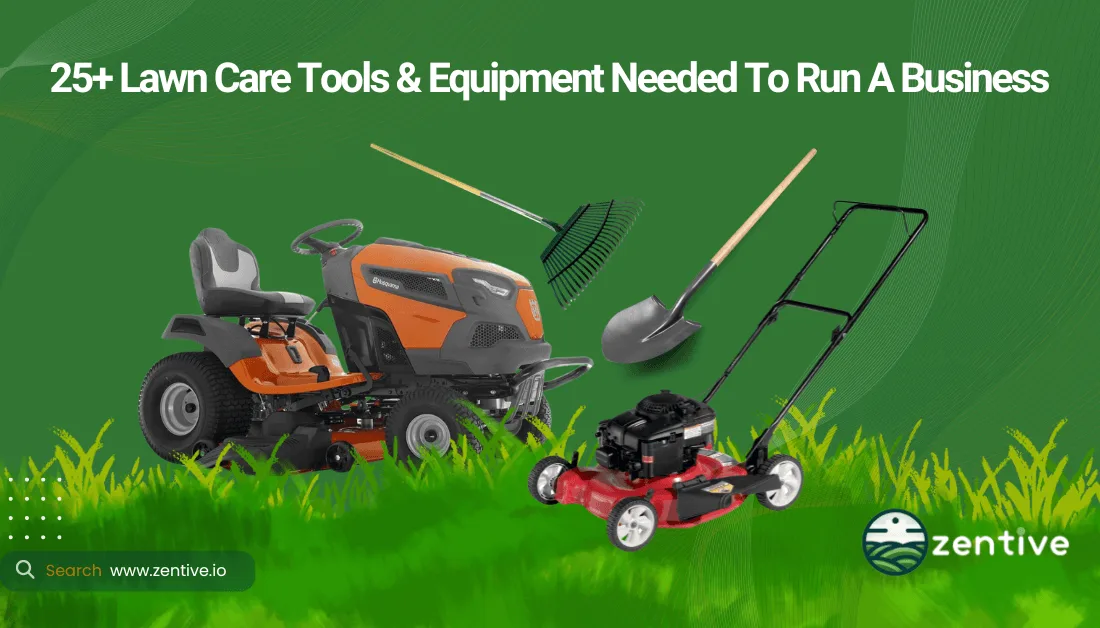
Starting your first lawn care business requires an investment in the tools, equipment & gear needed to do the job. Lawn care equipment refers to the specialized tools for lawn care that maintain and improve outdoor spaces, including lawns, gardens, and landscaped areas. Having the right lawn care tools enables your business to perform higher quality work in an efficient way.
Lawn care businesses typically invest between $5,000 and $10,000 dollars in quality equipment that meets commercial & residential demands. Not all new lawn business have the same access to capital and the initial investment into equipment varies greatly depending on the size of your business, owning vs renting, buying new vs used equipment, and other factors. Consider our tool below to find which tools your new lawn cutting business will need to invest in.
Find the Right Lawn Care Tools
Purchasing the right lawn tools & equipment helps professionals deliver superior service, minimize downtime, and secure a competitive edge in the industry. Lawn care companies must consider factors like durability, cost efficiency, ease of use, and maintenance requirements when selecting their tools.
The below table has the main types of tools used by lawn care professionals.
| # | Tool Category | Summary |
|---|---|---|
| 1. | Lawn Care Power Tools | Engine-driven equipment such as ride-on mowers, power aerators, and backpack blowers that increase efficiency for large areas. |
| 2. | Lawn Care Hand Tools | Manual implements like rakes, shovels, hand pruners, and edging tools for detailed trimming and small-area tasks. |
| 3. | Lawn Care Vehicles | Utility carts, ATVs, and trucks used to transport equipment, materials, and debris across job sites. |
| 4. | Lawn Care Safety Equipment | Protective gear such as gloves, safety glasses, hearing protection, and steel-toe boots to ensure operator safety. |
| 5. | Lawn Care Software Tools | Job management platforms, scheduling apps, and CRM systems for planning routes, tracking jobs, and invoicing clients. |
| 6. | Miscellaneous Lawn Care Tools | Supplementary items like soil testers, spreaders, watering wands, and turf aerator shoes for specialized tasks. |
Lawn Mowers
Lawn mowers are the most essential tool to deliver any lawn service your customers. Different types of grass mowers are used depending on the needs of your customers & available budget. Below are the 5 types of mowers used by most lawn cutting businesses.
| # | Mower Type | Summary |
|---|---|---|
| 1. | Walk-Behind Mowers | Push-powered mowers ideal for small to medium lawns, offering precision control and easy storage. |
| 2. | Riding Lawn Mowers | Seat-equipped mowers with engine drive, suited for large areas and reducing operator fatigue. |
| 3. | Zero-Turn Mowers | High-maneuverability mowers using dual wheel steering to achieve tight turns and efficient trimming. |
| 4. | Stand-On Mowers | Compact mowers where the operator stands, offering visibility and quick dismount for frequent stops. |
| 5. | Reel Mowers | Manual or motor-driven cylinder mowers that deliver a clean cut for fine turf and low-noise operation. |
1. Walk-Behind Mowers
The walk-behind mower is a manually operated tool for mowing that requires the user to push the machine across the lawn. Push mowers are not as common among professional lawn care companies but will get the job done when first starting out. Walk-behind mowers come in both gas-powered and electric variants. Expect to pay between $200 to $1,000 dollars for a new walk-behind mower.
Keep an extra set of deck wheels on hand if you choose to go with a push mower. Swapping in larger-diameter “turf saver” wheels on uneven lawns will prevent deck bounce and gives you a much cleaner cutting edge to save you from having to revisit your client sites to fix striping issues.
2. Riding Lawn Mowers
The riding lawn mower is a larger, seat-equipped machine that enables the operator to control the mower while seated. Riding mowers are the most common type of mowers used by most lawn mowing businesses to mow large properties quickly. Expect to invest between $2,000 and $4,000 dollars.
Be sure to track engine-hour meter readings on your riding mower weekly so you can schedule hydrostatic transmission oil changes at the manufacturer’s recommended interval. Slacking on maintenance will lead to expensive transmission failures in peak season when you can't afford any downtime.
3. Zero-Turn Mowers
The zero-turn mower is a specific type of riding mower that offers a zero-turn radius for precise maneuverability. Zero-turn mowers are used by both commercial and residential lawn care companies to more easily cut complex landscapes. These types of mowers are generally more expensive & range $3,000 to $10,000 dollars depending on the brand.
Choose a model with fully sealed deck spindle bearings instead of traditional grease-zerk spindles. This can cut your time spent greasing in half every week and keeps you from having to unbolt the deck for bearing replacements during busy weeks.
4. Stand-On Mowers
The stand-on mower is a compact & highly maneuverable mower that requires the operator to stand while mowing. Many lawn operators prefer to stand while mowing but it comes down to personal preference. Stand-on mowers have better visibility and agility that makes them a great choice when working on manicured lawns, athletic fields, and golf courses. Expect to invest between $5,000 to $8,000 dollars to get a new stand-on mower.
Use the quick-fold foot platform feature on standing mowers to switch between mowing and edging easier without having to dismount. Saving 10–15 seconds per property really adds up across a 50-site route for a given day.
5. Reel Mowers
The reel mower is a manual, scissor-type mower that utilizes a series of rotating blades to cut grass with precision. Reel mowers are old school and very uncommon to see used by a professional lawn care business. The only reason to use a reel mower is if you have to deliver a super fine cut with minimal impact to the environment. Reel mowers typical cost between $150 to $500 dollars.
Calibrate your blade-to-bedknife gap every 80-100 hours of use to get the most of your reel mower. Maintaining that hairpin-tight setting is what gives high-end turf its signature manicured look that clients look.
Lawn Care Hand Tools
Lawn care hand tools are manually operated gear used to maintain & trim lawns and gardens. Most lawn care businesses use their hand tools for a variety of detailed work on their customers' properties. The below table has the lawn care hand tools needed to run a mowing business.
| # | Hand Tool | Summary |
|---|---|---|
| 1. | Rakes | Tined tools used to collect leaves, thatch, and debris for lawn cleanup and soil aeration. |
| 2. | Shovels | Spade-like implements for digging, edging, and moving soil or mulch during landscaping tasks. |
| 3. | Hedge Shears & Trimmers | Scissor-action tools designed for shaping and thinning hedges, shrubs, and border plants. |
| 4. | Hand Pruners & Loppers | Cutting tools for trimming small branches and thick stems to maintain plant health and shape. |
| 5. | Garden Forks & Pitchforks | Forked implements for loosening soil, turning compost, and lifting plant material with minimal damage. |
| 6. | Trowels and Hand Spades | Small digging tools for planting, transplanting, and weeding in confined or delicate areas. |
| 7. | Manual Edgers | Handheld devices used to create clean, defined borders between lawn and adjacent surfaces. |
| 8. | Weeding Tools | Specialized hoes and pullers designed for removing weeds by the root to prevent regrowth. |
| 9. | Hand Saws | Compact saws for cutting thicker branches and small limbs during pruning or removal tasks. |
1. Rakes
Rakes are used to gather leaves, debris, and level soil. Rakes are the most basic of all the hand tools, all lawn care businesses use them. There several types of rakes including leaf rakes , garden rakes, and landscape rakes for heavy-duty tasks. Every lawn care company needs a rake to keep tidy lawns and prepare garden beds. Expect to pay between $10 and $50 dollars from popular rake brands like Fiskars and Bully Tools.
Don't cheap out! Invest in a heavy-duty landscape rake with adjustable tine spacing. This level of adjustability will let you efficiently move heavier debris or level fresh topsoil without switching tools & wasting time during a job.
2. Shovels
Shovels are a versatile hand tool used for digging, lifting, and moving bulk dirt & debris. Different types of shovels include spades for cutting through soil, digging shovels for excavation, and snow shovels for clearing snow. The average shovel costs between $15 to $60 dollars from common brands like Ames and Truper.
Always keep a square point shovel with a tempered steel blade for edging and trenching. Using a shovel as a straight edge lets you cut clean sod lines and irrigation trenches to impress your clients.
3. Hedge Shears & Trimmers
Hedge shears and trimmers are manual cutting tools used to maintain hedges, small trees, and shrubs. There are manual & powered hedge shears available to purchase for your business depending on your budget. Shears and trimmers are essential for creating neat, defined landscapes. Expect to pay between $20 to $50 dollars for manual versions and between $50 to $200 dollars for powered models from brands like Fiskars and Black & Decker.
Go for cordless electric hedge trimmers with dual-action blades if you can afford them. The dual-action reduces handle vibration by up to 50% so your crews can trim for hours on end without discomfort.
4. Hand Pruners & Loppers
Hand pruners and loppers are cutting tools lawn care businesses use to trim and shape a variety of plants. Hand pruners are generally used for small branches and delicate cuts. Loppers have longer handles and larger blades to better handle thicker tree branches & bushes. The price of loppers & pruners typical ranges from $15 to $50 dollars for pruners and $30 to $100 dollars for loppers from leading brands like Felco and Corona. Opt for pruners with sap-release coatings on the blades to prevent sticky clogs when moving from spring bloom clean-ups to sticky summer shrub pruning.
5. Garden Forks & Pitchforks
Garden forks & pitchforks help lawn care workers loosen, lift, and turn over soil and other organic material. Garden forks have multiple tines that make them best suited for breaking up compacted soil. Pitchforks are built for lifting and pitching loose hay or compost on job sites. The price ranges from $15 to $40 dollars from common brands like Spear & Jackson and Fiskars.
Choose forks with a slight forward bend in the shaft if you plan on using them frequently. Angled forks give you some extra leverage when breaking through compacted subsoil and saves you some time.
6. Trowels and Hand Spades
Trowels and hand spades are small handheld tools lawn care contractors use for small precision digging and planting. Trowels work best for potting and small planting, while hand spades are better for deeper digging in tight spaces. Prices range from $5 to $20 dollars for trowels and $10 to $30 dollars for hand spades from common brands like Fiskars and Garden Weasel.
Carry a narrow transplanting trowel with a depth gauge etched on the blade if you use it regularly. This simple trick lets you plant liners or bulbs at exactly the right depth without wasting time pulling out a measuring tape on every hole.
7. Manual Edgers
Manual edgers are a specialized tool that creates defined borders between lawns and garden beds. Edgers give a very clean look to the transition to mulch beds & add to the curb appeal of your clients properties. There are different types of edges including half-moon and dual-edged designs. Most edgers cost around $20 to $50 dollars from generic hardware stores like Lowes or Home Depot.
Pick a dual wheel half moon edger if you plan to get heavy use from it. The one wheel design stabilizes the tool and eliminates back strain that comes from having to lean over single spike edgers all day in the hot sun.
8. Weeding Tools
Weeding tools are handheld tools to remove unwanted plants from lawns and garden beds. Lawn care companies use these simple tools to clean up their comstomers garden beds & keep the property looking nice. Weeding tools are generally cheap and cost between $5 to $25 dollars from brands like Fiskars and Garden Weasel.
Keep a long-handled dandelion weeder with an arched U-shaped blade in your truck on residential maintenance jobs. The added leverage in that design lets you pop deep taproots out cleanly without disturbing surrounding turf & nearby plants.
9. Hand Saws
Hand saws are basic manual cutting tools used for pruning branches and taking down small trees. Lawn care businesses use different types of hand saws like pruning saws, bow saws, and panel saws for different types of cutting. Prices of basic hand saws range from $15 and $40 dollars from leading brands like Bahco and Corona.
Use a pruning saw with replaceable bi-metal blades if you do lots of tree trimming. Once the teeth dull on your saw you can simply snap in a fresh blade rather than having to get your blade sharpened or replaced.
Lawn Care Vehicles
Lawn care vehicles are essential to transport crews, equipment, supplies, and hauling debris. Below are the 3 vehicles lawn care businesses need to get started.
| # | Vehicle Type | Summary |
|---|---|---|
| 1. | Pickup Trucks | Versatile trucks used to haul equipment, supplies, and debris between job sites with ease. |
| 2. | Utility Trailers | Open-bed trailers for transporting mowers, tools, and landscaping materials when extra capacity is needed. |
| 3. | Dump Trailers | Hydraulically operated trailers that simplify unloading of soil, mulch, and debris directly at the work area. |
1. Pickup Trucks
Pickup trucks are a must have for any lawn care company for transporting heavy loads and equipment. Dodge, GMC, and Ford all make top of the line trucks that can handle the wear and tear that comes with running a lawn mowing business. Prices on pickup trucks have a wide range, but you can expect to pay between $20,000 to $80,000 dollars. Purchasing used trucks with heavy miles is the easiest way to say money when buying your first company truck.
Install stake pockets every 12″ along the bed rails in your truck to secure tarps and bulk bags. This simple tip will help prevent shifting loads of mulch or soil when driving between jobs.
2. Utility Trailers
Utility trailers are a common vehicle accessory that can be hauled by your truck to transport lawn care equipment and supplies. Open and enclosed utility trailers can help to protect your cargo from the weather and possible theft. Expect to invest between $2,000 and $10,000 dollars for a brand new trailer from stores like Tractor Supply or Lowes.
Choose a torsion axle setup instead of leaf springs if you have the budget for it. Utility trailers with a torsion style axle offer a much smoother ride and and prevents damaging your mowers and handheld gear when driving from job to job.
3. Dump Trailers
Dump trailers are a specialized attachment to your truck allows lawn care crews to transport and unload bulk clippings, soil, mulch, and debris. Dump trailers vary in size and capacity. The average price of dump trailer ranges from $3,000 to $10,000 dollars. Expect to pay more for hydraulic dumping trailers compared to manual.
Fit an electric brake controller calibrated to your typical load weight or get a new truck that provides trailer braking. Investing in properly tuned brakes keep heavy mulch or gravel dumps from pushing your truck’s rear end & damaging your trucks under heavy braking.
Lawn Care Safety Equipment
Lawn care safety equipment is essential to keep yourself & your employees safe when out working on jobsites. Too many new lawn care businesses think they can avoid investing in safety equipment only to deal with unnecessary injuries and workman's comp claims. These four safety items should be owned by all lawn care contractors.
| # | Safety Equipment | Summary |
|---|---|---|
| 1. | Eye Protection | Safety glasses or goggles to shield eyes from debris, chemicals, and UV exposure. |
| 2. | Hearing Protection | Ear plugs or earmuffs to reduce noise from mowers, trimmers, and other loud equipment. |
| 3. | Gloves | Durable work gloves to protect hands from cuts, blisters, and chemical contact. |
| 4. | Steel-Toed Work Boots | Footwear with reinforced toes to prevent injury from heavy objects and provide traction. |
1. Eye Protection
Eye protection is the most basic lawn safety tool designed to shield your eyes from flying debris. Basic eye protection includes safety glasses, goggles, and face shields. Stock anti fog safety glasses with side vents for your crew if they spend hours blowing wet grass clippings. Standard lenses fog within minutes and your guys will spend too much time stopping to wipe their glasses. Expect to pay between $10 to $50 dollars for essential eye protection.
2. Hearing Protection
Hearing protection is a often overlooked safety tool that guards the ears against excessive noise. Running a mower 8 hours a day can do real damage to healthy ears if hearing protection isn't used. Both over-the-ear headphones & in-ear earplugs offer great protection to prevent long term damage. Give high NRR reusable earplugs with corded retention clips to your crew so they don't drop loose plugs in mud or grass. The average cost of hearing protection is between $10 and $100 dollars.
3. Gloves
Gloves help lawn care workers protect their hands from cuts, abrasions, and chemical exposures. Safety gloves come in different materials such as latex, nitrile, and leather. Rotate between nitrile coated work gloves for wet jobs and reinforced leather gloves for working with heavy debris. Using the right pair for the task extends your glove life and cuts replacement costs during peak season. Gloves typically cost between $5 to $30 dollars.
4. Steel-Toed Work Boots
Steel-toed work boots are worn by lawn care workers to protect your feet from falling objects, sharp objects, and heavy duty tools. Worker boots come in multiple styles like lace-up and slip-on boots. Investing in boots with puncture resistant midsoles instead of just basic steel toes is worth the money. Lawn crews are constantly stepping on hidden stakes and debris that would lead to costly medical claims without quality work boots. Prices range from $50 to $200 dollars for new lawn care work boots.
Lawn Care Software Tools
Lawn care software helps streamline job quoting, scheduling, routing, invoicing, and more. Use these two lawn care software tools to automate business operations for your lawn mowing company.
| # | Software Type | Summary |
|---|---|---|
| 1. | Lawn Care Business Management Software | All-in-one platforms for scheduling, invoicing, estimating, and customer relationship management to streamline operations. |
| 2. | Lawn Care Design Software | Visualization tools for creating detailed 2D/3D landscape plans, planting layouts, and irrigation designs for client presentations. |
1. Lawn Care Business Management Software
Lawn care business management software is a digital tool that organizes scheduling, customer information, invoicing, and other administrative tasks in one place. Lawn care businesses often use a variety of random apps & manual processes to quote, schedule, and collect payments from their customers. Software for lawn business management, like Zentive, lets business owners focus more on providing quality lawn service & finding more clients. Zentive lets you sync your custom crew punch in & out times directly so you can avoid manual timesheet when tracking labor cost for each route. Expect to pay between $30 to $150 dollars per month for a quality lawn business app.
2. Lawn Care Design Software
Lawn care design software helps lawn care professionals create detailed layouts, design landscapes, and help clients visualize projects. Lawn design software helps plan and present custom proposals to your customers. Pick a lawn design app that can import your GPS tracked property boundaries so that your 3D mockups match the exact client property dimensions. Design software costs between $200 to $2,000 dollars on average.
Miscellaneous Lawn Care Tools
Below are miscellaneous lawn care tools your business needs to operate. These tools aren't needed to sign your first lawn care client, but they can help you provide a higher quality service as your business grows.
| # | Tool | Summary |
|---|---|---|
| 1. | String Trimmers | Handheld or backpack units using spinning nylon line to edge and trim grass in tight spaces and along borders. |
| 2. | Leaf Blowers | Gas or electric blowers that clear leaves, grass clippings, and debris quickly from lawns, driveways, and walkways. |
| 3. | Spreaders | Push or tow-behind devices that evenly distribute seed, fertilizer, or ice melt across large turf areas for consistent coverage. |
1. String Trimmers
String trimmers are handheld lawn care tools that uses a rapidly rotating string to cut grass and weeds. String trimmers can be gas-powered, electric, or battery-powered. Lawn care businesses that do commercial work should use dual feed bump head models instead of single feed units to keep crews mowing instead of servicing equipment. String trimmers typically range from $30 to $300 dollars from brands like Stihl, Husqvarna or Echo.
2. Leaf Blowers
Leaf blowers are the easiest way to move leaves, grass clippings, and debris with a powerful stream of air. Handheld, backpack, and wheeled leaf blower models are all available for lawn care businesses to use. Backpack blowers with anti-vibration mounts and padded hip belts are the best way to keep your crews comfortable during back to back cleanup jobs. The price of an average lead blower varies between $30 and $500 dollars from companies like Stihl, Echo and DEWALT.
3. Spreaders
Spreaders are a lawn care tool used to spread fertilizer, seed, or lime evenly across a lawn. Both broadcast spreaders and drop spreaders are used by lawn care companies to distribute fertilizer in a wide fan like pattern. Be sure to calibrate your drop spreader’s gate opening with a shim to dial in precise fertilizer rates on the fly rather than wasting time swapping plates. Spreaders range in price from $20 to $300 dollars on average from companies like Scotts, EarthWay and Lesco.
How To Decide Which Lawn Care Equipment You Need?
Decide which lawn care equipment you need for your business evaluating the type of work your crews perform. Lawn care business owners require durable, high-capacity tools but homeowners often just need cost-effective equipment. The services your lawn care enterprise offers like landscaping, tree trimming, or irrigation are the biggest factor in determining equipment you need to invest in. Track your average fuel consumption per hour on each machine during your peak season. Knowing the usage of your equipment lets you prioritize your investment into equipment that your business needs to provide essential services.
Deciding between renting and buying is a major cost variable to consider. Renting lowers upfront costs and buying delivers long-term savings for jobs with consistent demand. The size of your lawn business and available funding plays a major factor in the tools you need & tools that would be nice to have.
How Does Type Of Lawn Business Affect Equipment Needs?
The type of lawn business directly affects equipment needs as commercial lawn care companies require high performance, durable tools. Residential services tend to favor versatile and cheaper options. Commercial providers often service large areas with frequent maintenance demands, necessitating robust machinery like ride-on and zero-turn mowers. Commercial crews normally choose quick swap attachment systems so a single machine can handle mowing, dethatching, aerating, or snow-blowing. There is only so much space in the truck, picking tools with more utility is a must for commercial businesses that go on dozens of routes a day. Residential lawn businesses tend to use cost effective like walk-behind mowers.
What Tools Do Commercial Lawn Mowing Businesses Use?
Commercial lawn mowing businesses use heavy-duty equipment like zero-turn mowers, ride-on mowers, and walk-behind mowers. Many commercial lawn pros invest in deck washdown ports on zero turn mowers so that they can more easily clean clippings off the deck in minutes on-site. These specialized tools ensure efficient, consistent performance on large scale properties that commercial mowing businesses service.
Should You Rent Or Buy Grass Cutting Equipment?
You should consider the financial health of your lawn business before deciding to rent or buy grass cutting equipment. Renting grass cutting equipment will be cheaper upfront and offer more payment flexibility. Buying your own mowers will cost you more upfront but allow you to save money in the long run. Many new lawn care businesses choose to rent or lease major equipment to manage cash flow issue. Use our tool below to see if you should rent or buy grass cutting equipment for your lawn business.
Rent vs Buy Calculator
Is Used Grass Cutting Equipment Worth It?
Yes, used grass cutting equipment is worth it because it for people looking for fairly priced equipment. Always check the hour meter versus the calendar age because used mowers with >1,000 hours will likely not be under warranty. This could cost you more money in repairing belts, blades, spindles, etc on your mowers. Always inspect and evaluate the maintenance history before buying from a seller.
What Are Essential Tools When Starting A New Lawn Mowing Business?
Lawn mowers, string trimmers, edgers, and basic hand tools are essential tools when starting a new lawn mowing business. Include a heavy duty tow behind hose reel on day one because having water for cleanup and simple irrigation tasks lets you upsell additional services. New lawn business owners often have small budgets and it's ok to start small and buy more equipment as your client roster grows.
How To Acquire Lawn Care Tools With No Money?
Acquire lawn care tools with no money with responsible financing options like leasing and small business loans. Leasing is a common way to get immediate access to quality lawn care equipment without excessive upfront costs. Negotiate with your vendors on consignment deals where you pay 30 to 40% upfront and 60 to 70% from invoice proceeds. Creative deals like this spread give you time to get the revenue flowing before having to pay bigger expenses.
Get This Guide as a PDF
Save this article for offline reading. We'll send a formatted PDF straight to your inbox.
No spam. Unsubscribe anytime.
Ready To Streamline Your Field Service Business?
Zentive is the all-in-one field service management software built for landscaping, lawn care, tree care, and snow removal businesses. Start your free trial today.
No credit card required · Cancel anytime