
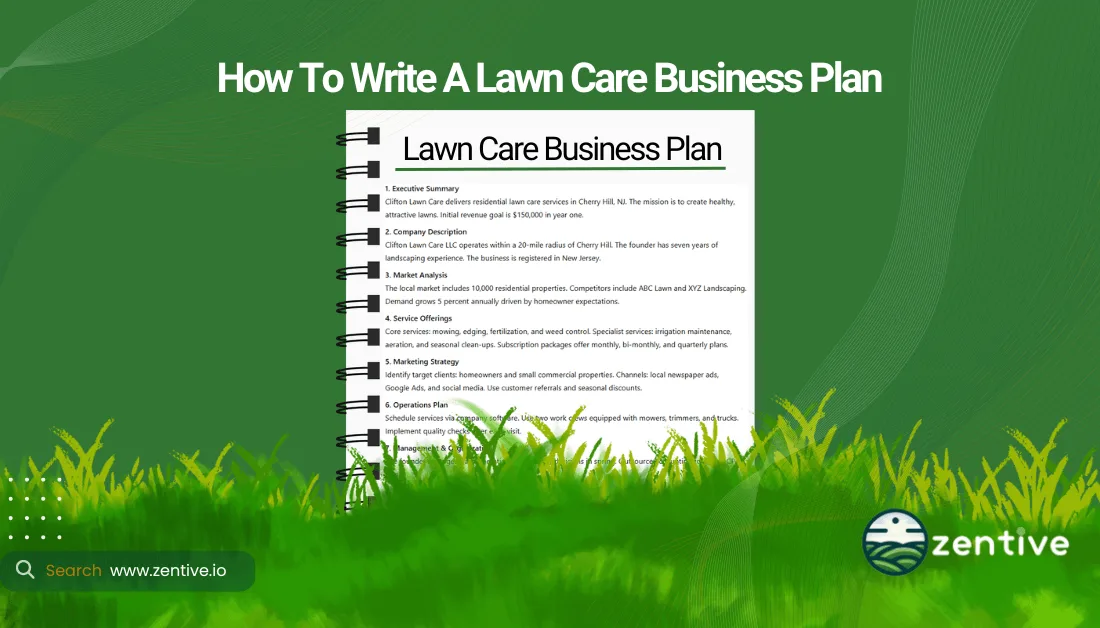
A lawn care business plan is a strategic business document that outlines the vision, operational structure, financial projections, and growth strategy for lawn maintenance companies. Lawn care business plans are required to seek funding, guide operational decisions, establish clear metrics for success, and provide a roadmap for sustainable growth in the competitive lawn care industry.
Creating a lawn care business plan involves eight key elements: executive summary, company description, market analysis, service offerings, marketing strategy, operational plan, management structure, and financial projections. Both commercial and residential lawn care companies benefit from creating a detailed business plan regardless of the size of your business.
Download our comprehensive lawn care business plan template below & customize it to aligin with your own business, operations, culture, and growth goals.
What Is A Business Plan?
A business plan is a formal document outlining a company's objectives, strategies, market analysis, financial projections, and operational structure. This document serves as a roadmap for business growth by establishing financial targets, identifying challenges, demonstrating market viability, allocating resources, and creating accountability mechanisms.
Here are the four main types of business plans that companies use.
- Startup Business Plans
- Strategic Business Plans
- Operational Business Plans
- Expansion Business Plans
Business plans hold particular importance for landscapers due to seasonal revenue fluctuations, equipment investment requirements, workforce management challenges, and competitive local markets. These companies benefit from structured planning to manage cash flow, optimize scheduling, plan equipment purchases, and develop targeted marketing campaigns.RetryClaude can make mistakes. Please double-check responses.
Why Is A Business Plan Important For Lawn Care Business?
A business plan is important for for lawn care businesses because it provides a structured framework for growth, operational efficiency, and financial sustainability. Your business plan is simply the framework in which you will operate & manage your business. It serves as both an internal guide and external validation tool to guide you through the challenges & opportunities that your business will face in the future.
The main benefits of creating a business plan for your lawn care business include clarifying business vision through defined mission statements and growth objectives, expanding funding opportunities with banks and investors, improving operational efficiency through documented processes, and mitigating risk through competitor analysis and seasonal revenue planning.
Lawn care businesses need comprehensive business plans regardless of size. Even small businesses face challenges like seasonal revenue fluctuations, equipment failures, and hiring difficulties that they need to plan for.
| Aspect | Summary |
|---|---|
| Purpose | Provides a structured framework for growth, operational efficiency, and financial sustainability. |
| Internal Guide | Defines mission statements, vision, and documented processes for day‑to‑day operations. |
| External Validation | Presents comprehensive financial projections to banks and investors to secure funding. |
| Operational Efficiency | Improves workflow by standardizing procedures and resource allocation. |
| Risk Mitigation | Analyzes competitors and plans for seasonal revenue fluctuations to reduce uncertainties. |
| Industry Applicability | Essential for lawn care, tree service, and snow removal businesses of all sizes. |
| Key Challenges Addressed | Manages equipment‑intensive operations, labor issues, and localized competition. |
What Should Be Included In A Lawn Care Business Plan?
A lawn care business plan should include eight essential components including an executive summary, company description, market analysis, service descriptions, marketing strategy, operations plan, management team section, and financial projections.
Successful lawn care business plans are noticeably from generic business plan templates. They do this by incorporating industry specific elements like weather contingency planning, routing efficiency & density analysis, equipment depreciation schedules, and seasonal revenue projections that help plan workforce & hiring needs.
How To Create A Lawn Care Business Plan?
Create a lawn care business plan by following these 9 steps.
- Begin with the High-Level Summary: Gives a quick overview to capture investor or partner interest.
- Expand on the Business Description: Defines your services, goals, and business identity for clarity and direction.
- Undertake a Comprehensive Market Review: Identifies local demand, competition, and opportunities to position your services effectively.
- Formulate a Targeted Marketing Approach: Outlines how you'll attract and retain customers in your service area.
- Provide a Detailed Operations Blueprint: Establishes clear day-to-day processes for efficient service delivery.
- Identify Necessary Tools and Software: Ensures you're equipped to perform jobs and manage the business smoothly.
- Clarify Management Structure and Team Roles: Helps organize staff responsibilities to boost accountability and growth.
- Construct a Thorough Financial Roadmap: Projects revenue, expenses, and profit to guide smart financial decisions.
- Wrap Up with Supplementary Materials: Adds supporting documents like licenses or vendor lists to strengthen the plan.
1. Begin with the High-Level Summary
Begin your business plan with a high level summary section. The high level summary gives an overarching snapshot of your entire lawn care business plan. This summary serves to provide a clear mission statement, outline your primary services, and highlight key financial projections. The summary gives a potential investor or manager glimpse of your business & sets the stage for the information you will cover in the rest of the business plan.
Keep your high level summary brief, limiting it to about 1-2 well structured paragraphs. Clearly state the mission of your lawn business, describe your core services like residential maintenance, garden design, and irrigation installation, and outline your expected financials.
2. Expand on the Business Description
Expanding on the business description involves diving deeper into the details of your lawn company. The business description provides more details on the purpose and scope of your lawn care business by explaining the company’s background, values, and strategic positioning. Do not forget to include a a precise mission statement in your business plan. Many new lawn care entrepreneurs skip over creating a clear mission statement, but it is critical for establishing a company culture. Include a clear narrative that describes your business model and value you provide to your customers. Include more detailed financial expectations that support your lawn care companies strategy for growth.
3. Undertake a Comprehensive Market Review
Performing a comprehensive market review is critical to understanding where your business stands in relation to other lawn care companies in your service area. Your market analysis should include specific details like customer demographics, market trends, and pricing strategies in your local lawn care market. Be sure to analyze what percentage of lawn maintenance work goes to HOA contracts & local property management firms. In some markets, you'll find there are too many competitors competing for just a handful of commercial contracts. Be honest with your assessment of available market share your business has the skill & reputation to take on.
4. Formulate a Targeted Marketing Approach
Create a marketing strategy that defines the strategies and channels that your lawn business will utilize to attract new customers. Every local market has slightly different strategies for getting new customers that need to be accounted for in your lawn care marketing plan. Direct mail & placing yard signs on your customers lawns work very well in communities with high density neighborhoods. Whereas networking and cold outreach works better for commercial clients.
Define the specific marketing tactics such as digital advertising, local promotions, and community outreach that your lawn business will use. Create estimates of your customer acquisition costs to ensure they support your available budget.
5. Provide a Detailed Operations Blueprint
A detailed operations blueprint outlines the day to day processes and workflows your business uses to deliver lawn care services to your customers. Detail your scheduling, staffing, invoicing, and quality control measures. Create a contingency plan for how to handle weather delays by communicating with your clients and employees. Investing in a quality business management app can help plan your lawn care businesses operations & stay organized.
6. Identify Necessary Tools and Software
Identify the tools and software to streamline your lawn business operations. Lawn care business software like Zentive helps lawn care business owners spend less time on admin tasks and more time on generating more revenue. Zentive's lawn care business management app has route optimization features saves lawn businesses hours per week during peak season by optimizing route density.
Define the purpose and benefit of each tool & app your plan to use. If you can't justify the benefit a tool provides your company then it's a sign that the tool is not needed. Creating your yearly business plan can serve as a yearly reminder to audit the tools and software you use to run your lawn care operations.
7. Clarify Management Structure and Team Roles
Clarify the management structure and team roles in your lawn business plan to communicate your business's hierarchy. Detail the roles, responsibilities, and reporting structure for everyone within your company. Assigning your crew members and technicians to specific zones increases accountability and reduces drive time. Many new lawn care entrepreneurs structure their crews in very efficient ways that results in their teams spending more time in a truck then cutting grass.
For larger lawn companies, define key leadership positions, explains high level team roles, and reiterate the mission statement of your business. Clarifying your management structure helps forecast staffing cost estimates and identify productivity improvements for your lawn management company to make.
8. Construct a Thorough Financial Roadmap
Constructing a clear financial roadmap is a critical part of any lawn care businses plan. Without honest financial planning your lawn business will be operating blindly and hoping things work out.
Including a detailed financial roadmap means outlining revenue models, earnings forecasts, expense forecasts, and funding requirements. Provide honest and detailed numerical data such as start-up costs, operational expenses, revenue forecasts, and profit margins. Planning off season income strategies, like snow removal, will help boost your annual cash flow and finance acquisitions of new equipment or keep staff employed.
9. Wrap Up with Supplementary Materials
Wrap up your business plan by including any supplementary materials or documents that reinforce your business plan. Documents your reference in previous sections such as legal documents, detailed market research, and resumes of key team members should be attached here. Include copies of your commercial service contracts and quality before & after pictures to impress potential investors if you're attempting to raise capital. Each supplementary item you include must be clearly labeled and integrated into the narrative of your lawn care business plan.
What Types Of Lawn Care Businesses Need A Business Plan?
All types of lawn care businesses need a business plan. Large or small & commercial or residential lawn care businesses benefit from creating a business plan. Many small and solo lawn businesses make the mistake of neglecting business planning. Even small mowing businesses need to create business plans to avoid under pricing their services and burning out after months of financial instability.
The type of lawn care business you runs significantly influences the details of your business plan such as determining target markets, services offered, operational complexity, and financial projections. Commercial, residential, large, and small lawn care companies each possess unique needs that need to be considered when making their own business plans.
How To Write A Business Plan For Commercial Lawn Care Companies?
Commercial lawn care companies operate on a larger scale & serve HOAs, property managers, and businesses. Include detailed strategies for getting commercial clients, managing high volume projects, and addressing complex contractual requirements when writing a business plan for commercial lawn care companies. Be sure to include strategies for dealing with delayed payments from large commercial clients that often arise. Most commercial contracts specify payment on a net 30 or net 60 terms, which can create major cash flow issues if you don't plan for it.
How To Write A Business Plan For Residential Lawn Care Companies?
Write a business plan for residential lawn care companies by detailing the unique challenges they face such as residential customer service. Residential businesses generally charge less for their services & have more customer than commercial lawn care companies to generate revenue. This means they need to plan to handle the complaints and needs from a larger and more diverse customer base compared to commercial maintenance business. Residential lawn companies should account for service window flexibility in their business planning as residential clients often expect 1-2 day buffers and not strict appointment times.
How To Create A Business Plan For A Small Lawn Care Company?
Create a business plan for small lawn care companies by developing a clear niche strategy and tailoring services offerings to stand out in their local community. Small lawn businesses have to secure a loyal customer base to achieve sustainable growth. Business plans for lawn companies should have a section for upselling seasonal add ons like aeration, mulch installs, snow removal, or holiday lighting to boost revenue outside of peak season.
How To Create A Business Plan For A Large Lawn Care Company?
Creating a business plan for a large lawn care company requires more intense planning for their extensive operational, financial, and strategic operations. Large lawn companies have to focus on efficiency to make sure they maintain profitability as they expand their crews, service areas, and service offerings. Include information about zoning routes for density and assigning dedicated crews to commercial vs. residential accounts to improve efficiency in business plans for bigger lawn maintenance businesses.
When Should Lawn Care Companies Write A Business Plan?
Lawn care companies should write a business plan before starting their business. This let's you clarify your vision, objectives, and strategies before starting a lawn mowing company blindly without a plan. Creating a solid business plan will make it much easier to secure loans, investments, or grants if your business needs cash. Be sure to update your plan seasonally to adjust for rising fuel, labor, and equipment repair costs every year after your lawn business launches.
How Do Lawn Care Companies Plan Funding For Their New Business?
Lawn care companies plan funding for their new business deciding between self-funding, bank loans, and government lawn care grants. All of the funding details appear in the financial section of your business plan. List the real startup costs like trailer upgrades, mower maintenance, and off season storage fees that most new owners underestimate. Underestimating the funding needs of your new lawn business is a recipe for trouble in the long run.
Does A Lawn Care Business Plan Help Sell Your Business?
Yes, a lawn care business plan helps sell your business. Your business plan will more clearly communicate the value and financial performance of your business. Buyers will want to see documented systems, service agreements, and average job times before determining if your business is worth buying. A business plan will be less useful if your company is being acquired solely for your customer list but is still important for learning about how to sell a lawn care business.
Get This Guide as a PDF
Save this article for offline reading. We'll send a formatted PDF straight to your inbox.
No spam. Unsubscribe anytime.
Ready To Streamline Your Field Service Business?
Zentive is the all-in-one field service management software built for landscaping, lawn care, tree care, and snow removal businesses. Start your free trial today.
No credit card required · Cancel anytime