
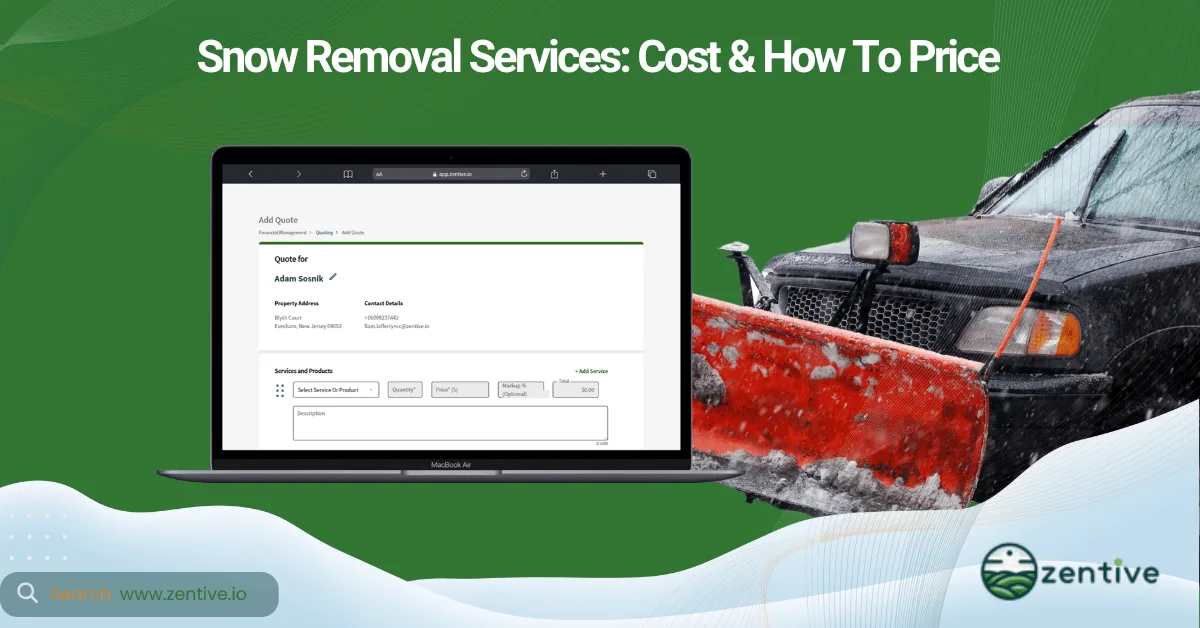
Snow removal business owners must understand service costs and quoting methods. Pricing begins with a site visit to assess the job scope, followed by calculating labor, materials, overhead, and profit margin. Professionals typically determine pricing using these core elements.
Use this formula: Total Cost = (Labor Costs + Material Costs + Overhead) + Profit Margin
Straightforward jobs are easy to quote with this method. However, complex jobs require support tools. Snow removal quoting software streamlines pricing by automating calculations, reducing errors, and saving time. It adjusts costs based on specific project details.
A free downloadable quote template is included to assist with your next snow removal project.
How To Price Snow Removal Jobs?
Price snow removal jobs using the below 6 steps.
- Define the Scope: Identify the specific services and areas to be covered.
- Calculate Labor Costs: Estimate wages for staff based on the job's time requirements.
- Summarize Material Costs: Account for salt, de-icers, and other necessary supplies.
- Compute Overhead Expenses: Include business expenses like equipment maintenance and insurance.
- Aggregate Total Costs: Combine labor, material, and overhead expenses for the total cost.
- Apply Profit Margin: Add a percentage to ensure profitability.
1. Define the Scope
Defining the scope means visiting the job site to get a clear picture of the client's needs. Determine whether the client wants plowing only or also pathways cleared and salt applied. Without a site visit, you won't know what the client envisions! Walk through the area, see any tricky spots, and get a feel for what's involved. This will reassure the client that you care about their needs.
Next, outline the exact tasks of the job - plowing, de-icing, blowing, salt spreading - everything should be included.
2. Calculate Labor Costs
Calculate labor costs by multiplying each crew member’s hourly rate by the estimated hours required for the job. Labor costs are the expenses of your staff. The costs are directly linked to how many hours the job takes and what you're paying your crew. You can calculate the labor costs using this formula: Labor Costs = Hourly Rate x Hours Worked.
The calculation seems straightforward enough, but you still need to figure out how many hours the job will take. It's tempting to guess it, but take the time to make an accurate prediction. For reference, snow removal contractors generally charge between $20-$35 per hour, depending on experience, type of job, and location.
3. Summarize Material Costs
Summarize material costs by listing and pricing all salt, de-icers, fuel, and other supplies needed for completion. Material costs involve the cost of the goods you use during the job. Think salt, fuel, de-icing agents, or sand - anything that needs to be applied or replenished.
Material cost is one of the best areas to keep costs down. Take some time to gather quotes from a few suppliers and factor in any delivery fees. The cheaper the material costs, the lower your costs, and the more attractive the quote looks to the client.
4. Compute Overhead Expenses
Computing overhead expenses by allocating a portion of equipment maintenance, insurance, utilities, and administrative costs to the job. Overhead expenses cover the costs that keep your business running beyond just labor and materials. These expenses include utilities, office supplies, equipment, insurance, and admin staff. These costs should be included in your quote as a fixed rate.
You need to account for project-specific overheads. For instance, if a job needs special equipment, like larger plows or dump trucks, be sure to add those costs here.
5. Aggregate Total Costs
Cost aggregation is the process of adding labor, materials, and overhead expenses up to obtain your total cost. Be sure to add a small contingency fund to your aggregation cost to account for unexpected expenses or overruns.
6. Apply Profit Margin
Apply a profit margin by adding a set percentage to the aggregated cost to achieve the target profit. Profit margin is the money you use to grow your business. For snow removal, average profit margins for most jobs, including plowing, blowing, and removal, often hover around 10-20% (25% in some cases, like shoveling and de-icing).
The type of job influences your profit margin and, ultimately, how much you charge for the specific snow removal job.
How Much to Charge for Snow Removal Jobs?
Charge between $50 to $150 for residential snow removal jobs and $150 to $500 for commercial snow removal jobs. The best way to approach charging snow removal jobs is to use an hourly rate, as outlined in the table below.
| Service Type | Commercial Price | Residential Price |
| Snow Clearing with Plow | $75 - $150 per hour | $50 - $100 per hour |
| Manual Snow Shoveling | $35 - $75 per hour | $25 - $50 per hour |
| Snow Blowing | $50 - $120 per hour | $40 - $90 per hour |
| Roof Snow Removal | $90 - $200 per hour | $70 - $150 per hour |
| Salt & De-icing Application | $30 - $80 per hour | $25 - $60 per hour |
Prices differ between snow removal jobs because of various reasons like skill level required, equipment involved, size of the job, etc.
Why Is the Price of Snow Removal Jobs Different?
The price of snow removal jobs is different because of factors like property size, service requirements, and equipment and labor costs. This is especially true for commercial snow removal, as one client can vastly differ from the next client.
When you price commercial snow removal jobs, consider the property size and complexity. Larger or more complex properties take more time and resources. Consider service requirements and frequency. Regular services, like weekly de-icing, differ in pricing compared to one-off snow-clearing jobs.
Finally, factor in equipment, labor, and operational costs in your snow removal quote. Heavy-duty machinery and skilled labor impact overall expenses.
How to Quote Snow Removal Jobs?
A snow removal quote details your snow removal services, costs, and payment terms in one document. Creating the quote takes time, especially when you need to calculate everything by hand. This is why many businesses use snow removal management software to make quoting easier.
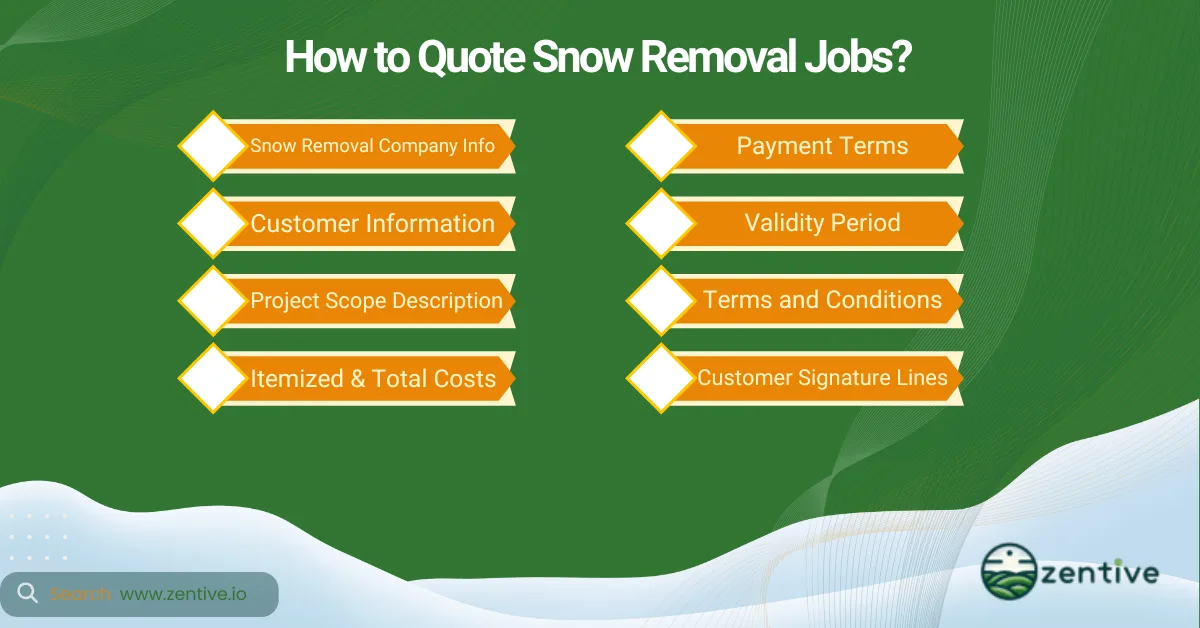
There are eight steps you should follow when you're creating your snow removal job quote.
- Snow Removal Company Information: Business name, address, and contact info.
- Customer Information: Customer's name and address.
- Project Scope Description: Define exactly what's included, like plowing, blowing, or de-icing.
- Itemized & Total Costs: Break down costs (labor, material, overheads, etc.) by each service.
- Payment Terms: Define payment schedules and any deposit requirements.
- Validity Period: Specify when the quote expires.
- Terms and Conditions: Include additional terms regarding weather delays or adjustments.
- Customer Signature Lines: Space for client approval.
We have a free quote template you can download and use. Still, you should think of using snow removal quoting software to create better quotes.
Why Use Snow Removal Quoting Software?
Snow removal management software simplifies several management aspects of a snow removal business, including the quoting process. This software has many benefits, including automating quoting, scheduling, invoicing, and routing.
Software like Zentive has a snow removal price calculator, which helps reduce human error when calculating job costs. It has pre-loaded templates, which help you create different types of professional snow removal estimates for different services.
How to Create Snow Removal Estimates with Software?
Creating a snow removal estimate with quoting software involves four easy steps. Let's use snow plowing as an example.
- Select the Job Type: Choose snow plowing from the pre-loaded list of services.
- Input Labor and Material Costs: Add the time it will take to complete the job and estimated material prices.
- Add Overheads: Include any additional business expenses, such as utilities, admin, etc.
- Review and Save: Double-check, then save or send to the client.
Once you've completed the first quote with snow removal job management software, the rest will be much easier. For instance, Zentive stores cost data and will use it for future jobs, saving you even more time when creating jobs.
How to Quote Different Snow Removal Services?
You quote different snow removal services by uniquely handling each. There are 9 snow removal services, and each has different expenses. For example, roof snow removal might need special safety equipment, while sidewalk de-icing usually doesn't.
What Are the Types of Snow Removal Quotes?
There are two main types of snow removal quotes - hourly and fixed cost. Hourly quotes charge clients based on the time spent on a job. These are best when the job's duration is unpredictable, like heavy snow days. Fixed cost quotes offer a single, upfront price for the entire job, regardless of how long it takes. They are better for more predictable jobs, giving clients a single price for the project.
The type of snow removal business you have will influence the type of quote you use. For instance, commercial jobs might lean toward hourly, as snow depths vary, while residential services often use fixed quotes for smaller, more manageable spaces.
However, the type of snow removal service you offer is the most influential factor in determining the type of quote you'll use. For example, hourly quotes work better for plowing contracts, while fixed-cost quotes are better for jobs like de-icing.
How to Bid on Commercial Snow Removal Contracts?
Bid on commercial snow removal contracts by providing detailed, competitive bids highlighting your businesses capability of handling large areas. Commercial clients require snow removal services for office parks, hotels, and retail centers. Commercial jobs are large projects, so they require equipment that can keep up with demand; unlike residential jobs,
How to Bid on Residential Snow Removal Jobs?
Bid on residential snow removal jobs by focusing on providing a competitive, transparent, and clear bid. Residential snow removal clients are homeowners who usually have small snow removal jobs like clearing driveways or sidewalks. Trust and good prices are key to winning more residential snow removal jobs.
How to Win More Snow Removal Jobs?
Win more snow removal jobs by creating better bids and using software to automate follow-ups. When you automate your follow-ups with software like Zentive, you stay top-of-mind. This immediately places you at the top of the list when clients need snow removal services. You should follow bidding best practices to win more clients.
Best Practices When Bidding Snow Removal Jobs
There are three best practices you should follow when bidding on snow removal jobs.
- Conduct a thorough site visit and assessment: Visit the property to understand the job requirements and potential problem areas before bidding. This will help you create more accurate bids and show clients you care.
- Use detailed, itemized bids: Transparency boosts client trust. A detailed breakdown of all the costs will help the client better understand all the costs and minimize potential disputes down the road. Plus, it looks more professional.
- Follow up after submitting: A follow-up call or email shows commitment. It helps you stay top-of-mind, which increases your chances of winning the bid.
Get This Guide as a PDF
Save this article for offline reading. We'll send a formatted PDF straight to your inbox.
No spam. Unsubscribe anytime.
Ready To Streamline Your Field Service Business?
Zentive is the all-in-one field service management software built for landscaping, lawn care, tree care, and snow removal businesses. Start your free trial today.
No credit card required · Cancel anytime