
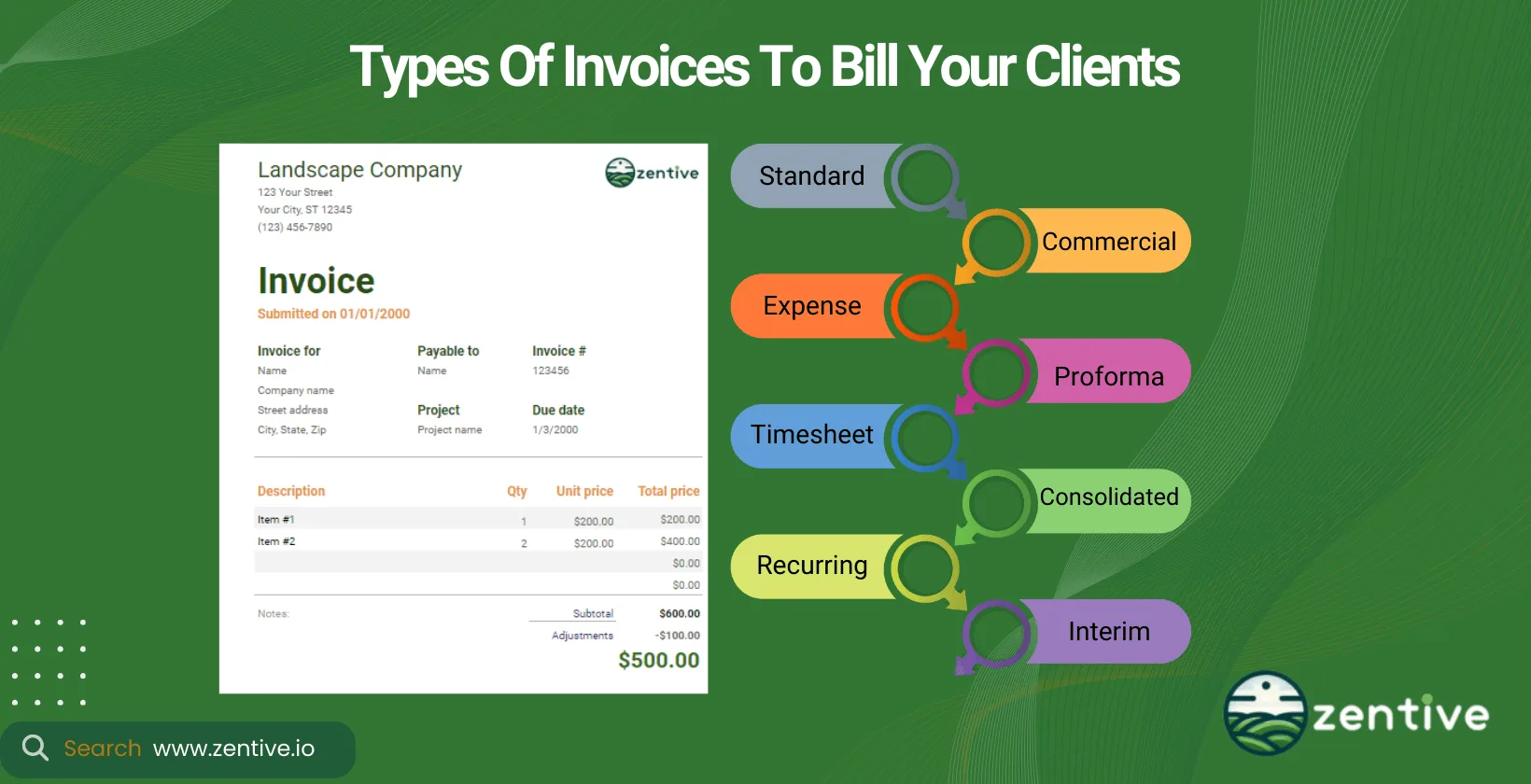
An invoice is a type of document businesses issue to request payment for goods or services they provide. It's a fundamental business document as it allows for more accurate financial records and ensures timely payments.
There are 13 types of invoices, and landscapers and other field service businesses often use multiple types of these invoices depending on the billing needs and scenarios. Businesses can send these invoices either as physical copies or electronically. Electronic invoices have become the norm because of their extensive backup capabilities and easy distribution.
So how do you actually decide which type of invoice to use for your business? Businesses determine the best type of invoice by evaluating factors such as service nature, billing frequency, legal requirements, client expectations, and invoice software compatibility.
Best use case —
Why this works —
Below is a list of the 13 types of invoices businesses use.
| Invoice Type | Description |
|---|---|
| Standard Invoice | A basic bill issued by a seller to a buyer detailing goods or services provided and the total amount due. |
| Commercial Invoice | An invoice used in international trade that provides customs with details about the goods being exported. |
| Expense Report | A document submitted by employees to record business-related expenses for reimbursement. |
| Proforma Invoice | A preliminary invoice sent before delivery, outlining the goods or services and estimated costs. |
| Timesheet Invoice | An invoice that bills clients based on the hours worked, often used by service providers. |
| Consolidated Invoice | A single invoice that combines multiple charges or transactions into one bill. |
| Recurring Invoice | An invoice automatically sent at regular intervals for ongoing services or subscriptions. |
| Interim Invoice | A partial invoice requesting payment for a portion of a large project before completion. |
| Final Invoice | The last invoice issued after a project's completion, summarizing all charges and payments due. |
| Past Due Invoice | An invoice sent to notify a client that a payment is overdue. |
| Retainer Invoice | An invoice requesting advance payment to secure future services. |
| Debit Invoice | An invoice issued to increase the amount owed due to additional charges or corrections. |
| Credit Invoice | An invoice that reduces the amount owed, often due to returns or billing errors. |
1. Standard Invoice
A standard invoice, known as a "basic invoice," is a common billing document issued by businesses to request payment for goods or services provided. Due to its user-friendliness, it's the most popular invoice type used by landscapers.
This invoice includes the business's and client's contact details, an invoice number, the amount owed, and payment terms. Businesses use standard invoices to bill for services provided. Why use it in your business? It provides a straightforward way to request payment. It doesn't require a steep learning curve, and it's easy for the client to interpret. It's not really as suitable as some of the other types of invoices for complex billing tasks.
| Standard Invoice | |
|---|---|
| Best Use Case | For routine billing of goods or services provided to clients. |
| Pros | Simple to create; widely recognized and accepted; suitable for most transactions. |
| Cons | Lacks specialized details needed for specific industries or complex transactions. |
2. Commercial Invoice
A commercial invoice details goods sold to customers overseas in international trade. Of the different types of invoices, this one is the best for international trade as it complies with international shipping regulations.
A commercial invoice includes shipment details, total value, and information required for customs. This invoice type facilitates smooth customs processing but requires detailed and accurate information to avoid delays.
| Commercial Invoice | |
|---|---|
| Best Use Case | For international trade transactions requiring customs declaration. |
| Pros | Provides necessary details for customs clearance; helps avoid legal issues during import/export. |
| Cons | More complex to prepare; may require detailed product descriptions and compliance information. |
3. Expense Report
An expense report is submitted by employees to get reimbursed for business-related expenses. It's not one of the traditional types of invoicing, but it still falls under the invoice category. A standard expense report includes a list of expenses like travel, meals, and lodging incurred during business activities.
It's commonly used by employees in various industries, especially those that require travel. The main benefit of an expense report is that it ensures employees are reimbursed for out-of-pocket expenses. Employees need to keep detailed documentation and receipts; otherwise, discrepancies might arise.
| Expense Report | |
|---|---|
| Best Use Case | For employees to report and get reimbursed for business-related expenses. |
| Pros | Facilitates accurate reimbursement; helps track business expenses for accounting. |
| Cons | Requires detailed record-keeping; can be time-consuming to review and approve. |
4. Proforma Invoice
A proforma invoice is an estimated invoice sent before the final delivery of goods or services. This invoice type provides an estimate of costs and terms of sale. It's one of the few invoices among the different types of invoices that are sent before final delivery. Yet it's quite effective as it helps clients understand costs before the final transaction, enabling them to properly plan payment means.
Businesses engaging in preliminary negotiations or international trade often use a proforma invoice. You will need other forms of invoice to receive payment, given that a proforma invoice is not a formal request for payment.
| Proforma Invoice | |
|---|---|
| Best Use Case | Providing a quote or estimated costs before the sale is finalized. |
| Pros | Helps customers understand costs upfront; useful for securing financing or import permits. |
| Cons | Not a demand for payment; may not be legally binding. |
5. Timesheet Invoice
A timesheet invoice bills clients based on the hours worked. A typical timesheet invoice includes logged hours and hourly rates. It's one of the best invoice options for freelancers, lawyers, therapists, and consultants, as it accurately reflects time spent on a project. The only drawback of timesheet invoices is that people require precise time tracking.
| Timesheet Invoice | |
|---|---|
| Best Use Case | Billing clients based on hours worked, common in freelance or consulting services. |
| Pros | Provides transparency; ensures clients are billed accurately for time spent. |
| Cons | Requires meticulous time tracking; clients may dispute hours logged. |
6. Consolidated Invoice
A consolidated invoice combines multiple smaller invoices into one. It works by aggregating charges for services or products delivered over a period. Of the different types of invoices for business, consolidated invoices are probably the best for companies providing recurring services or subscriptions.
Why not use a standard invoice? A consolidated invoice's main benefit is that it simplifies billing for clients with multiple transactions. This can be especially helpful when clients use multiple add-ons or separate products from the same company.
| Consolidated Invoice | |
|---|---|
| Best Use Case | Combining multiple charges or transactions into a single invoice for a client. |
| Pros | Simplifies billing; reduces paperwork; convenient for both seller and buyer. |
| Cons | Can be confusing if not detailed properly; delays in invoicing until all services are rendered. |
7. Recurring Invoice
A recurring invoice is used for regular, ongoing services or subscriptions. This invoice type automatically generates at regular intervals. It's commonly used by IT services (antivirus software, web hosting platforms, etc.), subscription services (Netflix, Disney+, etc.), and utilities.
Businesses use recurring invoices because they make billing for repetitive services easier. The initial setup is quite easy, but someone still needs to perform ongoing management to ensure the invoice is, in fact, delivered to the client.
| Recurring Invoice | |
|---|---|
| Best Use Case | For ongoing services or subscriptions billed at regular intervals. |
| Pros | Saves time with automation; ensures consistent cash flow; improves customer convenience. |
| Cons | May lead to errors if not updated for changes; requires monitoring for cancellations or adjustments. |
8. Interim Invoice
An interim invoice bills for the partial completion of a large project. Businesses issue interim invoices at agreed-upon milestones to ensure they get paid for work and don't run their capital expenses into the red, i.e., ensure a healthy cash flow. Construction and hardscaping companies and project-based businesses (freelancers) use interim invoices.
| Interim Invoice | |
|---|---|
| Best Use Case | Requesting partial payments during long-term or large-scale projects. |
| Pros | Improves cash flow; reduces financial risk; keeps clients updated on costs. |
| Cons | May complicate accounting; requires clear agreement on payment milestones. |
9. Final Invoice
A final invoice is issued upon the completion of a project. Businesses usually use a final invoice with a proforma invoice. A final invoice includes an itemized list of all services provided and the total cost.
Service providers, such as landscapers and other field service businesses, use final invoices after completing a project or job. The main advantage of a final invoice is that it provides a detailed summary of the entire project, but the business needs to ensure the invoice is accurate to avoid disputes.
| Final Invoice | |
|---|---|
| Best Use Case | Issuing the last bill upon project completion, summarizing all charges. |
| Pros | Closes out the project financially; provides a complete record for both parties. |
| Cons | If disputes arise, payment may be delayed; relies on prior accurate interim billing. |
10. Past Due Invoice
A past-due invoice is a standard invoice that has not been paid by the due date. This invoice type includes details such as the original amount, any late fees, and new payment terms. Any business dealing with late-paying clients will likely use a past-due invoice. A past due invoice encourages timely payment by highlighting overdue status.
| Past Due Invoice | |
|---|---|
| Best Use Case | Reminding clients of overdue payments that haven't been settled by the due date. |
| Pros | Encourages prompt payment; serves as a formal reminder; can include late fees. |
| Cons | May strain client relationships; requires follow-up if ignored. |
11. Retainer Invoice
A retainer invoice requests an advance payment for future services. Lawyers, consultants, and freelancers use retainer invoices to secure payment before the service is rendered. They often use this type of invoice as it ensures consistent cash flow and client commitment. It requires careful management of hours against the retainer.
| Retainer Invoice | |
|---|---|
| Best Use Case | Requesting advance payment to secure services for future work. |
| Pros | Ensures commitment from client; improves cash flow; covers initial costs. |
| Cons | May deter clients unwilling to pay upfront; requires careful tracking of retainer usage. |
12. Debit Invoice
A debit invoice, known as a debit memo, increases the amount a client owes. You issue a debit invoice to adjust previous invoices. Any type of business that needs to correct underbilling or add charges can use a debit invoice. A debit invoice needs to be well-detailed to avoid any client confusion.
| Debit Invoice | |
|---|---|
| Best Use Case | Increasing the amount a client owes due to additional services or corrections. |
| Pros | Adjusts accounts receivable accurately; communicates extra charges clearly. |
| Cons | May confuse clients; can lead to disputes over unexpected charges. |
13. Credit Invoice
A credit invoice, known as a credit memo, decreases the amount a client owes. This invoice type shows a negative amount to adjust previous invoices. Businesses issuing refunds or correcting overbilling often use a credit invoice as it simplifies the process of issuing credits or refunds.
| Credit Invoice | |
|---|---|
| Best Use Case | Reducing the amount owed by a client due to returns, discounts, or billing errors. |
| Pros | Improves customer relations; corrects overbilling; keeps financial records accurate. |
| Cons | Requires careful documentation; may affect revenue reporting. |
What Are The Different Invoice Formats?
A physical copy and an electronic invoice are the two types of invoice formats. A physical copy is a printed paper invoice delivered by mail or hand to the client. The main advantage of using a physical copy is that it's tangible and cannot be easily ignored. It's the go-to option for businesses and clients who are less tech-savvy. It's slower to reach the client compared to electronic services if the client is not in direct contact. It incurs higher costs in the long run due to printing and mailing.
In comparison, an electronic invoice, or e-invoice, is a digital version of an invoice sent via email or through an online invoicing system. E-invoices have faster delivery and processing times. They have reduced costs as there are no printing or postage fees & are easier to store and track.
On the downside, electronic invoices can be overlooked in a cluttered email inbox and require clients to have internet access and a basic understanding of technology. Businesses should evaluate benefits and drawbacks before selecting an invoice format.
How To Pick The Correct Invoice Type?
The correct invoice type depends on your type of business, software and systems compatibility, nature of services or products, billing frequency, legal requirements, and client expectations.
The nature of your business significantly influences the type of invoice you should use. For instance, landscapers typically use standard invoices for their services. Depending on the specific scenario, they might use retainer invoices for long-term projects or recurring invoices for monthly lawn care subscriptions.
It's important that you ensure your invoicing system is compatible with your existing software. It will lead to more headaches than anything else if the two systems aren't compatible, especially if financial data cannot be accurately recorded.
The services or products you offer are arguably one of the main factors that dictate the appropriate invoice type. For example, businesses providing ongoing services benefit from using recurring invoices, while those with project-based work prefer interim invoices.
Consider how often you need to bill clients. Recurring invoices are ideal for regular, periodic billing, while standard or final invoices suit one-time transactions.
Legal requirements play a key role when picking invoice type. Different regions and industries often have specific invoicing requirements, especially when dealing with international trade. Ensure your chosen invoice type complies with all relevant legal and regulatory standards to avoid complications.
Understanding your client's preferences and expectations can guide your choice. For instance, landscapers use standard invoices because they are simple and easy to understand, improving client satisfaction.
Which Invoice Type Do Landscapers Use?
Landscapers use a standard invoice type. These invoices are straightforward, including all necessary details, such as the client's contact information, a breakdown of services provided, the total amount due, and payment terms.
There do come times when you need to create a landscaping invoice for certain situations because a standard invoice isn't suited. For instance, landscapers often use retainer and interim invoices when it's a long-term project, and they need to ensure healthy cash flow.
Different types of landscapers, such as commercial and residential landscapers, use different invoice types. Commercial landscapers often use interim invoices to bill for large projects with multiple phases. In comparison, residential landscapers use standard invoices because they are straightforward and include all the necessary details.
You can use our free invoice template to create custom and well-crafted invoices. Click the link below to start using our invoice template.
Which Type of Invoices Do Commercial Landscapers Use?
Commercial landscapers often use interim invoices to manage billing for large-scale projects. A commercial landscaper is involved in projects that typically have multiple phases, and interim invoices allow for partial payments at various milestones. This secures steady cash flow.
Commercial landscaping projects are generally larger and more complex. Unlike residential landscapers, commercial landscapers require detailed tracking and phased billing to manage costs and payments efficiently.
Which Type of Invoices Do Residential Landscapers Use?
Residential landscapers use standard invoices as they are easy and straightforward. But they can use consolidated invoices, especially if they provide multiple services like lawn care, gardening, and pest control within a single billing period.
Residential services often include multiple small tasks that can be bundled into a single package or charged separately, making standard and consolidated invoices ideal for residential landscapers. They are easy to create, and struggling to create an invoice is the last thing a landscaper wants to keep themselves busy with.
How To Create a Landscape Invoice With Software?
You can use invoice creation tools from software like Zentive to effortlessly create a landscape invoice. Landscaping invoicing software is a digital tool that helps businesses generate, send, and manage invoices electronically. These systems often come with templates and automation features to make the billing process easier.
The main advantage of using invoicing software to create invoices for field service businesses is that it's efficient and accurate. It makes tracking payments and managing overdue accounts much easier. For instance, Zentive has an automated follow-up feature that reminds clients to pay their accounts when they fail to pay over a pre-determined period.
Invoicing software integrates with accounting software like Quickbooks, which enables better financial tracking.
Get This Guide as a PDF
Save this article for offline reading. We'll send a formatted PDF straight to your inbox.
No spam. Unsubscribe anytime.
Ready To Streamline Your Field Service Business?
Zentive is the all-in-one field service management software built for landscaping, lawn care, tree care, and snow removal businesses. Start your free trial today.
No credit card required · Cancel anytime