
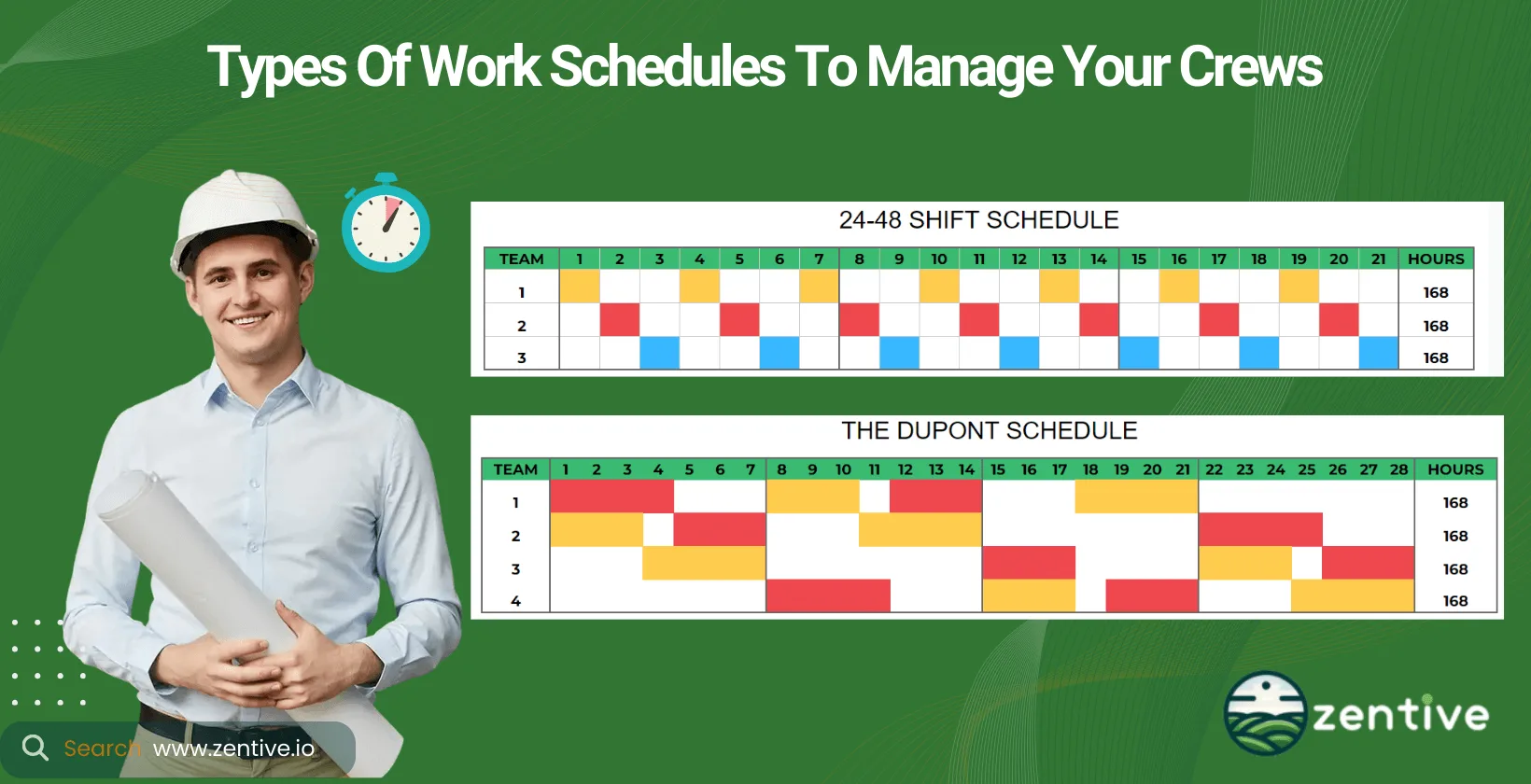
Employee work schedules are structured plans that define your team's working hours and days. Choosing the correct shift schedule is crucial as it will ultimately affect your work efficiency and the crew's morale. This is especially true for field services businesses like landscaping, where seasonal demand and outdoor conditions play significant roles.
There are 15 types of work schedules you can use to manage your crews. The 4-10 and seasonal shift schedules are the most popular in the landscaping industry. Before you use one of the two mentioned above, some key factors must be considered to ensure you pick the right work schedule for your working environment. These factors include operational hours, employee preferences, business demand, and budget constraints.
Quick Work Schedule Picker
Tap the option that looks most like your business to see a recommended crew schedule.
No selection yet. Pick a business type above to see the best-fit schedule.
Ready to test your schedule with drag-and-drop crew planning?
It's important to note that not one work schedule will perfectly match your business. Instead, you should pick one that aligns with your business demands and further optimize it to tailor it for your business. Tips to optimize worker schedules involve implementing landscape scheduling software, focusing on profitable services, scheduling in advance, maintaining flexibility, and balancing workloads.
Creating a work schedule demands careful planning, which is why we created a work schedule template. Feel free to click the link below to download our free work schedule templates.
Landscaping Work Schedule Template
1. Dupont Shift Schedule
The Dupont shift schedule involves four teams working 12-hour shifts over a four-week cycle, with rotations between day and night shifts.
An example of what this would look like is week 1: four night shifts, three days off, followed by week 2: three day shifts, one day off, week 3: three night shifts, three days off, and finishing it off with week 4: four day shifts, seven days off.
The Dupont Shift work schedule is ideal for 24/7 operations like police stations and healthcare facilities. Businesses enjoy using this type of working schedule because it offers long breaks (seven days off in the fourth week) and gives a predictable schedule. Long shifts can be tiring, especially for those not accustomed to it and there is a possibility for high overtime costs.
Dupont Shift Schedule Example
| Week | Monday | Tuesday | Wednesday | Thursday | Friday | Saturday | Sunday |
|---|---|---|---|---|---|---|---|
| Week 1 | Night Shift | Night Shift | Night Shift | Night Shift | Off | Off | Off |
| Week 2 | Day Shift | Day Shift | Day Shift | Off | Night Shift | Night Shift | Night Shift |
| Week 3 | Off | Off | Off | Day Shift | Day Shift | Day Shift | Off |
| Week 4 | Day Shift | Day Shift | Day Shift | Day Shift | Off | Off | Off |
2. 2-2-3 Shift Schedule
The 2-2-3 shift schedule is a 28-day rotation where employees work 12-hour shifts, with two days on, two days off, followed by three days on.
An example of this employee work schedule looks as follows: two-day shifts, two days off, followed by three day shifts, two days off, and then finally two-night shifts, three days off.
This shift schedule is common in manufacturing and healthcare (nurses and doctors). It offers the advantage of a regular, predictable pattern, and employees work fewer days annually. The long shifts lead to fatigue, and adjusting to night shifts is challenging.
3. 4-10 Shift Schedule
Employees work four 10-hour days, followed by three days off. A typical week would consist of 10-hour shifts from Monday to Thursday, with Friday to Sunday being given off.
It's one of the best work schedules for construction and landscaping business. Even some tech industries use it. Businesses and employees prefer the 4-10 shift schedule because it offers a better work-life balance through the three-day weekends.
Still, the long workdays can be exhausting. It's a price worth paying if it means you have three-day weekends.
4. 9/80 Work Schedule
The 9/80 work schedule is where employees work 80 hours over nine days, allowing for an extra day off every other week. The typical 9/80 work schedule spans two weeks. In week 1, you'll have four 9-hour days and one 8-hour day. In week 2, you will have four 9-hour days and one day off.
Engineering and office firms often prefer the 9/80 work schedule over other staff schedules because it better aligns with their working environment.
Employees like this work schedule because they are awarded an extra day off every other week while maintaining a relatively normal workday length. The 9/80 work schedule is known to be complex to manage for large businesses if it is done manually or with inferior work scheduling software.
9/80 Work Schedule Example
| Week | Day | Work Hours |
|---|---|---|
| Week 1 | Monday | 9 hours |
| Tuesday | 9 hours | |
| Wednesday | 9 hours | |
| Thursday | 9 hours | |
| Friday | 8 hours | |
| Week 2 | Monday | 9 hours |
| Tuesday | 9 hours | |
| Wednesday | 9 hours | |
| Thursday | 9 hours | |
| Friday | Off |
5. 5-4-9 Work Schedule
A 5-4-9 is a compressed work schedule where employees work nine hours a day for eight days, one eight-hour day, and have one day off every two weeks.
An example of how this would look for your crew: Week 1 has four 9-hour days and one 8-hour day, and week 2 will have four 9-hour days, but instead of an 8-hour day, they will have one day off.
Governments and corporate settings prefer using this schedule because it promotes work-life balance and offers an additional day off on a bi-weekly basis. Businesses who implement this schedule should be aware that the schedule can lead to fatigue while employees are still adjusting.
6. 4-4-3 Shift Schedule
Employees work four days, followed by four days off, then three days on.
Usually, your first week has four 12-hour shifts followed by four days off leading into week 2. In the rest of week two, you will work three 12-hour shifts and then have three days off.
Apart from the 2-2-3 shift schedule, this schedule is one of the most preferred by emergency services from all the different types of shift schedules. Businesses who require continuous operations use the 4-4-3 shift schedule.
The benefits of using it include extended time off between shifts and provide predictable rotation. Long shifts can be demanding especially in emergency services and many employees have been known to complain about the sleep disruption.
7. Rotating Shift Schedule
Employees rotate through different shifts (day, swing, night) on a set schedule. You'll need to optimize this working schedule to fit your business demands, but you can use this example as a guide. Week 1 is day shift, week 2 is swing shift, and week 3 is night shift.
The rotating shift schedule is one of the best employee work schedules for manufacturing and healthcare, especially if you want to promote equality in terms of working hours and time between employees. Employees will have a fair distribution of less desirable shifts and variety in work hours. But, the rotating shift schedule is known to disrupt sleep patterns and make it harder to maintain a consistent routine.
8. Fixed Shift Schedule
Employees work the same hours and days every week. Your usual week would be working Monday to Friday between 9 AM to 5 PM or 8 AM to 4 PM.
It's ideal for office environments and retail. Landscaping businesses, especially residential landscapers, use it when they have a pre-set appointment list.
A fixed shift makes it easier to manage personal life as it provides a predictable and stable schedule. You don't really have flexibility and would often need to put in leave to run personal errands. The fixed shift schedule is not ideal for businesses with fluctuating demands, e.g., landscaping businesses that provide snow removal services.
9. Split Shift Schedule
The workday is divided into two or more segments with a long break in between. A typical working day would be characterized by a morning shift from 7 AM to 11 AM and then again an evening shift from 5 PM to 9 PM.
Businesses in transportation and hospitality often use this type of work schedule. Unlike the fixed shift schedule, the split shift schedule allows employees to run personal errands during the day while still making sure they work during peak business hours.
There are some cons to the split shift schedule. For instance, you'll have a long overall workday and employees are prone to burnout with this schedule, which is why the rotating shift schedule is a better option.
Split Shift Schedule Example
| Day | Morning Shift | Evening Shift |
|---|---|---|
| Monday | 7:00 AM - 11:00 AM | 5:00 PM - 9:00 PM |
| Tuesday | 7:00 AM - 11:00 AM | 5:00 PM - 9:00 PM |
| Wednesday | 7:00 AM - 11:00 AM | 5:00 PM - 9:00 PM |
| Thursday | 7:00 AM - 11:00 AM | 5:00 PM - 9:00 PM |
| Friday | 7:00 AM - 11:00 AM | 5:00 PM - 9:00 PM |
| Saturday | Off | Off |
| Sunday | Off | Off |
10. Flexible Work Schedule
Employees have flexibility in their start and end times within a set number of required hours. It's a very dynamic work schedule that offers a lot of leniency. For instance, your core work hours would be between 10 AM and 3 PM, and then you can do the other work hours as you see fit, either in the late afternoon, evening, or early morning.
Of all the employee work schedules, this one is the most popular among businesses that have remote employees or hire freelancers.
The flexible work schedule promotes work-life balance and increases job satisfaction levels. Employees require high self-discipline. The business requires a system that double-checks everyone's working hours and ensures they comply with the minimum number of hours.
11. Compressed Workweek
Employees work their full weekly hours on fewer days. For example, a nurse or programmer will work four 10-hour days, followed by three days off. This type of schedule is common in healthcare and tech.
Businesses that use the compressed workweek schedule have reported an improvement in employee morale because of the extended weekends, enabling them to fully recharge. The compressed workweek does have its drawbacks. Productivity has been known to drop on the fourth day of work due to fatigue.
12. Continental Shift Schedule
A continuous work schedule involves a mix of day, night, and swing shifts over seven days. It's similar to the rotating schedule but has different types of shifts within a week instead of on a per-week basis.
For example, week 1 has two day shifts, two night shifts, and three days off. In week 2, the employee will have three day shifts, one swing shift, one night shift, and two days off.
It's a common work schedule in sectors that require continuous operation, such as the manufacturing and energy sectors. It promotes a balanced work distribution. The continental shift schedule can be disruptive to personal life, and most people struggle to adjust to the rotating shifts.
13. On-call Scheduling
Employees are available to work as needed, often with little notice. It's common in the healthcare and emergency care industries. For example, a doctor will work during five days a week and be on-call either one day on the weekend or one night during the week.
On-call scheduling's main advantages are flexibility in staffing, rapid response to urgent needs, and the ability for employees to still obtain rest. Still, there are some drawbacks, such as unpredictable hours. It can be stressful for employees, as they are constantly aware that they can be called into work at a moment's notice.
14. Part-Time Scheduling
Employees work fewer hours than full-time, typically less than 30 hours per week. It's quite common in retail and hospitality during the festive and holiday seasons. Landscapers use this work schedule when workload exceeds the capacity of current crew members and the owner needs to hire part-time employees to tackle the extra work.
An example of what a typical part-time schedule includes: working on Monday, Wednesday, and Friday from 9 AM to 1 PM. It offers flexible hours to employees and promotes easier work-life balance. But, it comes at the cost of fewer employee benefits and less income.
15. Seasonal Scheduling
Employees work only during specific seasons or times of the year. It's very similar to part-time but the work agreement is usually for a longer period than a part-time schedule. For example, during the summer season lifeguards will work from June to August. Or, during winter, seasonal employees will work at a landscaping business to provide snow removal services.
Seasonal schedules are often used in agriculture, field service, tourism, and retail. This type of work schedule ensures peak demand is met. Most businesses utilizing seasonal scheduling provide temporary employment opportunities.
Similar to part time scheduling, seasonal scheduling unfortunately lacks job security and causes inconsistent income, which may deter people from applying to the job. Therefore, it's important to remember these factors when picking an employee work schedule for your business.
Seasonal Schedule Example
| Month | Employee | Role | Work Schedule |
|---|---|---|---|
| June | John Doe | Landscape Technician | Full-time |
| July | John Doe | Landscape Technician | Full-time |
| August | John Doe | Landscape Technician | Full-time |
| December | Jane Smith | Snow Removal Specialist | Full-time |
| January | Jane Smith | Snow Removal Specialist | Full-time |
| February | Jane Smith | Snow Removal Specialist | Full-time |
How To Pick An Employee Work Schedule For Your Business
When picking an employee work schedule for your business, consider your operational hours, employee preferences, business demand, labor laws, and budget constraints.
Operational hours are important because they determine whether your business needs to operate 24/7 or within standard business hours, directly influencing the type of work schedule. You should pay attention to employee preferences, i.e., their personal preferences and work-life balance.
Business demand is another important factor, especially for businesses subject to swings in demand due to seasons or hours. Consider the labor laws in your specific state and that you comply with them (working hours, breaks, and overtime).
Lastly, factor in your budget constraints by accounting for the potential overtime costs and additional staffing.
All of these factors form part of your business model. Different business models require different scheduling needs. For instance, field services businesses such as lawn care, snow removal, HVAC, and plumbing often operate based on customer demand and seasonal changes.
Therefore, you need to construct your work schedule around your business model. This is very important, especially for field service businesses like lawn care and snow removal. A typical employee schedule for a lawn care business could be a flexible schedule, allowing employees to start early in the morning during peak summer months to avoid the midday heat. Alternatively, compressed workweeks or a 4-10 shift schedule could be beneficial to give workers longer weekends for recovery.
In comparison, a snow removal business would benefit from an on-call or rotating shift schedule, as snow removal needs are unpredictable and can occur at any time during the winter months.
How To Choose Employee Work Schedule For Field Service Business
When choosing an employee work schedule for a field service business, consider the seasonality, customer demand, service type, and employee availability.
Seasonality is important because services like landscaping, lawn care, snow removal, and tree care have seasonal peaks. You need to ensure your business extracts the most value in terms of operational hours during those peak hours.
Customer demand in businesses like snow removal, HVAC and plumbing are important because these customers often require emergency services, making on-call schedules necessary. Service type plays a role as the complexity and duration of services can impact scheduling needs.
Lastly, employee availability should be a main priority when you choose an employee work schedule for your field services company. Employee personal issues arise and by accommodating them in your schedules should be a must.
Choosing a work schedule for a landscaping business is especially a unique and difficult task. Landscaping businesses must balance the job's physical demands and emergency-type services with efficient scheduling. It isn't that easy because you can't really pay a team to be on standby, but you can't decline clients that require emergency services. You can't overwork your core crew members, but you don't want to compromise the high standard of work your brand is known for. Implementing a 4-10 schedule during peak seasons can help manage workload while ensuring employees have ample rest.
What Is The Typical Work Schedule For Landscaping Business?
Landscaping businesses often use a 4-10 or flexible work schedule. Managing landscape business presents significant challenges as there are many intricate parts that you need to oversee. The job becomes easier when your employees are happy. That's where the 4-10 work and flexible work schedules come in. The 4-10 schedule provides longer weekends, which can improve employee morale and reduce burnout. Flexible schedules allow for adjustments based on weather conditions and customer demand.
These types of schedules provide excellent adaptability. For instance, during peak seasons, you can schedule shifts to earlier start times to avoid the heat. Conversely, during off-peak seasons, you can reduce working hours or even implement part-time scheduling.
The most important thing to do when implementing a work schedule is to adhere to best practices. This ensures consistent service quality, improves employee satisfaction, and optimizes operational efficiency.
Tips For Creating Employee Work Schedules
There are five main tips for creating employee work schedules. The most important among the tips for landscape employee scheduling is to implement scheduling software. Scheduling software can automate and streamline the scheduling process, ensuring fair distribution, accuracy, and efficiency.
The next tip is to focus on profitable services. Prioritize scheduling for services that bring in the highest revenue to maximize profitability. You should schedule in advance. Planning schedules ahead of time helps avoid last-minute changes and ensures all shifts are covered. This will help mitigate employee dissatisfaction.
When creating employee work schedules, it's important that you try and maintain flexibility. Some flexibility in schedules can improve employee satisfaction and adaptability to changing business needs.
Lastly, strive to balance workloads among employees. Distribute work evenly among employees to prevent burnout and maintain productivity.
Why Should Businesses Use Scheduling Software?
Scheduling software helps businesses improve workforce management by making it more efficient and accurate. For instance, scheduling software for landscapers often includes features such as shift planning, employee availability tracking, and automatic conflict resolution. All of which can help landscapers manage seasonal fluctuations, optimize crew assignments, and handle complex shift patterns.
Zentive can even generate printable PDF schedules for daily or weekly use, ensuring everyone is informed. The software is designed with adaptability in mind, allowing you to adjust the schedule based on the scheduling types you want for your business, from fixed and rotating shifts to flexible and on-call schedules.
Get This Guide as a PDF
Save this article for offline reading. We'll send a formatted PDF straight to your inbox.
No spam. Unsubscribe anytime.
Ready To Streamline Your Field Service Business?
Zentive is the all-in-one field service management software built for landscaping, lawn care, tree care, and snow removal businesses. Start your free trial today.
No credit card required · Cancel anytime