
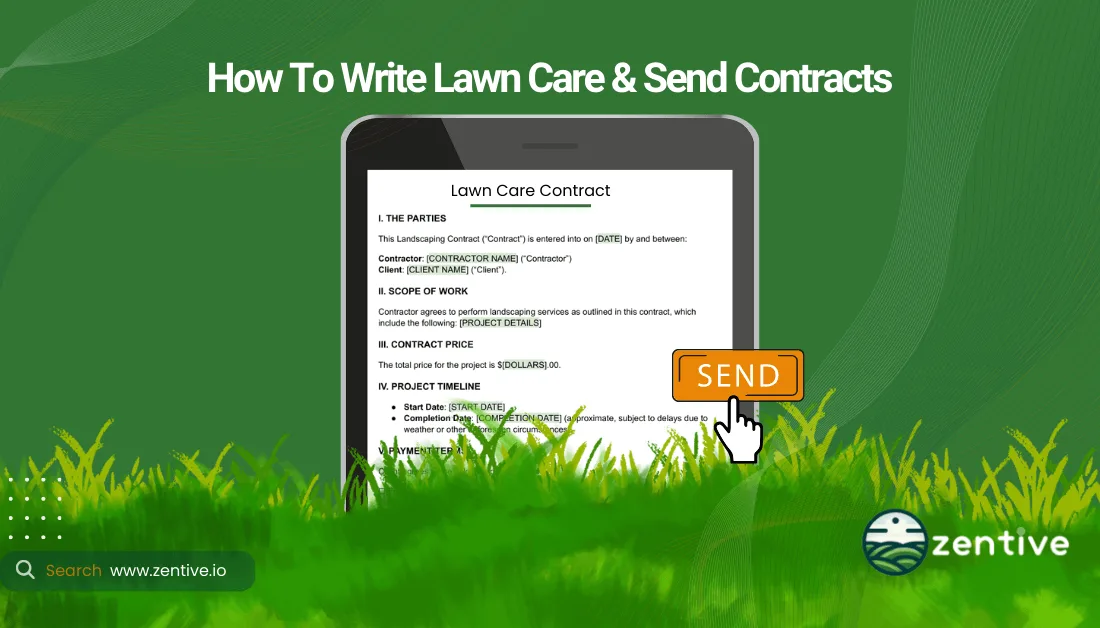
Lawn care contracts are legal agreements that outline services, schedules, terms, legalities, and payments between lawn care providers and clients. Both residential & commercial lawn care companies use contracts to manage customer expectations & solidify their service agreement. Without a contract in place lawn care companies experience late payments, frequent questions, and customer complaints more often.
Essential components of a lawn care contract include the scope of work, payment terms, service schedule, termination clause, and liability details. Keeping the contract simple & straightforward helps to provide clarity and protect both parties.
Feel free to use our lawn care contract template at no cost. Lawn care businesses looking to grow & appear more professional should consider using Zentive to manage their customer contracts & communications.
Follow the steps in the table below to write and send lawn care contracts.
| # | Step | Description |
|---|---|---|
| 1 | Gather Essential Business Information | Include your business name, contact info, license number, and insurance details. |
| 2 | Define the Job Scope of Work | List all services to be performed, such as mowing, edging, fertilization, or seasonal cleanups. |
| 3 | Plan Schedule and Job Duration | Specify how often the services will be performed and for how long (e.g., weekly, monthly, seasonal). |
| 4 | Specify Payment Terms | Detail service pricing, billing frequency, payment methods, and due dates. |
| 5 | Adjust Change Order Protocol | Explain how changes to the scope of work will be handled and approved. |
| 6 | State Warranties and Guarantees | Include any satisfaction guarantees or service warranties offered to the client. |
| 7 | Clarify Cancellation and Termination | Outline the process for contract termination and any cancellation fees or notice periods. |
| 8 | Explain Dispute Resolution | Specify how disagreements will be handled, such as mediation or arbitration procedures. |
| 9 | Confirm Insurance and Licenses | Reaffirm proof of liability insurance and any state/local business licensing requirements. |
| 10 | Acquire Signatures | Include signature lines for both the service provider and client, with date fields. |
| 11 | Include Additional Terms | Add any other legal or operational terms necessary for your specific lawn care business. |
1. Gather Key Company Information
Gathering key company information for a lawn care contract means collecting basic business details for both parties. Document your lawn business details such as company name, address, contact details, and tax identification numbers. Include your state contractor's license number and EPA pesticide applicator certification number if you have them as customers often ask for these during bidding.
Identify the name, address, and contact information of the customer your business is providing lawn care services to. Failing to document basic company & customer information on your mowing contracts leads to communication difficulties, payment delays, and potential legal complications during disputes.
2. Establish the Scope of Services
Establishing the scope of services requires defining exactly what work will be performed. The more detail you include in your definition of services the better leverage you will have resolving customer complaints in the future. This section of the contract sets a clear expectation of what your lawn management company will provide. Including details such as your mowing height range seems trivial but protects you from having to defend your crews work quality.
Having a comprehensive scope on your lawn care contract prevents misunderstandings and scope creep that can quickly make a job unprofitable. New lawn care companies frequently run into disputes with disgruntled customers when the contract lacks detailed definitions of the services being provided.
| Example Scope Items | Description |
|---|---|
| Routine Mowing | Cut turf to agreed height on specified schedule (weekly/bi‑weekly). |
| Edging & Trimming | Edge sidewalks, driveways, flower beds and trim around obstacles. |
| Blowing & Debris Removal | Blow clippings and clear leaves, sticks, and debris from hard surfaces. |
| Fertilization | Apply fertilizer according to soil test recommendations and seasonal needs. |
| Weed Control | Spot‑treat or broadcast herbicide applications in turf and beds. |
| Aeration & Overseeding | Core aerate compacted areas and seed thin or bare spots. |
| Seasonal Cleanups | Spring debris removal and fall leaf cleanup to prepare turf for the season. |
| Mulching & Bed Maintenance | Install or replenish mulch in planting beds and remove weeds. |
| Irrigation Inspection | Check and adjust sprinkler heads, valves, and timer settings. |
| Pruning & Shrub Care | Trim shrubs, remove dead growth, and shape ornamental plants. |
| Pest & Disease Management | Monitor for pests/diseases and apply treatments as needed. |
| Soil Testing | Collect soil samples and report pH/nutrient levels for recommendations. |
| Reporting & Communication | Provide service logs, upcoming schedule, and any change notifications. |
3. Set Timelines and Duration
Setting timelines and duration for your lawn services establishes both service schedules and contract length. Contracts for lawn care services have to specify precise timelines, such as weekly or bi-weekly). Be sure to build in weather delay clauses in your contract so that the customer understands that weekly mowing means every 7-10 days depending on weather conditions, not exactly every Tuesday.
These timeline details create scheduling clarity and makes it easier to schedule your crews. Customers will quickly become frustrated if you do not clearly communicate the schedule expectations & clarify how your jobs will be affected by bad weather.
4. Clarify Payment Arrangements
Clarifying payment arrangements means defining & detailing all financial aspects of the agreement with your customer. Payment terms will normally be shorter for residential home owners than large commercial clients. Your lawn care contract should include rates, billing frequency, acceptable payment methods, late fees, and any seasonal pricing adjustments. Clarifying seasonal pricing changes is important because many customers don't realize that spring startup services and fall cleanups cost more than regular maintenance visits.
Setting clear payment terms protects your cash flow that is crucial to making payroll & keeping your business operating. Lawn care businesses have no leverage to force customers to pay in a timely manner when they don't specify the payment rules in writing with a contract.
5. Outline Change Order Procedures
Outlining change order procedures establishes processes for modifying the original agreement in the even of certain conditions. Customers will often ask for additional services that need to managed with a documented change order to the original contract. Require at least 24 hour notice by your customers for service changes because your route scheduling is optimized for efficiency and last minute changes can cost you hours in drive time between jobs.
Clarifying change order procedures in your customer contract helps to maintain contract integrity while still allowing flexibility for changing conditions & evolving client needs. Lawn care companies that don't manage scope creep will quickly find themselves doing work for free & losing money on jobs. Notify your customer how changes to the contract will be handled upfront so their is a clear expectation.
6. Ensure Warranties and Guarantees
Ensuring warranties and guarantees in your lawn care contract defines the service quality promises and remedies. Contracts for lawn care services contain specific quality guarantees such as performance standards, satisfaction provisions, correction periods, and limitation of liability clauses. Exclude coverage in your lawn contracts for pre-existing conditions like fairy ring fungus or grub damage so that you're not responsible for fixing issues that were there before you started working with the customer.
Basic warranty and guarantee assurances help build client confidence while protecting your lawn business from unreasonable expectations. Many lawn care companies will not include service guarantees, so having them in your contracts will significantly increase trust customers have in your crews.
7. Explain Cancellation and Termination Terms
Explaining cancellation and termination terms addresses how both parties can end the contractual relationship. There are many reasons why your business and a customer part ways, documenting it in the contract upfront makes the process painless. Ensure your lawn care contract documents common termination conditions like notice periods, acceptable termination reasons, early termination fees, and final payment requirements. Include a clause about equipment access to prevent customers from locking gates or blocking access during your scheduled service window.
Clarifying these provisions in your contact creates clarity on the exit strategies while protecting both parties from sudden service disruptions. Always honor your service cancellation polices regardless of how a customer treats you. It is never worth getting a nasty review online that can show your business in a bad light. Reputation is everything in the lawn care industry!
8. Detail Dispute Resolution Methods
Detailing dispute resolution methods in your lawn care contract establishes basic conflict management procedures. Legal disputes with customers are not common, but every business has had to deal with them. Include structured dispute resolution mechanisms such as initial communication requirements, mediation processes, arbitration provisions, and legal jurisdiction specifications. Lawn care companies often use Zentive to take photo documentation of each completed job to prevent customers from claiming work wasn't done.
These procedures minimize your litigation risks while creating pathways for friendly conflict resolution. Going to court is expensive so nobody wins in litigation. Honor your commitments to your customers and your business should never have to battle our legal disputes in front of a judge.
9. Confirm Insurance and Licenses
Confirming insurance and licenses helps document the compliance & regulatory requirements in a lawn care contract. Commercial clients have more requirements in terms of the insurance and licenses your lawn businesses needs to work with them. Document your commercial general liability minimum of $1 million on the contact as residential customers rarely know the difference between personal and commercial coverage levels.
Include verification of insurance coverage in your contract such as liability policies, workers' compensation, property damage protection, and relevant state licensing documentation. Omitting insurance verification from your contracts for lawn care services exposes both your business & clients to significant financial & legal risks.
10. Secure Signatures
Securing signatures makes the document into a legally binding contract. Without signatures from your business & your customer, the lawn contract is nothing more than a piece of paper. A signature can be done manually or using an online software like Zentive for digital approval.
Include a property access authorization signature as you will need legal permission to enter gated communities & some commercial sites. Contracts lacking proper signatures will remain legally questionable documents that provide minimal protection for your company during disputes or enforcement attempts.
11. Include Relevant Attachments and Appendices
Including relevant attachments and appendices at the end of your lawn care contract supplements the main agreement with supporting documents. Attach items such as property maps, equipment specifications, chemical application details, and photographic property documentation. Attach a property condition report with photos of any existing damage to protect against false damage claims before you start work with the client.
Free Lawn Care Contract Download
Click the button below to download Zentive’s free printable lawn care contract template. Our template can be tailored to match the services & branding of your lawn care business. You can also sign up for a free 14-Day Free Trial of Zentive to test how your lawn care contracts can be automated with our business app.
How To Get More Lawn Care Contracts?
Get more lawn care contracts by improving your marketing efforts. Marketing directly increases lawn care contracts through targeted neighborhood campaigns, professional websites, and strategic social media presence. A lawn care company without marketing strategies experiences limited growth and reduced market visibility.
Networking with industry professionals creates valuable referral opportunities. Regular attendance at home improvement expos and business associations builds relationships with complimentary service providers: real estate agents, property managers, and home builders. Lawn care companies that neglect professional networking miss referral opportunities and lack industry insights.
Showcasing past successful projects demonstrates service quality and builds client confidence. A comprehensive portfolio includes before and after photographs and client testimonials displayed on professional platforms. Lawn care contracts become difficult to secure when businesses fail to document their work effectively.

Which Lawn Care Marketing Tactics Are Most Effective?
Targeted local SEO and direct mail campaigns are the most effective lawn care marketing tactics.
Commercial lawn care providers achieve optimal results through relationship marketing tactics focused on property management companies, HOAs, and facility managers who control multiple properties.
Residential lawn care businesses generate consistent leads through neighborhood-targeted Facebook ads, Google Local Service Ads, and referral programs with clearly defined incentives as their marketing strategies for lawn care. Door hangers delivered to specific neighborhoods immediately after completing visible high quality work for existing clients create geographical service clusters that maximize route efficiency and referral potential. Time your door hangers for Thursday evenings when most homeowners are planning their weekends and notice their neighbor's freshly cut lawn.
How To Get More Commercial Lawn Care Contracts?
Commercial lawn care contracts increase through targeted marketing to property management companies, corporate office parks, and multi-tenant facilities. Attend local commercial real estate networking events in your community in January & February when property managers are setting their annual budgets.
Direct mail campaigns featuring professional case studies and maintenance packages generate qualified leads from property managers seeking reliable service providers. Referral programs help get more commercial contracts for lawn care by offering commission incentives to facility managers produce high-value contracts with lower acquisition costs than cold outreach methods.
How To Get More Residential Lawn Care Contracts?
Get more residential lawn care contracts by offering free estimates only on Tuesdays and Wednesdays. These are normally your slowest service days and scheduling estimates during downtime gives you more time to sell to residential homeowners.
Customer testimonials displayed on your website and social media platforms helps to build trust with prospective clients who value social proof when selecting service providers. Residential customers will be more open to working with you if they can see examples of your past work on properties that look like theirs.
How To Create Better Lawn Care Contract Bids?
Create better lawn care contract bids including detailed service breakdowns, clear pricing structures, and professional software like Zentive. Including your actual equipment specifications helps create better bids because knowledgeable customers can tell the difference in cut quality. And it justifies your pricing over lowball competitors using homeowner equipment
Including professional photographs of similar completed projects in your bid provides visual evidence of quality and set realistic client expectations. Lawn care business software automates the bidding process, calculates accurate pricing based on property specifications, and shows a level of professionalism that low quality lawn businesses will not have. Learning how to quote lawn care jobs correctly is one of the best ways to boost revenue.
Which Software Can Be Used To Manage Lawn Care Contracts?
Zentive, Jobber, ServiceTitan, and LMN can all be used to manage lawn care contracts. Pick the best lawn care business software for your business to streamline & automate contract management, client communications, scheduling, and payment processing in a single platform designed specifically for lawn care professionals.
Zentive and similar specialized management systems integrate with QuickBooks to streamline accounting, track revenue by contract type, and automatically generate financial reports that measure business performance.
How To Send Lawn Care Contracts?
Use Zentive and other lawn care quoting & invoicing software to create, send, and track your lawn care contracts to customers. Sending contracts on Sunday evenings is a useful tip as homeowners are normally planning their week and most likely to review and sign proposals before Monday morning. Electronic signature platforms like DocuSign or Adobe Sign offer alternative options for sending lawn care contracts digitally.
Get This Guide as a PDF
Save this article for offline reading. We'll send a formatted PDF straight to your inbox.
No spam. Unsubscribe anytime.
Ready To Streamline Your Field Service Business?
Zentive is the all-in-one field service management software built for landscaping, lawn care, tree care, and snow removal businesses. Start your free trial today.
No credit card required · Cancel anytime