
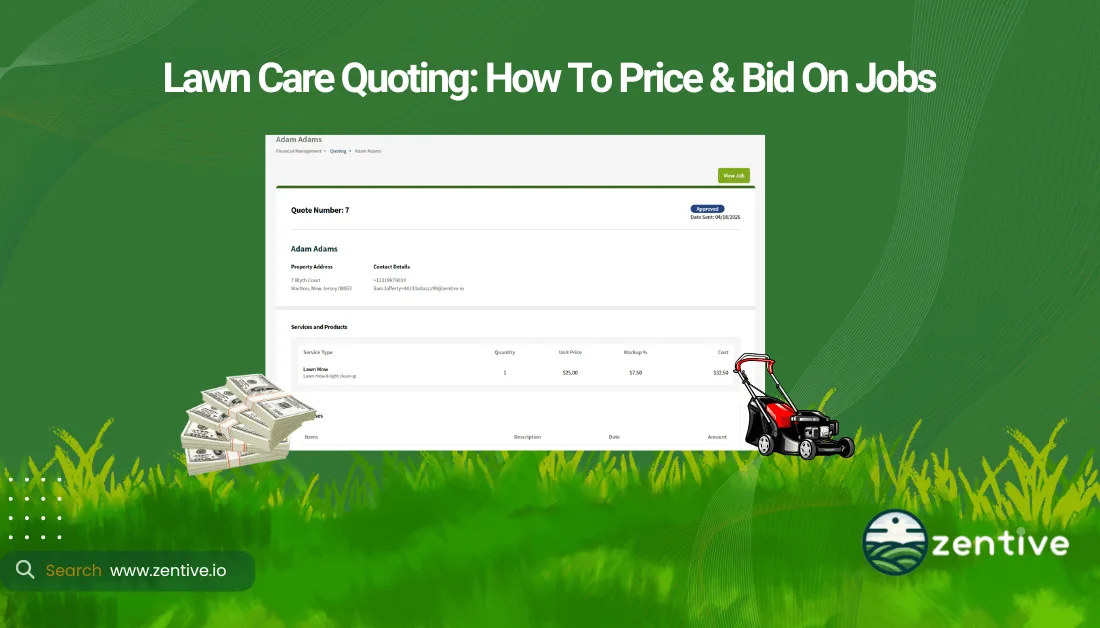
Providing accurate lawn care quotes helps land more jobs and ensure profitability. A lawn care quote template helps businesses set clear pricing, create professional estimates, and win clients. Using a professional template sets a standard of consistency that conveys professionalism to customers.
Pricing of specific lawn care services varies & depends on yard size, service type, labor, equipment costs, market rates, and factors like seasonal demand and travel distance affecting final costs. Lawn care businesses spend significant time to generate quotes by visiting the job site, assessing property size, considering job complexity, and estimating work hours.
Lawn care management software, like Zentive, makes quoting even easier by automating quoting, reducing errors, and speeding up estimates. Features like pre-set pricing, automated tax & discount calculations, and digital approvals improve efficiency and professionalism. The below chart contains the estimated costs of lawn care services by property size.
| Yard/Property Size | Estimated Price Range |
| Small (Up to 1,000 sq. ft.) | $30 – $50 |
| Medium (1,000 – 5,000 sq. ft.) | $50 – $100 |
| Large (5,000 – 10,000 sq. ft.) | $100 – $200 |
| Extra Large (10,000+ sq. ft.) | $200+ |
Lawn care professionals that don't want to invest in a professional lawn software can download our free quote template to use with their customers.
How To Price Lawn Care Jobs?
Price lawn care jobs with the below steps.
- Assess Job Scope: Evaluate the property size, service type, and complexity to determine work requirements.
- Calculate Labor Costs:Estimate total labor hours and multiply by employee wage rates.
- Determine Material Costs: Account for expenses on fertilizers, mulch, fuel, and other necessary supplies.
- Factor in Overhead Expenses: Include costs like insurance, equipment maintenance, and administrative expenses.
- Calculate Total Costs: Sum labor, material, and overhead expenses to determine base service pricing.
- Apply Profit Margin: Add a percentage markup to ensure profitability while remaining competitive.
1. Assess Job Scope
Assessing job scope by conducting a site visit and assessment allows you to evaluate property size, terrain, existing landscaping, and any special requirements that affect pricing. It impossible to give an accurate quote without sending an estimator to the clients property to investigate. There are apps that allow lawn care businesses to use satellite to estimate job size & create estimates, but they come with a higher level of uncertainty.
Job scope defines the services, tasks, and resources required to complete a lawn care project. Understanding the client’s vision and requirements is essential to providing an accurate quote and meeting expectations. Clearly defining the exact tasks and services—such as mulching, fertilization, aeration, lawn maintenance, or irrigation installation—helps ensure proper planning and pricing accuracy. Remember to always under promise and over deliver with your clients.
2. Calculate Labor Costs
Calculating labor hours accurately is crucial to avoid underquoting, delays, or excessive costs. Labor costs refer to employee wages paid for completing a project, calculated by multiplying the hourly rate by total hours worked. Labor costs will be the majority of expenses any lawn care business has for standard mowing jobs.
The average lawn care contractor salary ranges from $15 to $35 per hour, depending on experience, skill, and location. Factoring in crew size, job complexity, and efficiency ensures pricing reflects realistic labor requirements.
3. Determine Material Costs
Material costs include all physical resources needed to complete the job, such as fertilizer, mulch, sod, seed, pesticides, and fuel for equipment. Mowers and other equipment also count toward material costs. Calculate how much you spend on your mowers (monthly payment, maintenance, etc) and divide it by the number of jobs you do in a year to get a cost for each job.
Obtaining quotes from third-party material suppliers ensures you get the best pricing on bulk orders. Material delivery charges must be considered in your lawn care quote as transportation costs can significantly impact profitability.
4. Factor in Overhead Expenses
Factoring in overhead expenses means including costs that are not directly tied to a single project but are necessary for operations. Generic overhead costs are the most commonly overlooked by lawn care businesses trying to do their own books. These include utilities, office expenses, marketing, equipment depreciation, insurance, and payroll taxes, and more. Some projects require specific overhead expenses, such as rental costs for specialized equipment not typically used in daily operations. Factoring in overhead ensures your business covers essential operating costs while maintaining profitability.
5. Calculate Total Costs
Calculating total costs means adding together labor costs, material costs, and overhead expenses to determine the total cost of a lawn project. This calculation is simple but provides a baseline price before applying a profit margin. It is always recommended to add a contingency fund (typically 5-10% of total costs) to account for unexpected expenses, material overruns, or job delays. This helps ensure profitability on jobs that inevitably will have issues arise.
6. Apply Profit Margin
Applying your profit margin is the last step in creating a quote that is ready to send off to your customer. Profit margin is the percentage of total revenue retained as profit after covering all costs. Lawn care businesses typically apply 15-45% profit margins, depending on service type. Basic lawn maintenance services (mowing, edging) have lower margins (15-25%), while specialized services like landscape design, irrigation, and pest control can yield higher profit margins (30-45%) due to increased expertise and material costs.
Many lawn care businesses go wrong by constantly slashing service prices to compete in their local market. While this may be ok if you are trying to grow your lawn business & onboard new accounts, it is not a long term success strategy. Your business must generate a profit over the long run or it will not last.
How To Quote Lawn Care Jobs?
A lawn care quote is a detailed estimate outlining the cost, scope, and terms of a service to ensure transparency and secure jobs. Lawn care management software automates quoting, improving accuracy, efficiency, and professionalism.
Below are things to include in your lawn care quote.
- Lawn Care Company Information – List business name, logo, and contact details for professionalism.
- Customer Information – Include the client’s name, address, and contact details for personalization.
- Project Scope Description – Outline specific services like mowing, aeration, or landscaping.
- Itemized & Total Costs – Break down labor, materials, and final total for cost clarity.
- Payment Terms – Define accepted payments, deposits, and due dates to avoid disputes.
- Validity Period – Specify how long the quote is valid (e.g., 30 days).
- Terms and Conditions – State warranty policies, exclusions, and cancellation terms.
- Customer Signature Lines – Provide space for the client’s signature and approval.
A clear, professional lawn care quote builds trust and increases job conversions. Download our free quote template below to simplify your quoting process. You can also use our lawn care quote generator to easily create professional lawn estimates.
Why Use A Lawn Care Quoting Software?
Use a lawn care quoting software to save time, ensure pricing consistency, and creates professional estimates for different services like mowing, fertilization, aeration, and landscaping. Zentive is a custom lawn care quoting app that streamlines quoting by generating customized estimates, automating calculations, and ensuring competitive pricing. Lawn care quoting apps let businesses quickly generate different types of quotes for one-time jobs, recurring services, or large commercial contracts with just a few clicks. It also keeps a historical record of all your quotes & tracks statistics so that you can refine your business and marketing approach.
How To Create Lawn Care Estimates With Software?
Using lawn care quote and invoicing software for service estimates like mowing can be done in seconds. Create lawn care estimates with software by following the below steps.
- Select the Service: Choose the service type (e.g., lawn aeration, mowing, or weed control).
- Input Property Details: Enter yard size, terrain type, and any special client requests.
- Calculate Cost: The software automatically factors in labor, materials, and overhead expenses.
- Generate the Estimate: Create a detailed, itemized quote with total pricing.
- Send & Track the Quote: Email or text the estimate to the client and track approval status.
How To Quote Different Lawn Care Services With Software?
Quote different lawn care services with software by selecting the service type, labor, materials, and overhead costs. The software will automatically calculate the total cost and can be electronically sent to the customer for approval. Quotes vary because basic mowing requires minimal labor and materials, while services like aeration, fertilization, or landscaping involve higher expenses for specialized equipment and supplies. Lawn care business apps automate cost calculations, ensuring accurate, customized quotes for each service type while factoring in labor hours, material costs, and profit margins.
How To Price Lawn Mowing Jobs?
Price lawn mowing jobs by calculating costs based on yard size, labor time, equipment use, and your local lawn market rates. Unlike other lawn care services, mowing is a recurring, low-margin job, so pricing must be competitive while ensuring profitability. Lawns are most commonly mowed bi-weekly and can be charged to the client monthly, after each service, or yearly. Lawn care quoting software helps automate estimates by factoring in property size, business expense, and frequency of service for accurate pricing.
How To Price Yard Cleanup Jobs?
Price yard cleanup jobs by calculating costs based on labor hours, debris volume, equipment needed, and disposal fees. Unlike mowing, cleanup jobs are seasonal and vary in complexity, requiring flexible pricing for factors like leaf removal, storm cleanup, or overgrown yards. Consider the amount of debris to be cleared & assign a number of work hours for your crew to complete the job. Lawn care quoting software helps automate pricing by estimating workload, material costs, and hauling expenses for accurate and competitive quotes.
What Are The Types Of Lawn Care Quotes?
The types of lawn care quotes are hourly or fixed cost based on the job type. Hourly quotes charge for labor time and are common for yard cleanups or unpredictable jobs. A Lawn company can track their time & charge the customer a fixed hourly rate based on how long they spend working. While fixed-cost quotes provide a set price for services like mowing or fertilization. Commercial lawn care businesses often use fixed contracts, while residential services vary based on property size and service complexity.
How To Quote Commercial Lawn Care Customers?
Quote commercial lawn care customers by calculating costs based on property size, contract length, and service complexity. Commercial clients include office parks, hotels, apartment complexes, schools, and retail centers that require long-term, large-scale maintenance. Using lawn care quoting software ensures consistency and professional proposals and increases the chances of landing valuable commercial mowing & lawn maintenance contracts.
How To Quote Residential Lawn Care Customers?
Quote residential lawn care customers by estimating yard size, labor time, and materials for small lawn care jobs. Determine how often you need to service the customer & adjust your quote accordingly. Residential clients are homeowners needing routine maintenance, requiring quick, competitive pricing. The first person to send a homeowner a quote normally wins the job. Automated quoting software simplifies estimates and improves customer response times.
How To Win More Lawn Care Jobs?
Win more lawn care jobs by offering competitive pricing, stronger customer service, and professional quoting. Using automated follow-ups keeps clients engaged and increases job conversions. Using a software will help your lawn care company stand out from competitors that send manual invoices & take long periods to respond to customer feedback & service requests.
What Are Best Practices When Bidding Lawn Care Jobs?
Best practices when bidding lawn care jobs are displayed below.
- Conduct a thorough site visit and assessment: Evaluate yard size, terrain, and specific service needs.
- Use detailed, itemized bids to enhance transparency: Clearly break down labor, materials, and total costs.
- Follow up with the client after submitting the bid: Improve conversion rates with timely check-ins and customer engagement.
Get This Guide as a PDF
Save this article for offline reading. We'll send a formatted PDF straight to your inbox.
No spam. Unsubscribe anytime.
Ready To Streamline Your Field Service Business?
Zentive is the all-in-one field service management software built for landscaping, lawn care, tree care, and snow removal businesses. Start your free trial today.
No credit card required · Cancel anytime