
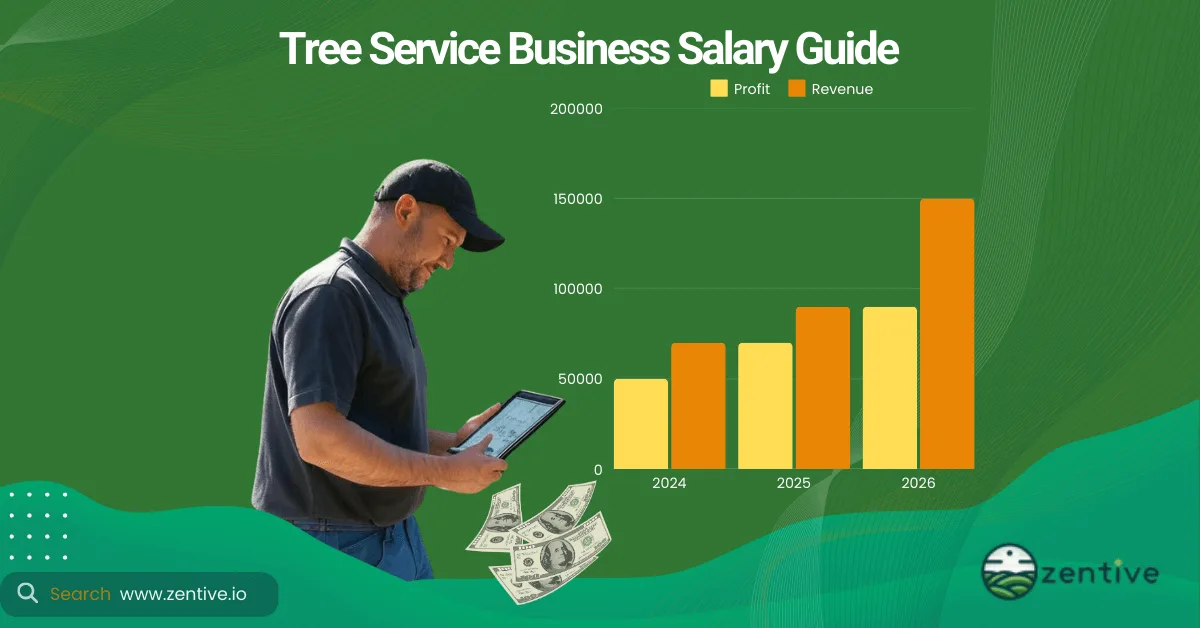
On average, a tree service owner salary ranges from $70,000 to $100,000 per year, with the average around $78,600. Tree cutters, or arborists, typically make between $40,000 and $60,000 annually, averaging $42,000. A tree service salary is among the highest in the green service industry compared to notable services like landscaping and pest control. This is because tree service personnel need a high level of expertise and often perform dangerous work.
Tree service businesses must still work hard and run a successful business to earn the above figures. Several factors influence these figures. Experience is key; for instance, those with multiple years of experience and an established brand earn more than newcomers.
Location matters too; for example, an arborist makes, on average, $98,400 per year in Seattle compared to $66,700 in Chicago. This is because areas with a high demand for tree-cutting services tend to offer better pay. The size of the tree-cutting business can impact earnings, with larger companies usually providing higher salaries.
How Much Do Tree Service Owners Make?
Tree service owners make between $70,000 and $100,000 per year, with an average income of $78,600. A tree service owner salary will vary based on several factors. The size of the business is arguably the main factor—larger companies often generate more revenue, leading to higher personal income.
The location of the business is important. States and cities with more trees and more extreme wind conditions naturally have a higher demand for arborist businesses.
Experience is crucial. Owners with years under their belts can charge premium rates for niche services other arborists cannot perform. They have a loyal customer base, meaning less spent on marketing and ultimately higher profitability.
On average, tree removal businesses see profit margins ranging from 10% to 20%, so if your revenue is a cool $1,000,000, you net around $150,000 for the business if you take the median figure. tractors have a higher earning potential than their wage-earning co
| Tree Service Owner Income Overview | |
|---|---|
| Average Annual Salary | $78,600 |
| Salary Range | $70,000 - $100,000 |
| Typical Profit Margins | 10% - 20% |
| Example Net Profit | $150,000 on $1,000,000 revenue (15%) |
| Key Success Factors | • Business size • Location & demand • Years of experience • Specialized services |
What Does a Tree Cutter Make Per Year?
Tree cutters make approximately $42,000 per year on average, depending on experience level. Entry-level workers start at around $30,000 per year. Mid-career arborists can expect to earn between $40,000 and $50,000 annually. Experienced tree cutters with specialized skills earn over $60,000 annually.
What Does a Tree Cutter Make Per Hour?
Tree cutters earn an average hourly wage of $23.84. We checked multiple open jobs for arborists, all coinciding with this figure, giving a range between $18 and $28 per hour for full-time employees.
The type of employment agreement you have will influence your pay. Part-time or seasonal workers may find themselves at the lower end of this range, usually around $15 to $20. Full-time employees with certifications and specialized skills can earn more ($23-$28 per hour).
Seasonal demand affects pay rates, with the potential for higher wages during peak times when services are in high demand and overtime is almost a certainty.
How Do Different Types of Tree Service Businesses Affect Pay?
The type of tree service business influences pay. Arborist companies that perform dangerous services (trimming the crowns of trees) or emergency services (clearing blocked roads) are paid more than arborists who provide trimming or cutting services.
Roles within a company influence pay. Laborers, designers, managers, and contractors all come with different salary expectations. The more responsibility your job description entails, the higher your pay.
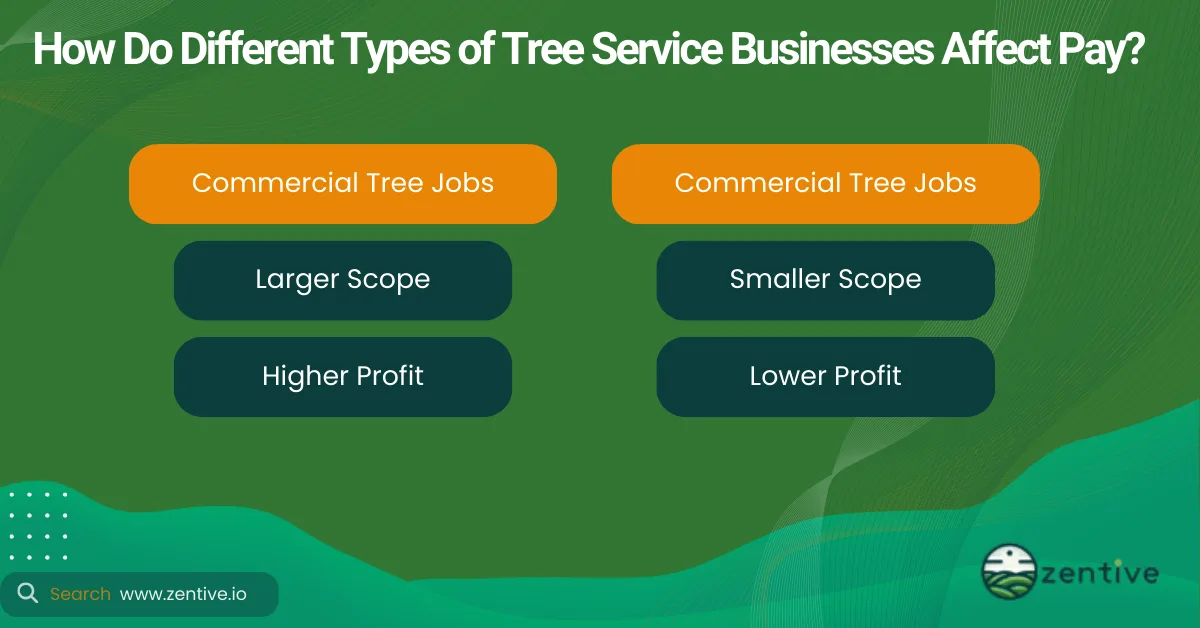
Specializations matter at different types of tree service companies. Residential services yield different, often lower, profits compared to commercial projects. Commercial work often involves larger contracts and can lead to higher income.
How Much Money Do Tree Service Contractors Make?
Contractors in the tree service industry typically charge per project, which makes predicting their income difficult, but they usually make around $60,000 annually.
Contractors have a higher earning potential than their wage-earning counterparts. This comes at the risk of a fluctuating income and uncertainty for work in future months. Their income fluctuates based on the number of contracts secured and the size of each project.
How Much Does a Self-Employed Arborist Make?
Self-employed arborists make, on average, $58,000 per year, with a range of $40,000 to $80,000. Earnings for self-employed arborists depend on factors like the size of their client base, the variety of services they offer, and their geographical location. For example, in busy areas with high demand, like Seattle, a self-employed arborist makes anything from $67,000 to $98,400.
How Much Money Do Commercial Tree Trimmers Make?
Working on commercial projects is more lucrative than residential jobs, and their earnings often approach the $80,000 to $100,000 mark. Commercial tree trimmers make more money than residential trimmers due to the larger scale of commercial work, which often means more significant contracts and, consequently, higher pay.
How Much Do Arborists Make in Different Parts of the USA?
Arborists' salaries vary between each state in the USA. Here's a breakdown of the average amount of money arborists make in different parts of the USA.
| State | Average Salary ($) |
|---|---|
| Alabama | 40,000 |
| Alaska | 50,000 |
| Arizona | 45,000 |
| Arkansas | 38,000 |
| California | 63,460 |
| Colorado | 48,000 |
| Connecticut | 52,000 |
| Delaware | 46,000 |
| Florida | 39,290 |
| Georgia | 41,000 |
| Hawaii | 47,000 |
| Idaho | 40,000 |
| Illinois | 50,000 |
| Indiana | 42,000 |
| Iowa | 40,000 |
| Kansas | 39,000 |
| Kentucky | 38,000 |
| Louisiana | 40,000 |
| Maine | 42,000 |
| Maryland | 50,000 |
| Massachusetts | 54,000 |
| Michigan | 45,000 |
| Minnesota | 48,000 |
| Mississippi | 37,000 |
| Missouri | 40,000 |
| Montana | 38,000 |
| Nebraska | 40,000 |
| Nevada | 45,000 |
| New Hampshire | 50,000 |
| New Jersey | 43,970 |
| New Mexico | 40,000 |
| New York | 58,010 |
| North Carolina | 42,000 |
| North Dakota | 40,000 |
| Ohio | 42,000 |
| Oklahoma | 39,000 |
| Oregon | 48,000 |
| Pennsylvania | 45,000 |
| Rhode Island | 50,000 |
| South Carolina | 40,000 |
| South Dakota | 38,000 |
| Tennessee | 40,000 |
| Texas | 37,240 |
| Utah | 42,000 |
| Vermont | 45,000 |
| Virginia | 45,000 |
| Washington | 50,000 |
| West Virginia | 38,000 |
| Wisconsin | 45,000 |
| Wyoming | 40,000 |
Note: These figures are approximate and your income will differ based on your experience and demand for services.
Which Country Pays Tree Service Workers the Most?
The United States pays tree service workers the most, with a pay range of $20-$30 per hour. Experienced arborists in the U.S. earn higher salaries due to the strong demand and the extensive tree care industry. Other countries with notable pay include the UK, Canada, and New Zealand, where skilled arborists are highly valued but are still paid less than in the U.S.
The E.U.'s pay for tree service workers is a bit lower compared to the countries we listed. For example, in France, most climbers are paid around 12-14 euros per hour. Seasonality and experience level affect international arborist & tree service pay rates.
How Does Seasonality Affect Arborist Pay?
Seasonality affects arborist pay by increasing earnings in spring and summer and reducing income in winter. A tree service technician's salary usually peaks during the busiest seasons, like spring and summer. In contrast, off-peak times such as winter and fall lead to a slowdown in work, affecting overall pay. Arborists offer supplemental services (i.e. holiday lights & leaf removal) during slow seasons to stabilize income.
How Much Do Arborists Make in the Winter?
In winter, arborists usually see a decrease of 10% to 30% in their earnings compared to busier months. This is because there is a lower demand for arborist services in winter. Many arborists try to supplement the decrease in service demand by offering other services like tree pruning, removal of hazardous branches weighed down by snow, and emergency services after winter storms.
How Much Do Arborists Make in the Fall?
Fall can be one of the most profitable seasons for arborists, usually accounting for around 30% of their total income. This season offers considerable opportunities like leaf removal, tree health assessments, and tree preparation for the upcoming winter.
What Factors Affect Average Arborist Salary?
Five main factors affect the average arborist's salary. Employers (tree service companies) are arguably the most influential factor in an arborist's salary. Each company does pay structures differently. Some companies offer higher base salaries, while others provide bonuses or commission incentives.
Employee skills, performance, and experience influence your salary. Arborists with specialized skills, certifications, or more experience can command higher wages and are often granted. Excellent performance within the company often leads to raises or promotions.
Government regulations are another determinant of the average arborist's salary. Laws regarding minimum wage, overtime, and taxes affect earnings.
Industry standards should be factored in. Salary benchmarks within the industry help set expectations for pay rates. Companies may adjust salaries to stay competitive. Salary is one of the main reasons the arborist sector has such a large churning rate - it's fairly easy for arborists to quit and work for the competitor offering more money.
Economic conditions, while not a main factor in salary amount, still affect job availability and wage levels. The health of the economy always plays a role in salaries, regardless of which sector you find yourself in. Factors like inflation and unemployment rates play a role.
We often see our clients, specifically tree service business owners, struggle to manage employee payments effectively. It's a skill they need to learn in order to retain skilled workers and ensure their business runs smoothly.
| Salary Factor | Explanation |
|---|---|
| Employer Pay Structure | Tree service companies determine salary through base pay, bonuses, commissions, and compensation models. |
| Employee Skills | Specialized arborist skills increase wage potential due to higher service value. |
| Certifications | Professional certifications justify higher pay by demonstrating verified expertise. |
| Experience Level | Greater arborist experience commands higher wages through proven job performance. |
| Job Performance | Consistent high performance leads to raises, promotions, and higher compensation. |
| Government Regulations | Minimum wage laws, overtime rules, and tax policies directly affect arborist earnings. |
| Industry Salary Standards | Industry benchmarks influence pay rates to remain competitive in the labor market. |
| Labor Market Competition | High employee turnover and competitor offers drive wage increases across companies. |
| Economic Conditions | Inflation, unemployment, and economic health impact wage levels and job availability. |
| Employer Payment Management | Effective payroll and compensation management improves worker retention and salary stability. |
How to Manage Tree Service Employee Payments
The best way to handle tree service employee payments is through accounting software like QuickBooks. It assists with payroll management, tracking hours, calculating wages, and handling taxes. Some business software, like Zentive, integrates with QuickBooks, making it easier to manage and schedule your tree cutting employees, invoicing clients, and so much more all in one place.
Does Tree Service Business Software Integrate with QuickBooks?
Yes, many tree service business software like Zentive integrate with QuickBooks. Tree service software helps you manage payments as well as other aspects of your business like scheduling, routing, invoicing, quoting, CRM, etc.
The main reason why you would want a business software that syncs with QuickBooks is to provide a streamlined and more effective business solution that saves you and your team time and reduces the chance of human errors, ultimately boosting profitability.
Get This Guide as a PDF
Save this article for offline reading. We'll send a formatted PDF straight to your inbox.
No spam. Unsubscribe anytime.
Ready To Streamline Your Field Service Business?
Zentive is the all-in-one field service management software built for landscaping, lawn care, tree care, and snow removal businesses. Start your free trial today.
No credit card required · Cancel anytime