
A tree service business maintains and cares for trees through trimming, removal, health assessments (arborists), and general maintenance. This guide breaks down the 6 main types of tree service businesses, the services each one offers, and how to manage and grow your company in 2026 with the right tools and strategies.
There are six different types of tree service businesses, each with distinct roles in the green industry and different target customers. Some types of tree services focus on large commercial projects, while others work directly with homeowners. Understanding where your business fits helps you choose the right marketing, staffing, and tree care software to run it profitably.
Each type of tree service business requires a different approach to business growth. Tree service business growth involves specialized business management software, efficient employee management, financial management, and skilled employees..
The below table contains the 6 types of tree services businesses.
| Tree Service Business Type | Definition |
|---|---|
| Commercial Tree Service Business | A commercial tree service business provides large-scale tree care services to municipalities, commercial properties, and managed estates. |
| Residential Tree Service Business | A residential tree service business provides tree care services to homeowners for private properties. |
| Tree Service Contractors | Tree service contractors perform specialized tree care services as independent workers or subcontractors. |
| Arborist Consulting Firm | An arborist consulting firm provides expert advice on tree health, risk, and management. |
| Tree Service Franchise | A tree service franchise operates under a national brand while providing standardized tree care services. |
| Emergency Tree Service Business | An emergency tree service business provides urgent tree removal and hazard mitigation services. |
1. Commercial Tree Service Business
A commercial tree service business provides tree care services to businesses, estates, municipalities, parks, and property management companies. Their service range typically includes tree removal, pruning, and maintenance of large trees that pose potential hazards or appear neglected.
When you run a commercial tree service business, you need to adeptly manage larger teams and specialized equipment. You need to be at your best in terms of contracts and bids, as commercial gigs usually require a higher level of compliance and documentation. Capital expenditure is considerably higher in commercial businesses than other types of tree service businesses.
The key to obtaining new commercial clients is about being a recognizable presence in the sector. That means networking with property managers, attending industry trade shows, and maintaining a strong online presence through SEO and targeted ads.
Commercial clients spend a lot of money on tree care services, so they often rely on referrals and proven track records, which is why showcasing your work through case studies is always recommended.
2. Residential Tree Service Business
A residential tree service business provides tree care services to homeowners who require tree care on their properties. Services include tree trimming, removal, stump grinding, and general tree health maintenance (pest and fungal control).
What sets this type apart from the standard tree service business is the focus on personalized service and customer relationships. Homeowners require a more hands-on approach, where clear communication and trust are vital. When you show homeowners you care, it gives them a sense of assurance that their trees are well looked after. This converts to a higher client retention rate and more word-of-mouth referrals.
To gain clients in this field, you need to deliver exceptional service at competitive prices. Make sure your employees are outstanding at their work and have good human skills. Remember, they're the face of the company. Local advertising, participating in community events, and building a reputation through word-of-mouth are good methods of onboarding new clients.
The most effective strategy our clients have used is optimizing their online presence, specifically encouraging positive online reviews and performing local SEO (Google My Business). Local SEO through Google My Business is free for residential tree companies and increases search visibility.
3. Tree Service Contractors
Tree service contractors work as independent professionals or as subcontractors for larger tree service companies. These contractors are often called in to perform specialized services such as tree removal, stump removal, emergency storm cleanup, or specific types of pruning.
Running a tree service contractor business means flexibility in your work. Use strong networking skills to secure contracts. How are people going to subcontract you if they don't know who you are?
Therefore, you need to bring your networking A-game to every trade show, business meeting, and more. Remember, securing contracts as a contractor is all about building relationships. Directly reach out to businesses and property managers so that they know who you are. And always deliver high-quality work to foster repeat business.
4. Arborist Consulting Firm
An arborist consulting firm provides actionable advice on tree health, safety, and management. These firms often work with property owners, municipalities, and even other tree service companies to assess tree conditions and make recommendations for care or removal. It can be anything from recommending the right way to cut a delicate tree to promote healthy growing to how to deal with a rare fungal infestation in a homeowner's garden without damaging flora.
What makes this type of business unique is the emphasis on knowledge and expertise. As a consulting firm, you're selling your skills and insights rather than physical labor. Arborist consulting firms require knowledge of tree biology, disease management, and safety protocols. People will pay a lot of money for your knowledge as long as you provide the correct advice.
To gain clients as an arborist consulting firm takes a different approach than the other types of tree service businesses. In this type of business, you need to position yourself as an expert. That means certifications, publishing articles or blogs, and participating in industry events. Remember, consulting is often relationship-driven, so building a strong professional network is essential. You might think you're in the tree service business, but you're actually dealing with people most of the time.
5. Tree Service Franchise
A tree service franchise is similar to a fast food franchise chain. You'll operate under an established brand, but instead of serving Big Macs and Kiddies Meals, you'll be offering the tree care services the franchise is known for. Franchisees benefit from the brand's reputation, marketing resources, and operational support, allowing them to focus on running the business and serving clients.
The main benefits of joining a franchise are that you'll be using a business model, system, and tools that already work, meaning you don't have to struggle to learn the ropes as much as you would when launching solo. But, of course, you have to pay franchise fees. You must adhere to the franchise's guidelines and standards.
New clients are often attracted through the brand's national or regional marketing efforts. Local marketing and exceptional service are still critical to building a loyal customer base in your area. You run the risk of a stripped franchise license if you're giving the franchise a brand reputation, but see this as a motivator to do your best rather than a drawback.
6. Emergency Tree Service Business
An emergency tree service business specializes in responding to urgent situations, such as trees damaged by storms, fallen trees blocking roads, or hazardous trees that pose immediate risks.
Running an emergency tree service business means you can charge a premium due to the urgency of jobs. This means you'll be working odd hours and exposing yourself to risky situations. Use specialized equipment and a team that can mobilize quickly and work well under pressure.
Local municipalities, insurance companies, and property managers are your clients, so focus on building relationships with these entities. Emergency tree service businesses distribute business cards to homeowners in neighborhoods with large trees in the event their services are needed.
A strong online presence with clear information about your availability and expertise helps you stand out when emergencies arise. Target local keywords on your website, e.g., "emergency tree removal service (location)." When people search this term on the internet, Google will help them find your website. Make sure to list all the services you do on your website; the last thing you want is to be called at 1 A.M. for a tree service you don't even provide.
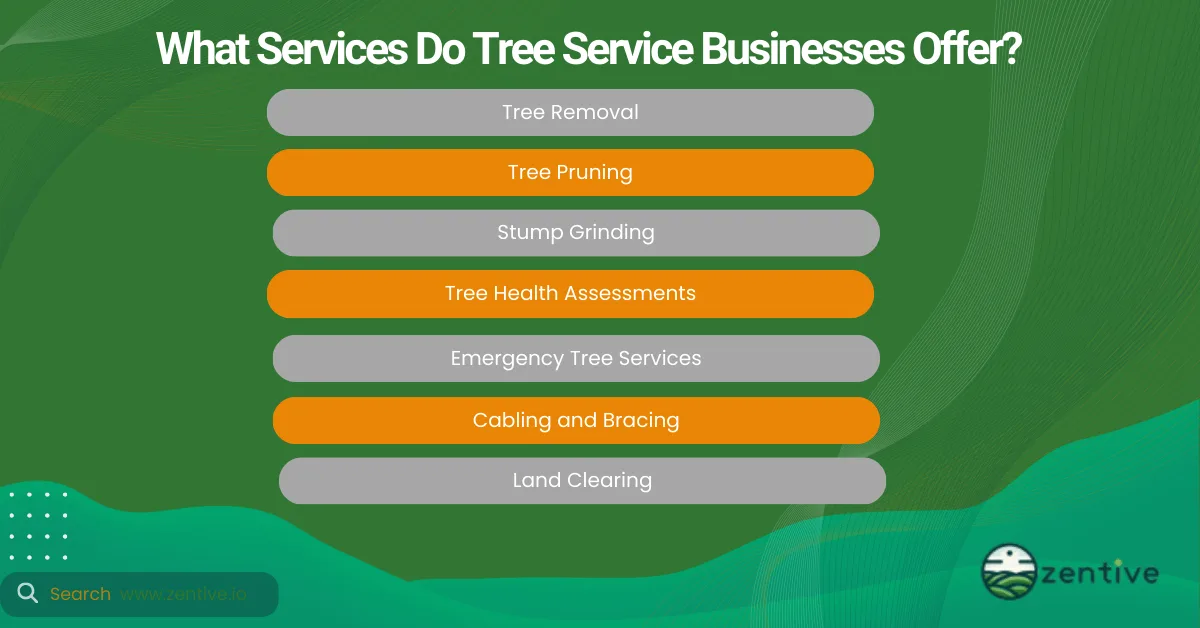
What Services Do Tree Service Businesses Offer?
Tree service businesses offer services including tree removal, tree pruning, stump grinding, tree health assessments, emergency tree services, cabling and bracing, and land clearing. Below is a list of the most common services tree service businesses offer.
- Tree Removal: Removing trees that are dead, dying, or pose a hazard to property.
- Tree Pruning: Trimming branches to improve tree health, shape, or safety.
- Stump Grinding: Removing tree stumps after a tree has been cut down.
- Tree Health Assessments: Evaluating trees for diseases, pests, and overall health.
- Emergency Tree Services: Responding to urgent situations, such as storm-damaged trees.
- Cabling and Bracing: Installing support systems to help weak or damaged trees.
- Land Clearing: Removing trees and brush for new construction or development.
Each business type has its own tree services list. Some overlap, but most are unique to a specific business type. For example, both commercial and residential will do tree removal, pruning, and even stump grinding. These two business types rely on arborist consulting firms for specialized tree health assessments and where to perform the most effective cabling and bracing. Similarly, only emergency tree service businesses offer emergency tree services even in the offseason.
Do All Types of Arborists Offer Offseason Services?
Yes, all types of arborists offer off-season services during fall and winter. Tree care doesn't stop when the leaves fall. In fact, these seasons are ideal for certain tasks. We list a breakdown of fall and winter services arborists usually do during the offseason.
Fall Services:
- Tree Pruning: Preparing trees for winter by removing dead or weak branches.
- Fertilization: Strengthening trees for the colder months ahead.
- Leaf Cleanup: Removing fallen leaves to prevent disease.
- Winterizing: Ensuring delicate trees like fruit and citrus trees are protected against the incoming cold.
Winter Services:
- Dormant Pruning: Pruning during the tree's dormant season to encourage growth in the spring.
- Winter Tree Assessments: Evaluating tree health when leaves are off, making it easier to spot issues.
- Snow and Ice Removal: Clearing snow and ice from trees to prevent breakage.
Arborists know that offering year-round services is the key to success in this industry, so they proactively plan for these services in their management plans.
How to Manage Different Types of Tree Service Companies?
Managing different types of tree service companies requires effectively addressing the unique challenges of each business type. Tree service companies require strategic planning and the right tools depending on the type of company.
One of the most effective ways of managing a tree service company is to utilize management software. These tools streamline operations, from scheduling to invoicing and customer management. It's especially crucial for larger businesses like commercial tree service companies, where managing multiple projects and teams can get complex.
It helps with the bidding process. We all know that proposals are part of the commercial tree service business description. It's something commercial businesses have to do to win new clients. The software helps you create proposals faster and more professionally.
The next management tip is coordinating employee schedules efficiently. The better you schedule your employees, the more jobs you get done, and the higher your client satisfaction will be.
It's something residential tree service businesses struggle with as they need to schedule multiple clients on a daily basis. These businesses can use scheduling software to help them prevent double bookings and better handle cancellations.
Tree service businesses need to diligently track your financials. Tree Service Contractors, in particular, need to meticulously track expenses and revenue to stay profitable in a competitive market. Yes, your prices need to be competitive & ensure profitability. Make sure you provide high-quality work if you offer more expensive prices. A quality service rendering is often better than a cheaper price.
Another important factor is recruiting high-quality employees. Finding and retaining skilled workers can be challenging, especially in the service industry. While arborist consulting firms might not struggle to retain employees, they should focus on hiring experts with specialized knowledge to maintain credibility and client trust.
| Tree Service Business Management Guide | |
|---|---|
| Software Usage |
• Streamline operations • Handle scheduling • Manage invoicing • Create professional proposals |
| Employee Management |
• Coordinate schedules efficiently • Prevent double bookings • Handle cancellations • Recruit quality staff |
| Financial Tracking |
• Monitor expenses • Track revenue • Set competitive pricing • Ensure profitability |
| Service Quality |
• Maintain high standards • Build client trust • Justify premium pricing • Generate referrals |
Why Do Arborists Need a Business Management Software?
Arborists need business management software because it makes operations more efficient and increases profitability. As I briefly mentioned, software for tree care business offers benefits, such as employee and job scheduling, quoting, invoicing, job routing, and customer management, all in one place.
How Do Arborists Manage Employee Schedules?
Arborists manage employee schedules with scheduling software. Each type of tree care business schedules its employees differently. For example, emergency tree service businesses have an unpredictable schedule, so they need a scheduling tool that allows for quick adjustments. Commercial tree service businesses and arborist consulting firms schedule teams in advance.
Meanwhile, residential tree service businesses and contractors need flexibility to cater to client availability. Hence, they need a scheduling tool that can provide a solution for this.
Scheduling tools like Zentive help numerous tree care service businesses plan jobs, assign tasks based on proximity to the job site and skill level, and track job completion progress.
How Do Arborists Manage Company Finances?
Arborists manage their finances through financial tools that help them track income, expenses, payroll, and profits. Managing finances is the single most important task in a business. It allows you to spot potential problems before they have the chance to bankrupt a business. Without good financial management, your business will not grow. A question we get a lot is how you should handle tips. While tipping is less common, you should track it as part of the revenue stream.
Arborists use financial management tools like Zentive to help them with their finances. Zentive offers tools for invoicing, expense tracking, and financial reporting. Zentive integrates with Quickbooks for easier financial management. Zentive can even help you identify employees who don't perform as well as they should and cost you more money than what they're generating.
How Can Arborists Find Better Employees?
Arborists can find better employees by creating well-defined job descriptions and advertising job postings in the right locations. Hiring and retaining high-quality employees in the green sector is a major challenge. These high turnover rates and the job's physical demands make it difficult to maintain a stable workforce. This makes it important that you hire tree care employees who are of high quality, laying the foundation for a stable workforce.
Commercial tree service businesses should offer competitive wages and benefits to attract quality candidates. Residential tree service businesses should focus on creating a positive work environment, providing competitive wages and opportunities for growth in terms of skill development and promotions.
How to Grow Your Tree Service Company?
Growing your tree service company requires you to diligently follow your business plan and implement great marketing strategies and financial management. The key is sustainable tree company marketing, and that's exactly what happens when you follow these three strategies.
Tree service companies focus on building relationships with people and businesses around them. For commercial tree service businesses, this includes building relationships with property managers and municipalities. Residential businesses, on the other hand, should focus on strong local marketing and exceptional customer service to grow their business.
How to Grow a Commercial Tree Cutting Company?
The best way to grow a commercial tree cutting company is through B2B (business-to-business) marketing. B2B marketing involves targeting property managers, real estate developers, and municipalities who need ongoing tree care services.
In B2B marketing, relationships are crucial. Attend industry trade shows, network with potential clients, and maintain a strong online presence that showcases your portfolio of past projects.
How to Get More Commercial Tree Cutting Business Contracts?
You get more commercial tree cutting business contracts by using tree-cutting business management software, displaying your expertise through professional contract proposals built with quoting software, offering competitive rates, and providing exceptional service to existing clients to secure referrals.
Commercial contracts are so invaluable because you secure reliable revenue for a long period of time without additional marketing investments. Management software can help you send out more professional proposals. The more proposals you send out, the higher your chances of securing new contracts.
How to Grow a Residential Tree Trimming Business?
Growing a residential tree trimming business requires business-to-consumer (B2C) marketing. This involves reaching out directly to homeowners who need tree care services.
Local advertising, seasonal promotions, word-of-mouth referrals, and a strong presence on social media platforms can boost residential tree trimming company sales.
How to Boost Residential Tree Trimming Company Sales?
You can boost sales for your residential tree trimming company by increasing marketing efforts and always striving for high customer satisfaction. Happy customers mean more referrals and positive online reviews. This means that by providing high-quality services, you're actually doing very effective marketing. People trust referrals and reviews much more than an ad.
Another effective strategy is to offer bundled services, such as a discount for booking both tree trimming and stump grinding together. This increases your sales per customer & makes your service more appealing by offering added value.
Get This Guide as a PDF
Save this article for offline reading. We'll send a formatted PDF straight to your inbox.
No spam. Unsubscribe anytime.
Ready To Streamline Your Field Service Business?
Zentive is the all-in-one field service management software built for landscaping, lawn care, tree care, and snow removal businesses. Start your free trial today.
No credit card required · Cancel anytime