
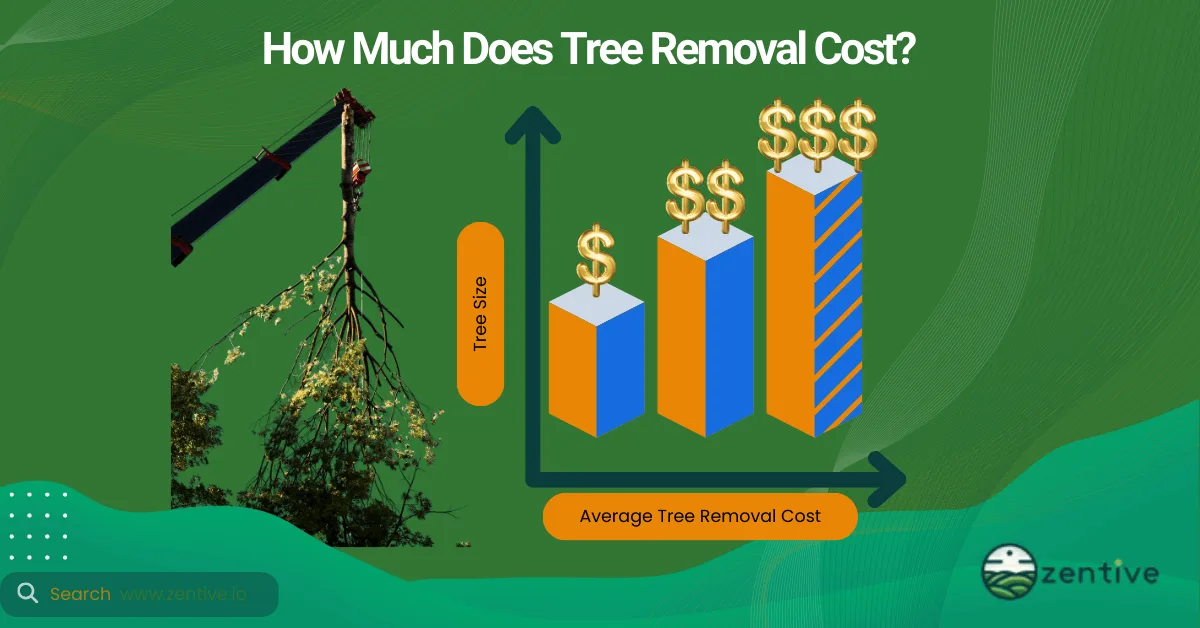
Tree removal involves safely cutting down and removing trees from residential, commercial, or public areas. It's one of the core tree services and is in high demand. Tree removal pricing involves calculating labor, equipment, risk, and disposal costs for cutting down a tree. In 2026, the average cost of tree removal ranges from $200 to $2,500 per tree.
Accurate tree removal pricing prevents losing jobs to competitors due to uncompetitive quotes. Tree removal pricing requires calculating direct costs and accounting for your desired profit margin.
Average tree removal costs vary depending on the location and size of the tree and the intricacies of the job. Bidding on tree removal jobs requires assessing trees' size, health, and quantity, along with the equipment and manpower needed. Accurate tree removal estimates result from evaluating scope, risk, equipment needed for the job, and labor requirements.
The main tip to estimating tree removal jobs is to use tree service estimating software, like Zentive. Tree quoting software is one of the best and easiest ways to price a tree removal job. This software simplifies calculations and helps avoid underbidding.
| Pricing Factor | Explanation |
|---|---|
| Average Tree Removal Cost | The cost of tree removal ranges from $200 to $2,500 depending on job complexity. |
| Small Tree Pricing | Small tree removal typically costs between $200 and $400. |
| Large Tree Pricing | Large tree removal costs range from $1,000 to $2,500 or $8 to $15 per foot. |
| Hourly Labor Rates | Tree removal labor rates commonly range from $50 to $150 per hour. |
| Type of Job | Emergency or hazardous tree removal jobs increase pricing due to higher risk. |
| Tree Species | Certain tree species cost more to remove because of wood density and structure. |
| Tree Size and Height | Taller trees require additional labor and sectional removal, increasing cost. |
| Tree Location | Trees near buildings or power lines raise removal costs due to added complexity. |
| Debris Removal | Hauling away branches and trunk material increases total tree removal price. |
What Is Cost Of Tree Removal?
The cost of tree removal ranges from $200 to $2,500 - smaller trees are $200 to $400, while larger trees are $1,000 to $2,500 ($8 to $15 per foot) or $50 to $150 per hour. It's a wide range, but too many factors influence the tree removal price to give a fixed amount. For instance, a small tree can cost more expensive to remove than a large tree due to its location on the property.
So, next time you ask how much does it cost to remove a tree, consider the tree's size, location, and species. Let's break down the factors that influence a tree removal estimate in more detail.
The type of job is the main factor. As discussed, emergency or hazardous jobs tend to cost more. Tree species are important. Some trees, like oaks or pines, are harder to remove and thus cost more. Size and height play a role. Taller trees require more labor and equipment and often a specialized approach to removal as they are too tall to fell in one go - they need to be removed piece by piece.
Location is another factor to keep in mind. Trees close to buildings or power lines add complexity and cost. Finally, debris removal should be factored in. Want all the branches and trunk hauled away? That will bump up the price as well.
How Much Does Each Type Of Tree Removal Service Cost?
Garden tree removal costs $200 - $500, standard tree removal is around $300 - $700, hazardous tree removal costs $1,000 - $2,500, and emergency tree removal will cost $500 - $3,000
As you can see, the price varies greatly depending on the type of job. Hazardous and emergency tree removals are typically more expensive due to the added risks and urgent nature.
How Much Do Emergency Tree Removal Services Cost?
Emergency tree removal services range from $500 to $3,000 but expect to pay more than $1,000. Tree removal is only classified as an emergency when immediate urgency and danger are involved. For example, if a storm knocks down a tree onto your roof, that's an emergency.
Tree care businesses often compete for these jobs because of the lucrative pay. Tree companies & their employees need special training and expertise to handle these types of jobs, regardless of the tree species or size, and prevent further damage or safety risks.
How Much Do Tree Removal Services Cost By Tree Species?
Tree removal costs start at $200 for the cheapest tree species and go up to $2,500 for the most expensive species. The species of the tree is a major factor in pricing. Harder woods or trees with extensive root systems considerably drive up the cost. Here's a quick look at some common tree species and their average removal costs.
| Tree Species | Average Removal Cost |
|---|---|
| Oak | $1,000 - $1,500 |
| Pine | $500 - $1,200 |
| Maple | $900 - $1,500 |
| Palm | $200 - $500 |
| Cedar | $400 - $1,200 |
| Fir | $800 - $1,400 |
| Birch | $400 - $900 |
| Spruce | $500 - $1,200 |
| Eucalyptus | $700 - $1,300 |
| Poplar | $800 - $1,400 |
How Much Do Tree Removal Services Cost By Size?
Small trees (up to 30 feet tall) cost $200 - $500, whereas large trees (over 60 feet tall) costs $1,000 - $2,500.
Any tree removal business knows that size matters when it comes to tree removal, both in height and diameter. Smaller trees are quicker and easier to remove. In contrast, larger ones require more equipment and manpower, as well as a special approach to avoid the trees falling on buildings. The bigger the tree, the bigger the bill.
How Does Tree Removal Jobs Vary By Location?
Tree removal costs vary by location, especially urban vs rural and between different states. Urban areas tend to have higher prices due to access challenges and regulations. In contrast, rural areas might be cheaper because there's less red tape. In urban areas, you might pay 20-30% more due to increased labor costs and tighter access. Here's a breakdown of the cost of tree removal in different states.
| State | Average Tree Removal Cost |
|---|---|
| California | $700 - $1,500 |
| Texas | $600 - $1,200 |
| New York | $900 - $2,000 |
| Florida | $500 - $1,200 |
| Illinois | $600 - $1,300 |
| Pennsylvania | $700 - $1,400 |
| Ohio | $500 - $1,000 |
| Georgia | $600 - $1,300 |
| North Carolina | $500 - $1,200 |
| Arizona | $700 - $1,500 |
What Is Tree Removal?
Tree removal is a landscaping service that involves safely cutting down and removing a tree from a property or public area. The process typically involves first assessing the tree's health, size, and location. Once a plan for the safe removal of the tree has been constructed, the tree removal specialists start removing the tree using a chainsaw or specialized equipment to cut it down piece by piece if it's a hazardous length. The stump may be ground down or removed entirely, depending on the client's preference.
The benefits of tree removal are manifold. It includes reducing hazards (dead branches or a tree ticking time bomb waiting to fall on your roof), improving property aesthetics, or clearing space for new landscaping or construction projects.
Residential clients usually remove a tree to make room for new gardens or to eliminate a safety risk. But homeowners aren't the only ones who seek tree removal services. Businesses want different types of tree removal services, usually to expand buildings or improve parking spaces.
What Are Types Of Tree Removal Jobs?
There are four types of tree removal jobs.
- Garden tree removal: Removing smaller trees in residential gardens, either to create space for landscaping or construction.
- Standard tree removal: Removing trees of average size that pose no immediate hazard.
- Hazardous tree removal: Taking down trees that are damaged, diseased, or leaning dangerously.
- Emergency tree removal: Urgent removal of trees that have fallen or are at immediate risk of falling, usually due to storms.
Each of these jobs comes with its own unique price tag. For instance, emergency tree removal usually costs more than garden tree removal due to the urgency of the job.
How To Create Estimate For Tree Removal Jobs
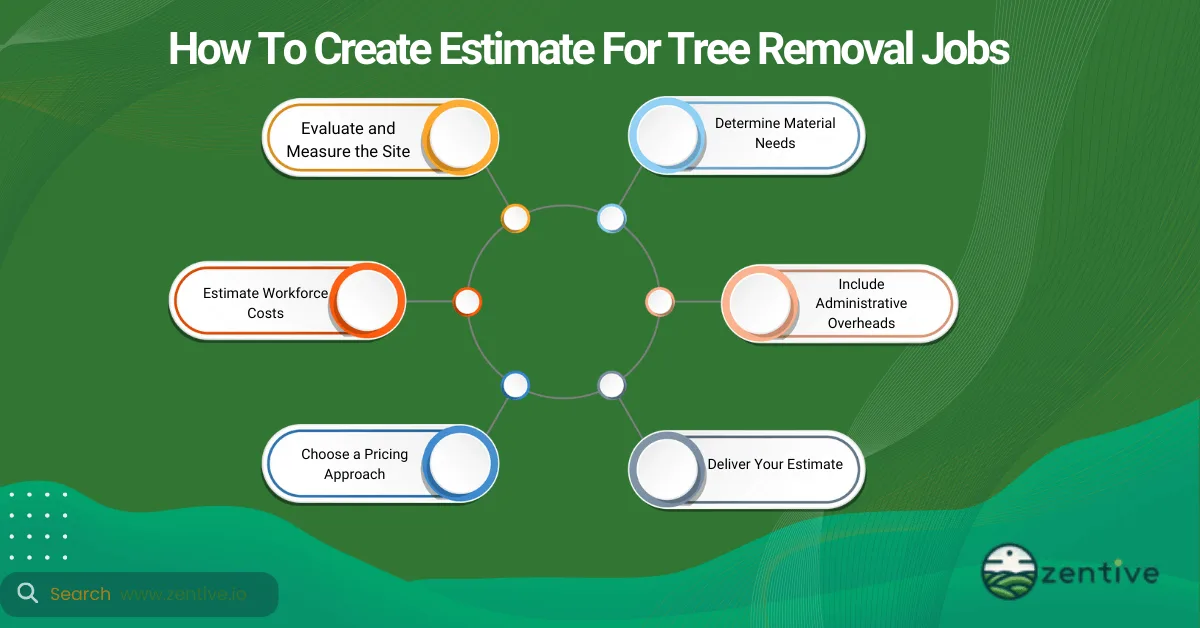
There are six steps involved in creating an estimate for tree removal jobs. The process is quite similar to learning how to price tree care jobs.
| Quoting Step | Definition |
|---|---|
| Evaluate and Measure the Site | Site evaluation measures tree size, access conditions, and job complexity. |
| Determine Material Needs | Material determination identifies equipment, fuel, and supplies required for the job. |
| Estimate Workforce Costs | Workforce cost estimation calculates labor hours and employee wages. |
| Include Administrative Overheads | Administrative overheads account for insurance, licensing, and operating expenses. |
| Choose a Pricing Approach | Pricing approach selection defines fixed, hourly, or per-foot job pricing. |
| Deliver Your Estimate | Estimate delivery presents the final quote clearly to the customer. |
1. Evaluate and Measure the Site
Before you can give an accurate estimate, it's important to visit the site and assess the tree's condition and surroundings. A site visit allows you to examine key factors, such as the height and diameter of the tree, which significantly impact the time and resources needed for removal.
Additionally, check for the proximity to structures, utilities, and roads—trees near power lines or buildings complicate the job and increase costs. Lastly, don't forget to identify potential hazards, like damaged limbs or unstable soil, that could require additional precautions.
2. Determine Material Needs
Once you've assessed the site, the next step is determining the necessary materials and equipment. You'll need to estimate the tools and machinery required, such as chainsaws, cranes, or stump grinders.
Depending on the size of the tree and the job, you may need to plan for debris disposal—removing all the branches and logs adds to the final cost. Identify any other material requirements, such as protective gear or specialized cutting tools, and factor them into your estimate.
3. Estimate Workforce Costs
Manpower is another key factor in your estimate. You need to determine the crew size and skill levels based on the job's complexity. Some trees require a larger crew or specialized workers (like climbers or certified arborists).
Then, calculate the hours needed per task—from cutting down the tree to cleaning up afterward. You can use labor cost formulas - the number of hours x hourly wage of each crew member - to arrive at a precise estimate. Don't forget to include costs for specialized labor, like handling hazardous trees or working in hard-to-reach areas.
4. Include Administrative Overheads
Administrative costs are often overlooked but can eat into your profits if not factored into the estimate. Insurance and permits may be required for certain jobs, especially in urban areas, and these need to be included.
You should account for transportation and logistics costs, mainly if the site is far from your headquarters. Finally, don't forget about billing, management, and office expenses—these might seem minor but can add up over time.
5. Choose a Pricing Approach
Now comes the decision: should you charge hourly or flat rates? Both have their pros and cons, but it largely depends on the complexity of the job. Flat rates are easier to quote and can help customers feel more secure, but hourly rates can be useful for unpredictable or lengthy jobs.
Make sure to include a contingency for unforeseen issues, such as hidden roots or bad weather, and ensure that your pricing guarantees profitability without overcharging.
6. Deliver Your Estimate
Finally, provide a clear, detailed breakdown of your estimate. This should include labor costs, material needs, and any other expenses like debris removal. Be sure to outline the timeline for the job and specify payment terms to avoid confusion. Don't forget to mention any guarantees or conditions for the job.
Tree quoting software, like Zentive, can help you streamline this process and present a professional estimate quickly. Zentive makes it easy to estimate jobs through its automated software and professional tree service estimate template that includes all the factors that affect the price of tree removal jobs.
What Factors Affect Price Of Tree Removal Jobs?
Six factors affect the price of tree removal jobs.
- Tree Size (Height and Diameter): Larger trees cost more to remove because they require more labor and equipment.
- Tree Species: Some species, like oaks or pines, are harder to remove and have higher removal costs.
- Tree Condition: Dead or diseased trees require additional care or present hazards, increasing the price.
- Location and Accessibility: If the tree is located near structures or power lines, or if it's hard to reach, the complexity (and cost) of the job increases.
- Complexity of the Job: Hazardous or emergency removals typically involve more time, care, and special equipment.
- Disposal and Cleanup: Removing the tree is only half the job—hauling away debris can add to the total cost.
What Are Business Expenses For Tree Removal Jobs?
Business expenses for tree removal jobs include material and labor costs, equipment, transportation, and business overhead.
Material costs include chainsaw lubricant and materials you require to perform the tree removal. Labor costs are the wager for your crew, office workers, and, if needed, specialized workers, like certified arborists. Equipment is usually chainsaws, stump grinders, and safety equipment, but it can be purchasing or renting machinery like cranes or wood chippers.
Transportation costs are the fuel and vehicle costs of getting your team and equipment to and from the job site, as well as the costs incurred for removing debris. The last cost is business overhead, including insurance, office costs, permits, and other administrative expenses.
What Landscaping Services Are Related To Tree Removal?
The below tree services are related to tree removal on your property.
Tree trimming involves pruning branches to improve tree health or aesthetics. Stump removal means extracting the tree stump to clear the space completely. Arborist reports are the professional assessment of tree health and recommendations.
Tree transplant means to relocate a tree to another part of the property. Wood chipping involves breaking down the removed tree into chips for mulch or disposal.
These are only a handful of the list of different tree services that are related to tree removal, but most tree care businesses focus on these services as they have the highest demand.
What Is Tree Trimming?
Tree trimming involves pruning branches to improve the tree's health or appearance. It's often done before tree removal to make the job easier. The cost of tree trimming tends to be affordable, but the cost can quickly shoot up if the tree is large.
What Is Stump Removal?
Stump removal involves extracting the leftover tree stump after the tree has been cut down. It's often necessary to avoid tripping hazards, prevent the spread of diseases from dead roots, or clear space for construction. The cost of stump removal is more expensive than trimming but can vary depending on the stump size and the method used (grinding vs. full extraction).
What Are Arborists?
An arborist is a professional who specializes in the care and maintenance of trees. Arborists are often called in to assess trees before removal or to recommend the best care strategies for preserving tree health. The cost of arborist services is expensive, but it's worth it for trees that require special attention.
What Are Tips For Pricing Tree Removal Jobs?
The three main tips for pricing tree removal jobs involve using tree quoting apps, calculating time precisely, and sidestepping frequent challenges.
You should use apps like Zentive to make the quoting process more efficient and reduce human errors. Ensure you accurately calculate the time needed to remove the tree. Don't rush your estimate—account for all tasks involved, from cutting down the tree to cleaning up the debris.
Finally, avoid common pitfalls like underestimating job complexity or failing to account for hidden costs - that's why a contingency fund is so important.
How Does Arborist Software Help Quoting Tree Removal Jobs?
Arborist software, like Zentive, makes quoting tree removal jobs easier by automating much of the process. An estimating software for tree service helps you generate accurate estimates quickly, keeps track of costs, and ensures that your pricing is fair and profitable regarding competitor pricing and your profitability terms.
What Is Average Time It Takes To Remove A Tree?
The average time to remove a tree depends on its size and location, but it usually takes between 2 to 6 hours. Larger trees in hard-to-reach areas might take longer, especially if special equipment is required.
The best approach would be to use a tree removal cost calculator to help you accurately calculate the time needed to remove a tree and the estimated cost.
What Are The Biggest Issues With Estimating Tree Removal Jobs?
The biggest issues with estimating tree removal jobs are underestimating job complexity, ignoring hidden costs, and failing to account for risks.
Underestimating job complexity involves not accounting for hidden roots or unstable soil, which can make the job more difficult and increase the cost of the tree removal job.
Ignoring hidden costs is another issue, but it's a rookie mistake. As you grow in experience, you'll learn to naturally account for hidden costs like debris removal and permit fees. The last one is failing to account for risks, meaning overlooking potential hazards, like nearby power lines or structures. It can hike up costs if you only realize the hazards too late.
Get This Guide as a PDF
Save this article for offline reading. We'll send a formatted PDF straight to your inbox.
No spam. Unsubscribe anytime.
Ready To Streamline Your Field Service Business?
Zentive is the all-in-one field service management software built for landscaping, lawn care, tree care, and snow removal businesses. Start your free trial today.
No credit card required · Cancel anytime