
The landscaping industry is a sector in the field service industry and involves the design, installation, and maintenance of outdoor spaces. Landscaping services include hardscaping, softscaping, lawn care, tree trimming, and garden maintenance. Landscaping services fall under Industry 561730 and are part of the green industry.
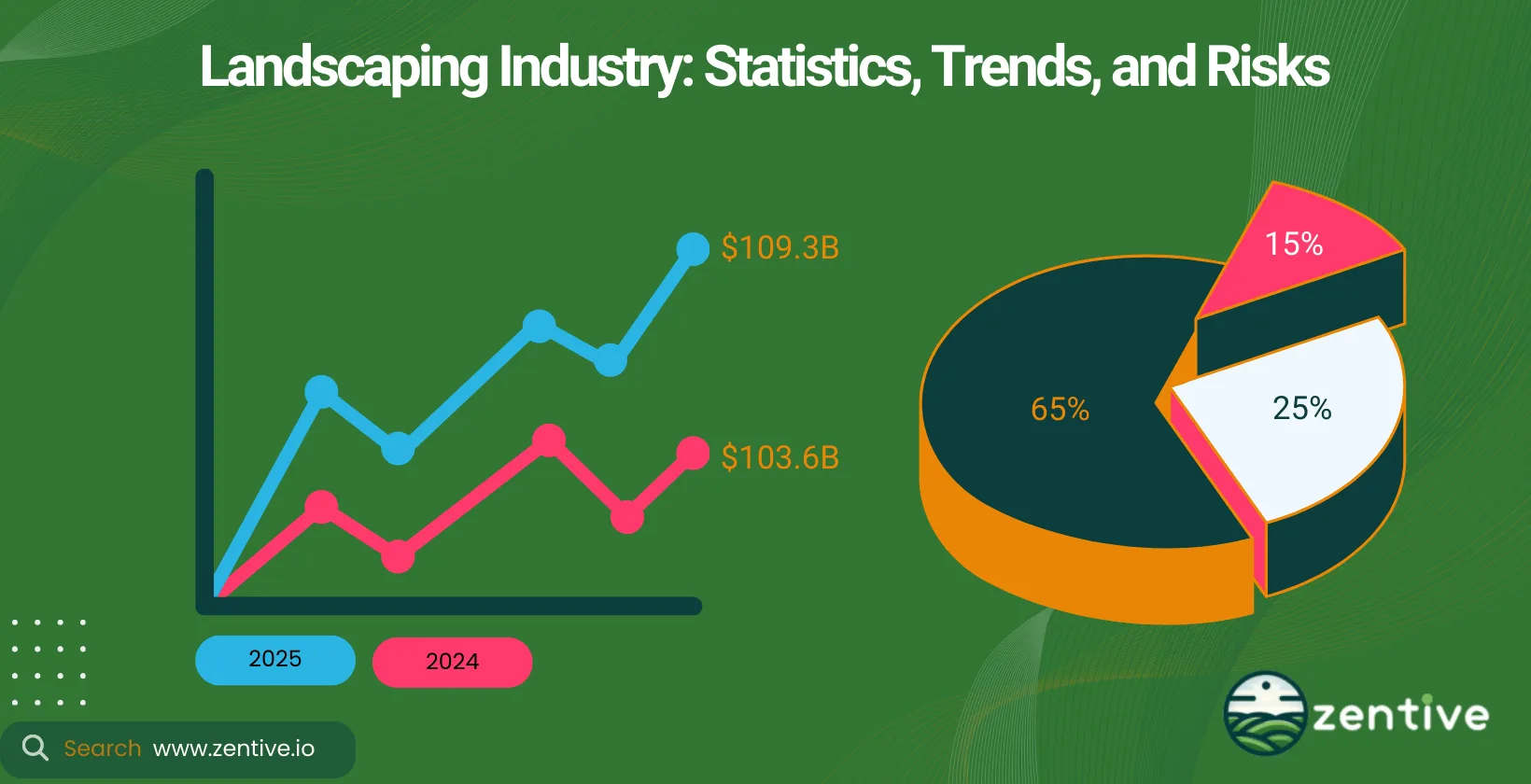
As a landscape business owner, you should know the latest trends and statistics in landscaping. This helps you stay competitive and adapt to market changes, helping your business grow and increase revenue. According to IBISWorld, the landscaping industry has experienced an annual growth rate of 4.2% from 2017 to 2022 and an annual growth rate of 8.2% over the past three years (Kentley Insights).
These stats can help you start if you're thinking of starting a landscaping business. We’ll cover key categories of landscaping industry statistics, including market size and growth, financial performance, customer demographics, environmental impacts, and labor metrics.
Landscaping Market Statistics
In the market statistics category, there are six landscaping market trends and statistics you need to watch closely.
- Industry Growth Rate: The landscaping industry has seen an annual growth rate of 8.2% over the past three years (Kentley Insights). The industry is expected to grow at an annual rate of 3.89% over the next five years (Mordor Intel).
- Market Size: In 2023, the landscaping industry had a market value of 153.56bn (Statista) and is expected to grow to 221.19bn in 2029 (Mordor Intel).
- Market Demands and Trends: More and more people are switching to Xeriscaping, an eco-friendly landscaping practice that reduces or eliminates the need for irrigation. Meanwhile, 83% of landscaping clients want indigenous plant species on their properties (ScottMax).
- Service Popularity: 80% of landscaping companies are structured around providing general landscape maintenance - lawn care, leaf removal, hedge, and tree trimming, etc. 90% of the North American landscapers offered lawn care and application, while 70% offered weed control. Additionally, 71% of all landscapers provide design and construction services (Statista).
- Market Segmentation: The majority (59%) of clients are residential homeowners from single-family residential homes, while 24% are commercial, 11% multi-family residential, 5% government, and 1% other customers (Mordor Intel).
- Competitive Landscape: The top American landscaping companies hold less than 10% of the total market share. See the latest revenue, workforce, and service data in our 2026 ranking of the largest landscaping companies.
Landscaping Financial Statistics
The landscaping financial statistics showed some impressive results. Here, we'll look at five key statistics.
- Average Revenue: On average, a landscaping company in the U.S. generates approximately $384,000 in revenue annually (IBISWorld). However, in 2022, the average sales generated from landscaping companies were $1.1 million, with 65% of businesses earning more than $1 million per year (Kentley Insights). The average cost per project was $8,150 (Ruby Home), and landscapers charge $50 to $100 per hour.
- Profit Margins: The gross profit margin for landscaping businesses typically ranges from 45% to 55% (IBISWorld). The net profit margin for landscaping companies usually falls between 5% and 12%, varying based on the scale and efficiency of the business (DynaScape).
- Cost Structure: Labor is the largest expense, accounting for about 45% to 55% of total operating costs (IBISWorld). The rest of the expenses, mentioned from greatest to smallest expense, include materials, equipment, and marketing.
- Investment Returns: Return on investment (ROI) is around 20% to 25% for significant capital expenditures like new equipment and technology enhancements (IBISWorld).
- Pricing Models: Landscapers generally offer types of pricing models: hourly rates ($50 to $100 per hour), project-based pricing ($4 to $12 per square foot), and service packages ($300 per month) (Homeguide).
Landscaping Customer Statistics
The next statistic is landscaping customer statistics, which include customer demographics, satisfaction levels, retention rates, acquisition rates, and service renewal rates.
- Customer Demographics: The majority of landscaping customers are homeowners aged 35-64. Most landscaping businesses are concentrated in states like California, Florida, and New York (Mordor Intel). Meanwhile, 59% of landscaping clients are single-family homes (Mordor Intel).
- Customer Satisfaction Levels: This is difficult to determine as you don't find net promoter scores (NPS) data readily available, especially for the landscaping industry. However, 78% of landscaping businesses met or exceeded their revenue goals for 2023, indicating that clients are happy with their landscaping experiences (Landscaping Management).
- Customer Retention Rates: Again, we can look at the metric of 78% of landscaping companies who met or exceeded their revenue goals for 2023, which implies a high customer retention rate.
- Customer Acquisition Costs (CAC): CAC varies on the marketing strategy a landscaping business uses, be it referrals, social media, or local SEO. However, this cost is very low for the landscaping industry, less than $500.
- Service Renewal Rates: Service renewal rates in the landscaping industry are very high, especially for general lawn care maintenance.
| Marketing Channel | Average Customer Acquisition Cost (CAC) |
|---|---|
| Referrals | $50 |
| Social Media | $150 |
| Local SEO | $200 |
| Paid Advertising (e.g., Google Ads) | $400 |
Environmental Landscaping Statistics
More and more people are becoming environmentally conscious, which means the landscaping and lawn care industry has to adapt to this new trend. Here are five statistics that highlight this trend.
- Water Conservation: Efficient landscaping practices, such as drip irrigation and the use of native plants, save significant amounts of water. Water-efficient landscapes can reduce water usage by up to 50% compared to traditional lawns (EPA) (US EPA) (NREL.GOV).
- Use of Eco-friendly Materials: Approximately 30% to 50% of materials used in sustainable landscaping projects are organic, sustainable, or eco-friendly (EPA).
- Carbon Footprint Reduction: Environmentally friendly landscaping practices can significantly reduce carbon emissions. For example, the use of WaterSense-labeled products and efficient irrigation systems in landscaping can help avoid nearly 331,000 pounds of carbon dioxide emissions annually in certain communities (EPA) (US EPA).
- Biodiversity Impact: Native plants provide essential habitats and food sources for local wildlife, including pollinators like bees and butterflies. Studies have shown that incorporating native plants can increase local biodiversity by up to 50% (Sustainably Forward; NALP).
- Waste Reduction: Sustainable waste management practices in landscaping, such as composting and recycling, can reduce waste by up to 40% (EPA).
Employee and Labor Statistics For Landscapers
Employees are the lifeblood of the landscaping services industry. Without them, the services won't be able to be done. Here are six pertinent statistics to the employees in the landscaping industry.
The landscaping industry is a significant employer and offers various roles, from general labor to specialized positions. Here are key statistics on employment numbers, wages, safety, turnover, training, and employee satisfaction in the landscaping sector.
- Employment Numbers: At the end of 2022, there were approximately 1,281,600 people employed in the landscaping and groundskeeping industry in the United States (U.S. Bureau of Labor Statistics).
- Average Wages: Landscapers and technicians earned a median wage of $17.96 per hour, $37,360 annually in 2023 (ONetOnline). Landscaping managers and supervisors earned higher wages, around $50,000 annually (IBISWorld).
- Safety and Accident Rates: Although the safety and accident rate in the landscaping industry is relatively high, few of these cases actually get reported. In 2019, only 12,400 workers were so injured that they required time away from work (BLS.GOV). And, in a decade (2011 to 2021), only 1,072 fatal instances occurred (OSHA.GOV).
- Employee Turnover Rate: Retention rate is a major concern in the landscaping industry. 51% of landscaping companies state that they struggle with labor and 89% of companies said they will have to hire new landscaping employees in the following year (Landscape Professionals).
- Training and Certification: Around 36% of landscaping and groundskeeping workers report having at least a high school diploma. (Thimble).
- Employee Satisfaction: Job satisfaction levels are fairly mixed, as evidenced by the 51% labor challenge statistic mentioned earlier. However, landscape business owners should do more, especially with human resource structures, with 63% lacking a recruiting and retention strategy, 79% without a documented career ladder, 45% missing an organizational chart, 46% without a safety training program, 48% not conducting weekly safety meetings, and 88% lacking an apprenticeship program (Golmn).
What Are the Current Landscaping Industry Trends?
There are three main landscaping industry trends that landscapers should watch. The first major trend is the shift to eco-friendly practices like Xeriscaping, reducing irrigation needs, and supporting native plants, which 83% of landscaping clients prefer.
Another trend is the increasing demand for maintenance services, with 80% of companies offering general maintenance and 71% providing design and construction services.
Lastly, landscaping businesses have begun seeing the value of technology. More and more landscaping businesses have started using business management software. This software is largely responsible for allowing smoother operations, boosting customer service, and managing employees more efficiently, all in an attempt to boost revenue and cut costs.
| Trend | Description |
|---|---|
| Eco-friendly Practices | There is a significant shift towards eco-friendly landscaping practices, such as Xeriscaping and using native plants to reduce irrigation needs. According to surveys, 83% of landscaping clients prefer environmentally sustainable options. These practices not only conserve water but also promote biodiversity and reduce maintenance costs. |
| Increased Demand for Maintenance Services | The demand for landscaping maintenance services is on the rise. Currently, 80% of landscaping companies offer general maintenance services, and 71% provide design and construction services. This trend highlights the importance of ongoing upkeep and professional management of landscaped areas to maintain their aesthetic and functional value. |
| Adoption of Technology | Landscaping businesses are increasingly recognizing the value of technology in their operations. The adoption of business management software has become prevalent, enabling smoother operations, improved customer service, and efficient employee management. This technology helps businesses boost revenue and cut costs by optimizing workflows and enhancing communication. |
What Are the Biggest Software Trends in the Landscaping Industry?
There are two major software trends in the landscaping industry. Landscape business management software is the first trend. This software manages scheduling, routing, client contact (quotes, invoices, follow-ups), and inventory. It improves accuracy, reduces admin tasks, and enhances customer satisfaction. Companies using it see at least a 30% increase in productivity (Method.me).
The second trend is 3D Design Software. Through this software, landscapers create detailed models of proposed designs, improving client communication and decision-making. Projects using 3D design software have a 25% higher approval rate (Linearity).
As a landscape business owner, it's important that you keep up with these trends to avoid falling behind competitors.
What Are the Largest Risks to the Landscaping Industry?
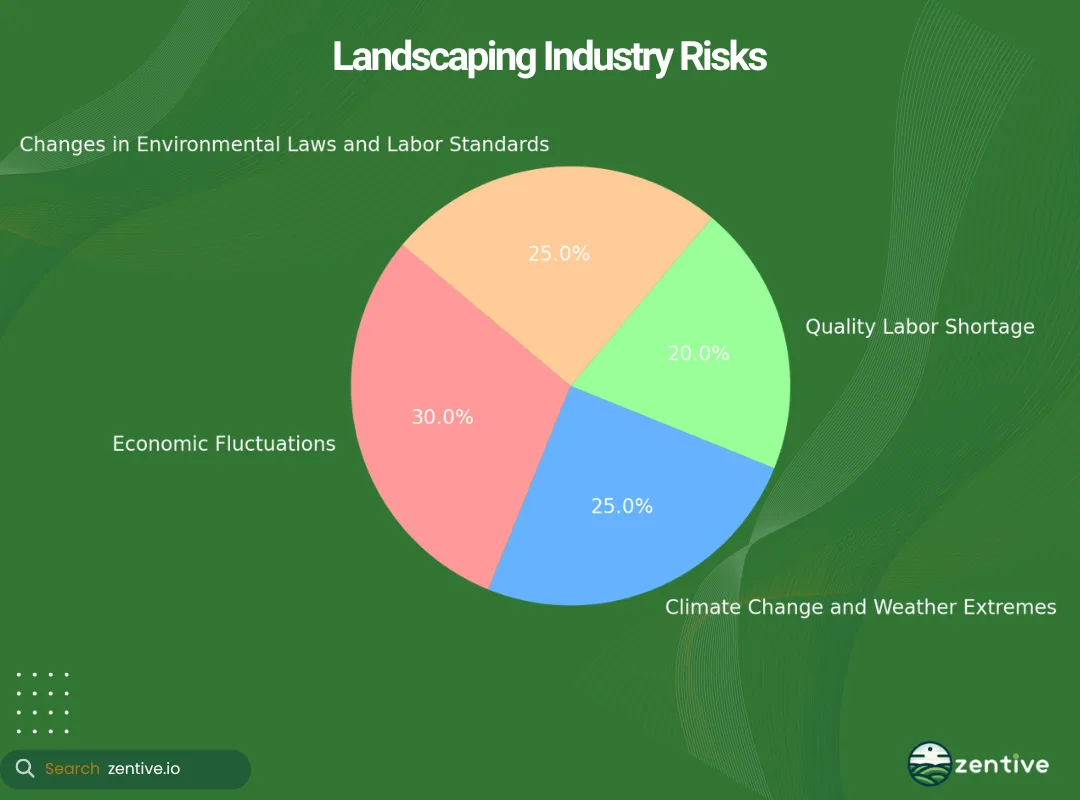
The landscaping industry has several risks, as do all businesses. The most prevalent risk is economic fluctuations, as we saw during the 2008 financial crisis and again in 2020 during the COVID-19 pandemic. During an economic downturn, people are less likely to pay for services such as landscaping.
Climate change and weather extremes are other major factors. After all, you can't mow the lawn when there are thunderstorms and the lawn is drenched. Dartmouth estimates that weather-related disruptions can reduce annual revenue by up to 10% for most types of businesses, and this statistic may even be more significant in the landscape industry.
Quality labor shortage is a major issue in the service industry, with 51% of companies reporting difficulties. High turnover and a lack of training programs further worsen this issue.
Changes in environmental laws and labor standards can pose compliance challenges. Non-compliance can lead to fines and reputational damage, highlighting the need for proactive management. These non-compliance issues are especially significant for new landscaping company owners.
What Risks Do Landscapers Face When Starting a Company?
As with any business, starting a new landscaping company will always involve risks. The BLS estimates that 20% to 30% of new companies fail within their first year. There are several reasons for this high number. The most significant risk of opening a landscape business is financial risk. Initial capital investments and cash flow challenges are the main challenges. Statistics show that 45% of small businesses fail within five years due to financial mismanagement.
Client acquisition is another risk—without new clients, you can't generate revenue. This is why a good business plan is so important—it gives you the knowledge of what types of clients your business needs and how to attract them.
Operational challenges are another risk. Managing operations efficiently is challenging for new businesses because of a lack of experience. This includes scheduling, supply chain management, and ensuring service quality. The best way to mitigate operational challenges is to have an advisor who knows everything the landscaping industry encompasses, including commercial properties and residential outdoor landscaping activities. Consider landscape management software to help make day-to-day operations more efficient.
Get This Guide as a PDF
Save this article for offline reading. We'll send a formatted PDF straight to your inbox.
No spam. Unsubscribe anytime.
Ready To Streamline Your Field Service Business?
Zentive is the all-in-one field service management software built for home service and field service businesses. Start your free trial today.
No credit card required · Cancel anytime