
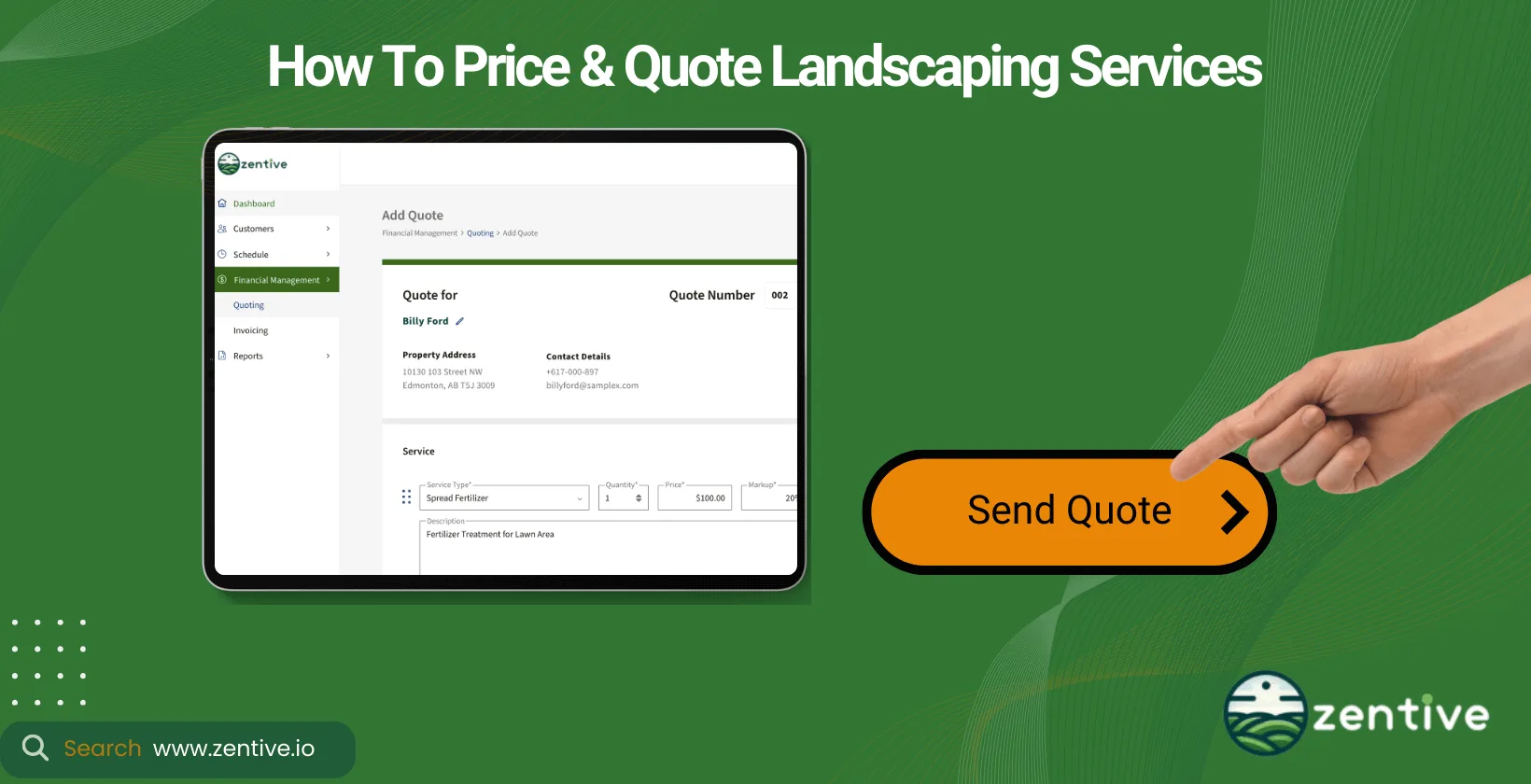
Quotes are essential for winning landscaping jobs. They need to be accurate and competitive so your landscaping services stand out from the competition. A challenging part of creating a quote is determining pricing. Landscapers determine pricing for a landscaping job through a comprehensive assessment of project scope, material costs, labor, and overhead expenses to ensure profitability while remaining competitive.
Landscapers often generate quotes manually by writing them or using a generic word template. Business management software can generate landscaping quotes, offering comprehensive quoting solutions that simplify estimation and quoting.
Automation allows landscapers to quickly generate accurate quotes, saving time and reducing errors. This boosts operational efficiency and improves customer satisfaction.
This guide explains how to price landscaping jobs, outlines the steps for accurate pricing, and discusses the benefits of leveraging technology. Use our free quote template & landscaping pricing calculator below.
Zentive Landscaping Pricing Guide Calculator
$
%
$
$
%
%
%
Formula: Price = Cost ÷ (1 − Margin)
Business cost per man-hour
Suggested price per man-hour
Labor (incl. burden)
Materials + Equip/Subs
Overhead + Contingency
How this works (quick view)
Labor = Hours × Crew × Wage × (1 + Labor Burden).
Direct Costs = Labor + Materials + Equipment/Subs.
Overhead = Overhead% × Direct Costs. Contingency = Contingency% × Direct Costs.
Cost Basis = Direct Costs + Overhead + Contingency.
Suggested Price = Cost Basis ÷ (1 − Profit Margin%).
Price / Man-Hour = Suggested Price ÷ (Hours × Crew).
How To Price Landscaping Jobs?
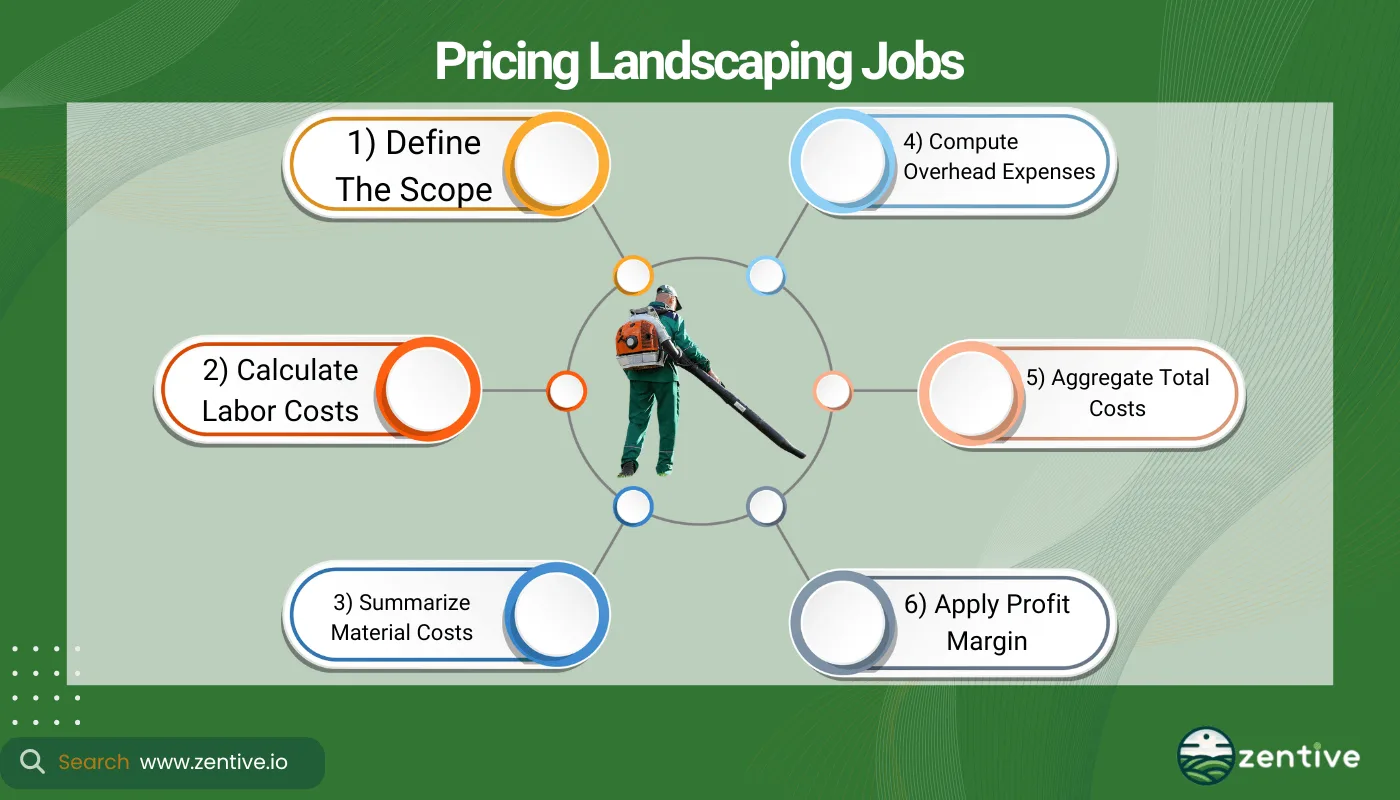
There are six steps involved when pricing landscaping jobs.
- Define The Scope: Clearly outline the project's tasks, deliverables, and boundaries.
- Calculate Labor Costs: Determine the total wages based on hours required and labor rates.
- Summarize Material Costs: Tally the expenses for all supplies and materials needed.
- Compute Overhead Expenses: Include indirect costs like equipment, insurance, and utilities.
- Aggregate Total Costs: Combine labor, material, and overhead costs into one overall figure.
- Apply Profit Margin: Add a percentage to the total cost to achieve your desired profit.
1. Define The Scope
Defining the project scope in a landscaping project involves establishing the specific boundaries, goals, tasks, and deliverables that the project will encompass. The foundation of any landscaping job is a clear understanding of its scope.
Landscapers need to conduct a thorough site visit and assessment. This will allow you to evaluate the area's specifics, such as soil type, existing vegetation, and topography, which can significantly influence the project's requirements.
Identify the exact tasks—be it mulching, lawn care, planting, hardscaping, or lighting—after visiting the site. Remember, a well-defined scope ensures both you and your client are on the same page from the start.
2. Calculate Labor Costs
Calculating labor costs means understanding the amount you pay to cover your employee's wages. Labor costs comprises a significant part of your quote. You can calculate labor costs by multiplying the hourly wage by the number of hours the project is expected to take.
It's very important that you accurately estimate labor hours, considering the complexity of the tasks and the team's efficiency, as this will significantly impact your profitability. This step requires a deep understanding of the tasks at hand and the average wage range for landscape contractors, which usually ranges from $10-$20 for an average hourly wage, sometimes even $30, or $30,000 to $46,000 per year.
Try Our Free Man-Hour Pricing Calculator
Calculate your true cost per man-hour and set profitable rates for your landscaping jobs.
Open Calculator3. Summarize Material Costs
Every landscaping project requires materials, from plants and stones to mulch and gravel. Accurately estimating these costs is crucial to a comprehensive quote.
I suggest you get quotes from third-party suppliers and secure those quotes before you give your final quote to the client, as it will ensure your quote's accuracy. Remember to include delivery charges, which can eat away at your profit if you don't include them when you estimate landscaping jobs.
4. Compute Overhead Expenses
Overhead expenses include all the indirect costs of running your business, from utilities and office expenses to equipment depreciation and insurance. It's important to calculate these expenses, be it weekly overhead cost or monthly, as they can eat away at your profit, and people often forget to factor them into their quotes.
Don't overlook project-specific overheads, like the rental costs for specialized equipment, such as an excavator.
| Overhead Expense | Description/Considerations |
|---|---|
| Equipment Depreciation & Maintenance | Costs for regular servicing, repairs, and eventual replacement of mowers, trimmers, and other tools |
| Fuel Costs | Fuel expenses for operating equipment and vehicles during lawn maintenance |
| Insurance | Premiums for liability, worker's compensation, and vehicle insurance to protect your business |
| Vehicle Expenses | Maintenance, fuel, and depreciation costs for service vehicles used on job sites |
| Office & Administrative Costs | Overhead for office supplies, utilities, communication, and software needed for operations |
| Marketing & Advertising | Expenses for promotional materials, online ads, and website maintenance to attract customers |
5. Aggregate Total Costs
Cost aggregation is the process of estimating a project's total cost by combining the individual cost estimates of its activities, work packages, or deliverables. Aggregate your labor, material, and overhead costs to determine the project’s total cost once they are calculated.
Every project, be it landscaping or home renovation, has unexpected expenses, which is why you should add a contingency fund. Including a contingency fund is a prudent practice to cover unexpected costs or overruns, ensuring your quote is both competitive and realistic. You can always refund the client the contingency fund if you don't use it.
6. Apply Profit Margin
Profit margin is the percentage of revenue that remains after all the expenses of the landscaping job, including overhead expenses and taxes, have been deducted from the revenue. It measures your landscaping company's profitability and efficiency in utilizing its resources.
The average profit margin for different landscaping services varies depending on the services offered and the business size. For instance, lawn care and maintenance services typically have lower profit margins due to dead man hours and windshield time. In comparison, landscaping and hardscaping services have higher profit margins as they involve time and materials, which can be charged to the client.
Generally, a profit margin between 25-30% is common in the landscaping industry, but it can vary depending on your services. For example, let's say you do a simple lawn mowing job. It may cost $50 in labor and $25 in supplies and generate $100 in revenue, resulting in a profit margin of 25%. However, a larger job may cost $2,500 in labor and $250 in supplies and generate $3,000 in revenue, resulting in a profit margin of 8%
How To Quote Landscaping Jobs
A landscaping quote is a document that outlines the estimated costs and services for a landscaping project. Landscaping management software like Zentive helps automate the process of creating quotes by providing pre-built templates and allowing for easy customization.
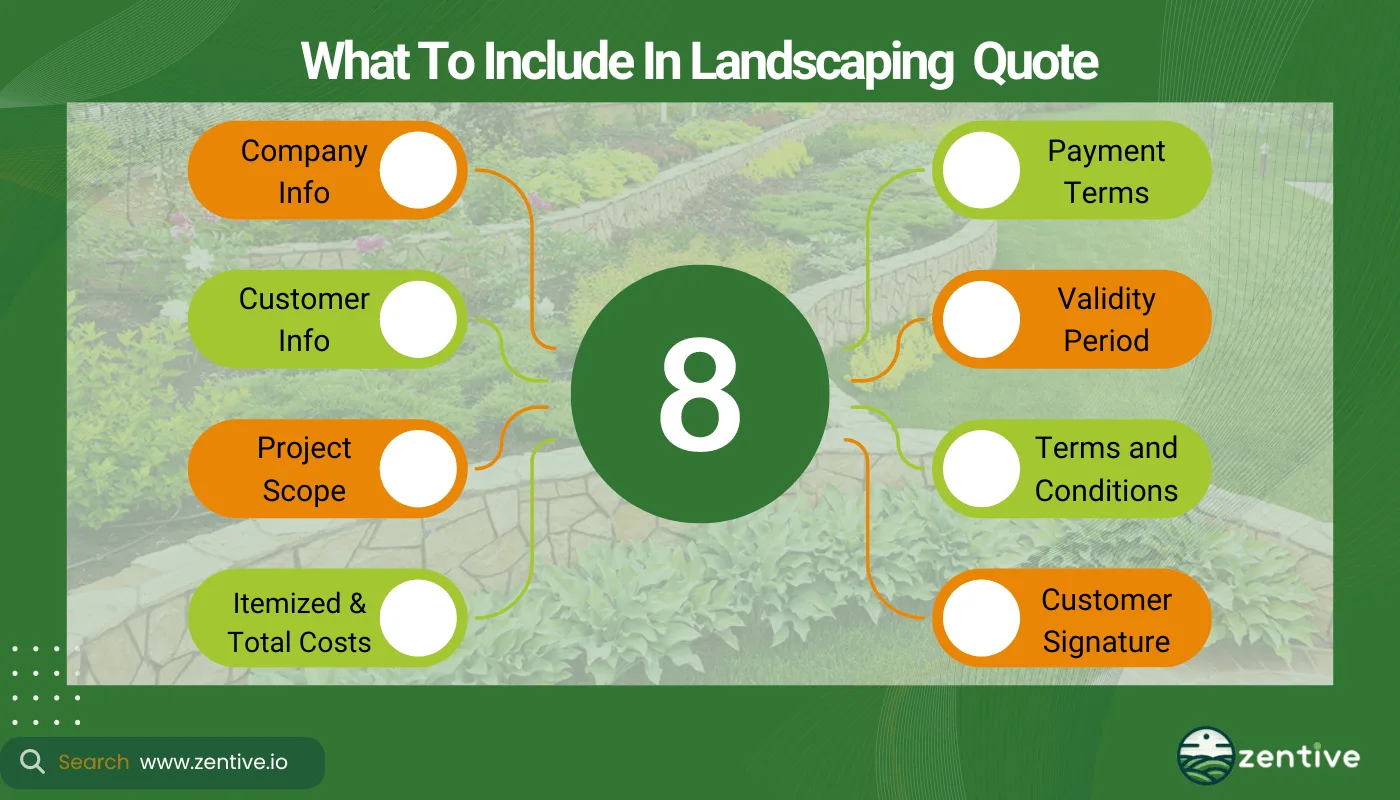
Here is an 8-step instructional list of the items you should include in a landscaping estimate.
- Landscape Company Information: The name of your landscaping company, contact details, and logo of your landscaping business.
- Customer Information: The client's name, address, and contact information.
- Project Scope Description: A detailed outline of the services to be provided.
- Itemized & Total Costs: A breakdown of all costs, including labor and material costs and any additional charges, alongside the total cost.
- Payment Terms: How and when payments should be made, including any deposit required.
- Validity Period: How long the quote is valid for, prompting timely decisions.
- Terms and Conditions: Any legal stipulations or service conditions.
- Customer Signature Lines: Space for the client to sign, indicating acceptance.
Free Landscaping Quote Template
We have a free quote template that you're more than welcome to download and use. It's tailored for the landscaping industry, so you don't have to make any adjustments. You only have to include the information above.
Why Use A Landscaping Quoting Software?
Use a landscape business management software like Zentive to increase its profitability and reduce operational costs for your business. Landscaping business management software is a type of software that optimizes the operational aspects of your landscaping business.
Zentive includes landscaping quoting software, allowing you to automate the quoting process and saving you time. It increases the accuracy of your quotes by reducing the errors in cost calculations.
Landscaping quote generators like Zentive can generate quotes for different landscaping services - lawn care, hardscaping, snow removal, softscaping, etc. This allows you to generate different types of quotes depending on the service you're offering on any given day.
How To Create Landscaping Estimates With Software?
Creating landscaping estimates with software is very straightforward and only requires five simple steps. Let's say you have a lawn care business and want to use landscaping job management software to create an estimate; then you'll need to do the following.
- Select the Service Type: Choose a service, like lawn care, to start creating an estimate. We've already done the first.
- Input Project Details: Enter details about the project and the client, such as project duration and project location. Basically, it's everything the software requires to generate the labor costs and project-specific overhead costs.
- Add Services and Materials: Itemize the required services and materials using the software's database or third-party quotes for accurate pricing.
- Adjust and Review: Fine-tune the pricing and details, then review the estimate for accuracy.
- Send to Client: Share the estimate with the client directly from the software.
How To Quote Different Landscaping Services?
Quoting varies across different landscaping services. All landscaping services have expenses that need to be paid and profit that needs to be generated. You can offer roughly 21 landscaping services, and each won't have the same profit margin, but every service will incur expenses, including materials, labor, and equipment.
How To Price Mulching Jobs
Pricing for mulching jobs is determined by the type and volume of mulch needed, the area to be covered, and the labor involved in applying the mulch. Consider the cost of the mulch per cubic yard, the area’s size, and the time required when pricing mulching jobs.
How To Price Tree & Flower Planting Jobs?
Tree and flower planting jobs are priced based on the plants' cost, the planting's complexity (including soil preparation and the depth of planting), and any follow-up care or maintenance included. To price planting jobs, consider the selection of plants, the labor involved, and any special care or equipment needed.
What Are The Types Of Landscaping Quotes?
There are two types of landscaping quotes: hourly and fixed costs. Hourly quotes are based on the estimated hours of labor required to complete a job multiplied by the hourly rate. You often use this type of quote for services where the project scope may evolve or is not clearly defined at the outset.
Fixed-cost quotes provide a single price for the entire project based on a detailed assessment of the work to be done, materials needed, and labor. This quote type offers your clients a clear understanding of the total cost, assuming the project scope does not change significantly.
The types of landscaping businesses (commercial vs. residential) and the services offered greatly influence the quoting process. Commercial landscaping jobs, such as office parks or hotels, prefer fixed-cost quotes due to their scale and the need for precise budgeting. Residential landscaping jobs, especially smaller, more variable tasks, may utilize hourly quotes to accommodate the flexibility often required by homeowners.
It's important to note that the type of landscaping services you offer affects the quoting process. Some projects evolve over time, which means they require a different quoting process than a once-off simple landscaping service.
| Aspect | Hourly Cost Quotes | Fixed Cost Quotes |
|---|---|---|
| Definition | Charges based on the number of hours worked, multiplied by an hourly rate. | A single, predetermined price for the entire project, regardless of the time taken. |
| Cost Predictability | Less predictable, as the final cost depends on the actual time spent on the job. | More predictable, as the total cost is known upfront before the work begins. |
| Flexibility | More flexible for projects where the scope may change or is uncertain. | Less flexible, as any changes or additions to the project may require renegotiation. |
| Client Preference | Preferred by clients who want to pay only for the actual time worked. | Preferred by clients who want to know the total cost upfront, avoiding surprises. |
| Risk | Risk is primarily on the client, as more time spent means higher costs. | Risk is primarily on the contractor, as unforeseen issues could impact profitability. |
| Suitability | Best suited for smaller, less defined, or ongoing maintenance projects. | Best suited for well-defined projects with a clear scope and timeline. |
How To Quote Commercial Landscaping Customers?
To quote for commercial landscaping customers involves understanding the scale and specific needs of businesses like office parks, hotels, and retail complexes. These clients typically require comprehensive landscaping services that maintain or increase their property's aesthetic and functional value.
Provide a detailed, fixed-cost quote covering the entire scope of work to get more commercial landscaping contracts. Your quote should clearly state the frequency and type of services offered.
How To Quote Residential Landscaping Customers?
Quoting residential landscaping customers requires a personalized approach that caters to individual preferences and each property's unique characteristics.
For small landscaping jobs or larger, more involved projects, the key is to offer flexibility in quoting, with options for both hourly rates and fixed costs, depending on the project's nature and the homeowner's preference. You should provide a detailed, itemized quote that outlines the scope of work, materials, and labor costs, much like a quote for a commercial job.
How To Win More Landscaping Jobs?
You can win more landscaping jobs by conveying a message of professionalism and expertise through every interaction with the potential client, including on-site meetings, quotes, and communication via the phone. Furthermore, you should implement automated follow-ups to keep your business top-of-mind for clients and demonstrate your commitment to their projects.
It's important you follow bidding best practices to ensure you land the client rather than scare them away.
What Are Best Practices When Bidding Landscape Jobs?
There are three best practices you should learn when studying how to bid on landscaping jobs.
- Conduct a thorough site visit and assessment: Understand the specifics of the project site and client requirements, i.e., what the client wants you to do and how to do it.
- Use detailed, itemized bids: Break down costs and services to provide clear, transparent pricing. Nothing can make a client more angry than uncovering hidden costs later in the job - it's a reputation killer.
- Follow up with the client after submitting the bid: Show your engagement and readiness to adjust the proposal as needed.
Get This Guide as a PDF
Save this article for offline reading. We'll send a formatted PDF straight to your inbox.
No spam. Unsubscribe anytime.
Ready To Streamline Your Field Service Business?
Zentive is the all-in-one field service management software built for landscaping, lawn care, tree care, and snow removal businesses. Start your free trial today.
No credit card required · Cancel anytime