
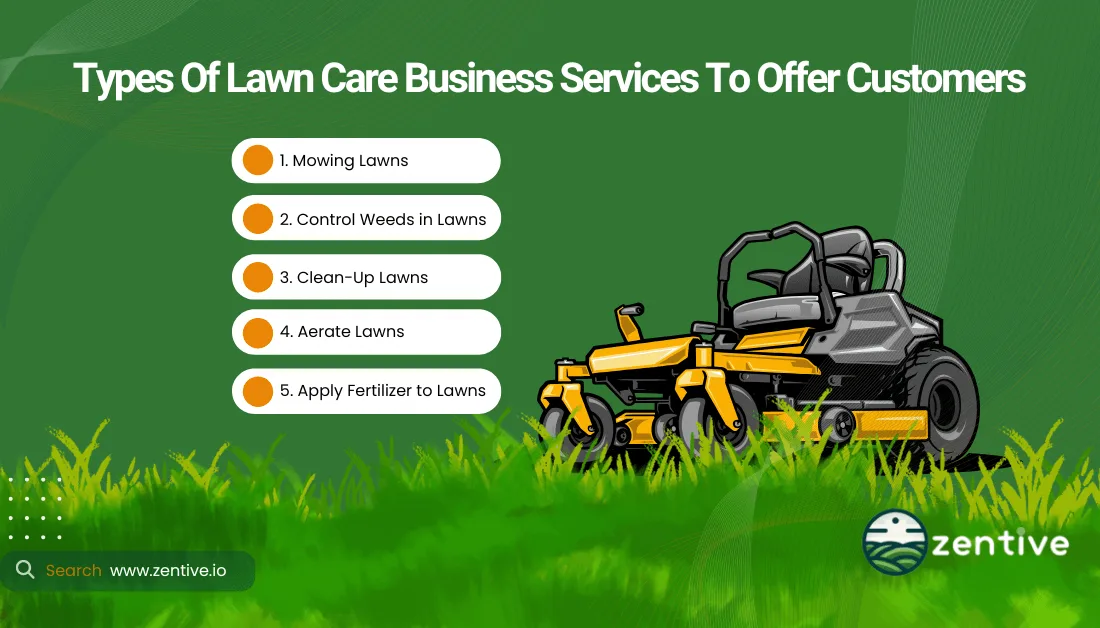
Lawn care services are the types of jobs that a lawn care management company offers to its customers. Lawn care services are means to maintain, improve, or replace certain features of the landscape for a residential or commercial customer. Examples of common lawn care services include basic mowing, fertilization, aeration, weed control, installing sod, and more.
Large national lawn care businesses like TruGreen, Weed Man, and Lawn Doctor offer a huge list of lawn services. They have the team & equipment resources to get just about any job done. Smaller lawn companies benefit from a smaller services list to decrease cost, reduce employee training, and boost worker efficency.
Choosing the best services to offer for your lawn mowing business means honestly evaluating market demand, required equipment investment, and local competition. Review our below table of 20 lawn care services your business can offer to customers.
| Service | Description |
|---|---|
| 1. Mowing Lawns | Cutting grass to a set height and clearing clippings for a neat appearance. |
| 2. Control Weeds in Lawns | Applying herbicides to eliminate and prevent unwanted weeds in turf areas. |
| 3. Clean‑Up Lawns | Removing debris and leaves from lawns to restore a tidy landscape. |
| 4. Aerate Lawns | Perforating soil to improve air, water, and nutrient flow to grassroots. |
| 5. Apply Fertilizer to Lawns | Supplying essential nutrients to promote healthy and vibrant turf growth. |
| 6. Dethatch Lawns | Removing excess thatch to improve soil aeration and moisture penetration. |
| 7. Apply Mulch to Lawns | Spreading protective material around plants to retain moisture and prevent weeds. |
| 8. Control Weeds in Flower Beds | Eliminating unwanted plants in beds to maintain clean ornamental areas. |
| 9. Install and Maintain Irrigation Systems | Designing and servicing water delivery setups for efficient landscape watering. |
| 10. Remove Leaves from Lawns | Clearing fallen foliage to prevent lawn damage and maintain aesthetics. |
| 11. Apply Pest Control for Lawns | Treating harmful insects to protect turf health and appearance. |
| 12. Seed and Overseed Lawns | Introducing new grass seed to establish or thicken existing turf. |
| 13. Test and Analyze Lawn Soil | Assessing soil nutrients and pH to guide precise lawn care decisions. |
| 14. Maintain Flower Beds | Planting, pruning, and weeding beds to keep ornamental areas healthy. |
| 15. Treat Lawn Diseases | Diagnosing and applying treatments to eliminate turf diseases. |
| 16. Apply Top Dressing to Lawns | Spreading a thin layer of soil or compost to level and enrich turf. |
| 17. Control Grubs in Lawns | Applying treatments to eliminate root‑feeding beetle larvae in turf. |
| 18. Renovate and Repair Lawns | Restoring damaged turf with grading, amendments, and reseeding. |
| 19. Install Lawn Drainage Solutions | Creating drainage systems to remove excess water and prevent pooling. |
| 20. Remove Storm Debris from Lawns | Clearing branches and debris after storms to restore safety and appearance. |
1. Mowing Lawns
Mowing lawns involves cutting grass to a specific height using a riding or push mower. Mowing includes cutting the grass, removing clippings, edging along walkways, and blowing debris from driveways. Both commercial businesses & residential homeowners get their grass weekly or bi-weekly depending on seasonality & personal preference.
Lawn care businesses need to invest in equipment such as riding mowers, push mowers, string trimmers, edgers, and leaf blowers to offer basic mowing packages. Expect to have your crews onsite for 30-60 minutes for a basic residential mow & charge between $30-80 per visit. The biggest time-saver and profit booster for mowing is route density. Use a lawn care business management app like Zentive to group multiple clients in the same neighborhoods to reduce travel time, cut fuel costs, and spend more time generating revenue.
2. Control Weeds in Lawns
Weed control eliminates unwanted weeds that can be an eyesore & competes with grass for nutrients, water, and sunlight. Lawn care professionals apply herbicides to prevent weed germination and eliminate any existing weeds. Weed control is a lower ticket service with costs ranging between $50-100 per application a few times per year. Be sure to educate your clients on realistic expectations before offering them weed control. Your crews will never achieve 100% eradication of every single weed. Emphasizes the goal is suppression and reduction, not total elimination of weed.
Upselling weed control to existing mowing customers is a great way to boost in-season revenue. Using our lawn business software Zentive, you can easily send a bulk SMS or email blast to your customer list to advertise weeding.
3. Cleanup Lawns
Lawn cleanup means removing debris, fallen leaves, twigs, and other unwanted materials from a customers property. Professional lawn management companies sell yard cleanups after storms, seasonal changes, or general periods of neglect. Commercial property owners preparing for events, selling homes, or recovering from severe weather events are common customers for lawn cleanups.
A small crew of workers armed with rakes, blowers, vacuums, tarps, and truck to haul debris can perform an average lawn cleanup in 1-3 hours. Lawn cleanups generally cost between $200-500 dollars. Price can vary significantly depending on the condition & size of your customers property. Research your local dumping & disposal fees and factor that into your lawn cleanup pricing.
4. Aerate Lawns
Aerating lawns means perforating the soil with small holes to allow air, water, and nutrients to seep down into the grass roots. Seasonal aeration helps keep your customers lawns green & healthy every year. Upsell your customers aeration in the early spring or early fall when temperatures are more moderate.
Lawn care companies need aerators, spike aerators, or liquid aeration tools to offer this service. It takes 30-60 minutes on average to aerate residential lawns and a few hours to area commercial properties or sports complexes. Aeration costs between $75 to $225 & is based on square footage and soil conditions of the customer's property.
5. Apply Fertilizer to Lawns
Fertilizer application supplies essential nutrients to your customers grass that is needed for growth, maintaining green color, and disease resistance. Lawn care companies use a combination of nitrogen, phosphorus, potassium, and micronutrients in either granular or liquid form.
Basic fertilizer push spreaders, drop spreaders, liquid applicators, and common protective gear is needed to offer fertilization to your customers. Make sure you calibrate your spreaders to avoid burning the lawn and getting angry calls from customers. Fertilization services cost between $50-$500 per application depending on the size of your customers yard & the type of fertilizer you use.
6. Dethatch Lawns
Dethatching lawns includes removing the layer of dead grass, roots, and debris that builds up between your customers soil and living grass blades. Dethatching done right will extract this built up material & improve air circulation, water penetration, and nutrient absorption in the customer's lawn.
Invest in dethatching machines, power rakes, vertical cutters, and debris collection systems in order to offer this service. Expect your lawn crews to take between 1-3 hours to dethatch the average property. The service costs $65-$300 for an average sized property but can increase in cost depending on the square footage and thatch thickness of your clients yard. Dethatching creates a lot of waste so be sure to include debris dumping & removal costs in to your pricing to customers. Use Zentive to enter your exact job costs & desired level of profit to generate a price that works for your lawn business.
7. Apply Mulch to Lawns
Mulching involves spreading organic or inorganic materials over a flower bed or soil areas to conserve moisture, prevent weeds, and upgrade curb appeal of your customers property. Mulching is a very popular service that is offered by most lawn care businesses to their customers yearly.
Purchase wheelbarrows, rakes, shovels, edging tools, gloves, and mulch blowers for larger applications in order to offer mulching. Mulching jobs are high profit margin for a lawn care business because it takes only a 1-3 hours to mulch the average property for an average cost of $150 to $700. The price your charge to customers for mulching will vary significantly based on the amount of mulch and type of mulch that is actually used. Build a relationship with a local supplier to get bulk much at a very fair price.
8. Control Weeds in Flower Beds
Weeding flower beds keeps unwanted vegetation & overgrowth out of decorative flower beds & keeps your customers properties looking great. Nobody wants weeds taking over their flower beds, damaging their curb appeal, or hurting the brand of their business.
Professional lawn care businesses weed flower beds by applying selective herbicides, installing weed barriers, or perform manual weeding. Keep in mind that manual weeding is time consuming, but it is preferred by customers that don't want their expensive plants exposed to chemicals. Include this in your labor cost when pricing weed removal jobs.
A lawn business needs precision sprayers, hand tools, weed barriers, and basic personal protective equipment to offer weeding in flower beds. The service requires 1-2 hours for residential properties and 3-8 hours for commercial sites. Charge your customers between $45-$250 per visit to weed flower beds at the average property.
9. Install and Maintain Irrigation Systems
Irrigation system installation and maintenance involves designing, installing, programming, and repairing sprinkler systems for lawns. Sprinkler systems keep your customers lawn watered & healthy year round, saving them hours of manual watering. Lawn care companies offer their customers winterization and spring start-up services. You can even keep you customers on a yearly plan that includes basic maintenance & discounted rates on sprinkler repairs.
Lawn management companies need trenchers, pipe, sprinkler components, controllers, valve boxes, diagnostic tools, and trained employees to offer sprinkler system services. Plan on your crews taking 1-3 days for residential properties and 1-2 weeks to install sprinklers for larger commercial properties. Most lawn businesses charge $3,200 for an average sprinkler installation job.
10. Remove Leaves from Lawns
Leaf removal is a common fall service lawn care companies offer to clear fallen foliage & leaves from a customers property. Lawn care companies collect, transport, and dispose of fallen leaves to save their customers hours of back breaking work & boost off season revenue. Investing in a leaf vacuum truck is optional but will significantly improve your teams per job efficency & boost your capacity to do more work in a single day.
Lawn business generally charge $150-$400 per visit for leaf removal services. Cost can increase for commercial jobs like schools or sports complexes.
11. Apply Pest Control for Lawns
Lawn pest control eliminates insects such as ticks, ants, fleas, and mosquitos from customers yards. Lawn care technicians perform pest control for both commercial & residential clients quarterly or at change of the season.
In order to add pest control to your lawn care services list, your business needs to purchase backpack sprayers, truck mounted applicators, granular spreaders, and protective equipment for your crews. Expect your crews to spend between 30 minutes to 1 hour on an average jobsite. Crews will have to be trained in basic integrated pest management (IPM) principles to learn the basics of pest control. Lawn care companies charge their customer $165 per visit on average for pest control.
12. Seed and Overseed Lawns
Seeding and overseeding is the practice of apply grass seed to fresh soil or adding seed to grow grass in bare spots on an existing lawn. Homeowners that are renovating their landscapes or looking to fix dead spots in their lawns are ideal candidates to market overseeding. Instruct your crews to take note of the yard condition in their lawn care CRM like Zentive to identify upsell opportunities.
Purchase power rakes, core aerators, slit seeders, broadcast spreaders, and soil amendment applicators before offering seeding to clients. Lawn care companies charge between $265 to $500 for overseeding on average. Be sure to use quality seed to avoid customer complaints & costly trips back to the jobsite that eat into your profit margins.
13. Test and Analyze Lawn Soil
Soil testing is running tests on your customers lawn to determine nutrient levels, pH balance, organic content, and overall composition. Soil testing does more than gather data on the health of lawn, it's a powerful tool for selling your customers additional services. Concrete data from a soil test is a great way to convince a client they need fertilization or another service.
Soil probes, collection containers, testing kits, and lab analysis equipment is needed to offer soil testing as a service. Lawn care companies offer soil testing for $50 to $100 per sample on average. Offering soil testing for free is a great way to build trust & gather data to upsell other services like fertilizing or seeding.
14. Maintain Flower Beds
Flower bed maintenance is a lawn maintenance service that includes planting, pruning, deadheading, and general care a customers flower bed areas. Homeowners love having vibrant flowers lining their property, but they don't love spending their own time maintaining them. Be sure to clearly communicate with your client to get on the same page for specific preferences and pruning styles.
Lawn maintenance companies need pruners, shovels, rakes, edgers, and specialized planting tools to offer flower bed maintenance services. Crews will visit the customers home weekly or bi-weekly to work on the customers flower beds. Line this up with your scheduled mowing days to increase your revenue per trip.
15. Treat Lawn Diseases
Lawn disease treatment is the process of eliminating or removing fungi, bacteria, and other dangerous microorganisms that damage your customers turf. Professional lawn care techs will diagnose the specific disease and apply a targeted treatment to the yard. Having employees that can diagnose lawn disease accurately is valuable. Many lawn diseases have similar symptoms & applying the wrong treatment can be a waste of time, money, and customer goodwill.
Lawn care businesses need backpack sprayers, truck mounted applicators, diagnostic tools, and protective gear in order to offer disease treatment as a service. Lawn businesses charge between $80 and $200 per fungi treatment on average. Cost will vary depending the the type of disease and size of the affected area.
16. Apply Top Dressing to Lawns
Top dressing application is about spreading a thin layer of soil, compost, or sand over a clients turf to level the yard. Bumpy yards affect drainage & create a tripping hazard for homeowners that want to make use of their property. The consistency of the top dressing material is critical because overly lumpy material won't spread evenly. Golf course managers, sports field operators, and homeowners are all prime candidates to sell your top dressing services too.
Invest in spreaders, drag mats, and a truck to transport the sand or soil if you want to offer top dressing services. Lawn maintenance companies charge their clients between $450 & $1,000 for lawn top dressing services.
17. Control Grubs in Lawns
Grub control eliminates grubs or larvae of different types of beetles. These grubs feed on grass roots and cause severe lawn damage that will leave your customers with dead spots. Some lawn care companies offer preventive treatments before seasonal hatching periods to prevent infestations. Understand that the timing of grub control applications is very specific and varies depending on region and the type of grub species.
Spreaders, sprayers, and miscellaneous application tools are needed to add grub control to your lawn care services list. Lawn management companies charge between $100 - $150 per treatment on average.
18. Renovate and Repair Lawns
Lawn renovations restore severely damaged, neglected, or poorly established turf areas on a customers property. The exact scope of a lawn restoration plan varies from soil amendment, grading, seeding, fertilization, and ongoing maintenance.
Investing in equipment such as power rakes, aerators, seeders, grading equipment, and soil amendment applicators is necessary to offer major lawn repair services. Lawn management businesses charge anywhere from $500 - $5,000 for lawn renovations on average. Costs can range significantly depending on the size of your customers property. Building out a detailed quote for a major lawn renovation with a lawn quoting app like Zentive ensures you itemize all the deliverables to the customer and provide an accurate, but competitive bid.
19. Install Lawn Drainage Solutions
Drainage installation involves lawn care crews removing excess water from problem areas of lawns. French drains, channel drains, dry wells, or basic grading solutions are used by professional lawn care companies to fix drainage problems.
Major equipment such as trenchers, pipe, gravel, fabric, catch basins, and grading machinery is needed to add drainage to your lawn care services list. Installation requires 1-3 days for residential properties and 1-3 weeks for commercial sites depending on complexity. Drainage solutions cost $1,500-$7,500 on average. Large commercial properties with large surface areas will be significantly more expensive.
Hiring employees with skills & experience in lawn drainage can be a very profitable investment for any lawn care business.
20. Remove Storm Debris from Lawns
Storm debris removal includes mobilizing your lawn crews to clients properties to clear fallen branches, displaced materials, and other storm related waste. Customers will be willing to pay a significant price to have a lawn care business mobilize to clear their yard or business landscape.
Having chainsaws, chippers, loaders, trucks, hand tools, and employees willing to rush to a clients property on short notice are all that is needed to offer storm debris removal. The price and scope of emergency storm services will always vary based on the severity of the weather event. Advertising emergency lawn cleanup services to your customers is a great way to boost revenue without a significant time investment.
How To Pick Services For Your Lawn Care Business Business?
Pick services for your lawn care business by evaluating some basic factors. Owners must honestly assess their ability to take on new work before expanding services. With more services means more specialized training and equipment could be needed.
Consider your business model. Residential & commercial lawn care companies target different services based on the needs of their customers. Seasonality & where your business is located affects demand & your ability to keep a crew busy year round. Having access to a basic lawn care business software, like Zentive, simplifies management tasks and makes it easier to run a lawn care business & scale your services.
Experienced lawn care business operators focus on maximizing billable hours per day. Having efficient routing, minimizing downtime between jobs & stacking related services is a major key for growth.
How Can A Lawn Care Business Software Help Expand Your Service Offerings?
Lawn Care business software can help expand your service offerings by introducing automation to your operations and increasing worker efficiency. Collecting historical customer data from a lawn care company management software, like Zentive, allows businesses to identify opportunities to upsell clients and introduce new services. Lawn care apps can track chemical application history & other customer specific notes for each job.
What Are The Different Types Of Lawn Care Companies?
The different types of lawn care companies are residential and commercial. Residential lawn businesses focus on providing services to individual homeowners. Commercial lawn companies prioritize proving services to businesses, schools, and government entities. Both offer similar services, but commercial lawn account normally have slower payment cycles than residential clients.
What Are The Different Residential Lawn Care Services?
Residential lawn care services include mowing, fertilization, aeration, weed control, seasonal cleanup, and more. Basic mowing is the foundational service of any residential focused lawn business, but it’s the least profitable on an hourly basis. Most lawn businesses focus on mowing to generate reliable recurring revenue and fill their schedule.
What Are The Different Commercial Lawn Care Services?
Commercial lawn care services include large scale mowing, irrigation system maintenance, hardscape installation, landscape design, and more. Commercial lawn businesses support property managers, municipalities, and other corporate clients. However, the bidding process is very competitive for lucrative commercial accounts, so they can be hard to get without using a professional lawn bidding software like Zentive.
How Does Seasonality Affect Lawn Care Services?
Seasonality affects lawn care services by limiting the amount of time lawn services can be offered each year. Grass grows seasonally & mowing is generally not needed year round in most parts of the US. Managing your workforce & keeping crews employed is the biggest challenge lawn care businesses face during seasonal changes. Keeping your best workers busy & paid year round requires expansion in to winter & fall services.
What Are Winter Lawn Care Services?
Below are winter lawn care services.
- Snow Removal – Clears snow from driveways, sidewalks, and parking areas.
- De-Icing Services – Applies salt or chemicals to prevent ice buildup on surfaces.
- Equipment Maintenance – Services and repairs Lawn Care equipment during the off-season.
- Winter Fertilization – Applies nutrients to strengthen grass roots before dormancy.
- Tree and Shrub Protection – Wraps and insulates plants to prevent winter damage
Winter services like snow removal are a great way to boost revenue in the winter months. But snow is not always predictable so there are no guarantees of keeping your crews busy.
What Are Fall Lawn Care Services?
Fall Lawn Care services prepare lawns for winter and promote spring regrowth. Below are the fall lawn care services to offer your customers.
- Leaf Removal – Collects and disposes of fallen leaves to prevent lawn suffocation.
- Core Aeration – Punctures soil to improve oxygen and nutrient flow to grass roots.
- Overseeding – Adds new grass seed to thicken turf and repair summer damage.
- Fall Fertilization – Delivers nutrients to prepare lawns for winter dormancy.
- Gutter Cleaning – Removes debris from gutters to prevent water damage and blockages.
Aeration, overseeding, and fertilization are critical for lawn health during the fall months. Send an email or SMS blast to your customers using Zentive to capitalize & sell as many of these services as you can.
How Does Your Business Experience Impact Your Lawn Care Services?
Business experience impacts lawn care services by determining the scope and quality of the services you can offer. Experienced lawn care business operators will often tell you that specializing in a few services often leads to greater profitability than being a generalist. Specialists can charge premium rates, reduces competition, and increase efficency by performing very similar jobs repeatedly.
Which Services To Offer In A New Lawn Care Business?
New lawn care businesses should focus on basic mowing services to build the client book. Mowing is always in high demand & requires minimal training and equipment to get started. Operators learning how to start a new lawn care business normally underestimate the cost of regular vehicle wear and fuel. Constant daily driving required for residential mowing puts an immense strain on your company vehicles. Put time in effort into vehicle & equipment maintenance while your building your new lawn business and putting cash in the bank.
What Tools Do You Need To Offer Lawn Care Services?
Tools needed to offer lawn care services include lawn mowers, trimmers, leaf blowers, spreaders, and more. Investing in professional grade equipment is worth it because it breaks down less often. Cheaper used or residential grade mowing lawn mowing tools are appealing to new businesses, but they are not built for the heavy use. Our compressive list of lawn care tools will help you find everything needed to offer lawn care.
How To Expand Your Service Lawn Care Services?
Lawn Care businesses expand services by investing in new equipment, training staff, and targeting high demand services. Marketing strategies for lawn care include digital advertising, local SEO, and upselling to existing customers. Use a software like Zentive to optimize your crews route density & maximize sales to your current customer book.
What Are The Most Profitable Lawn Care Services?
The most profitable lawn care services include fertilization, aeration, pest control, and landscaping install jobs. These services can demand higher prices due to specialized materials, equipment, and expertise. Remember that the actual profit margin depends heavily on the cost of materials used and efficient labor management. A service can have a high price but will produce minimal profit if your crews aren't working efficiently or if you're overpaying for materials.
Get This Guide as a PDF
Save this article for offline reading. We'll send a formatted PDF straight to your inbox.
No spam. Unsubscribe anytime.
Ready To Streamline Your Field Service Business?
Zentive is the all-in-one field service management software built for landscaping, lawn care, tree care, and snow removal businesses. Start your free trial today.
No credit card required · Cancel anytime