
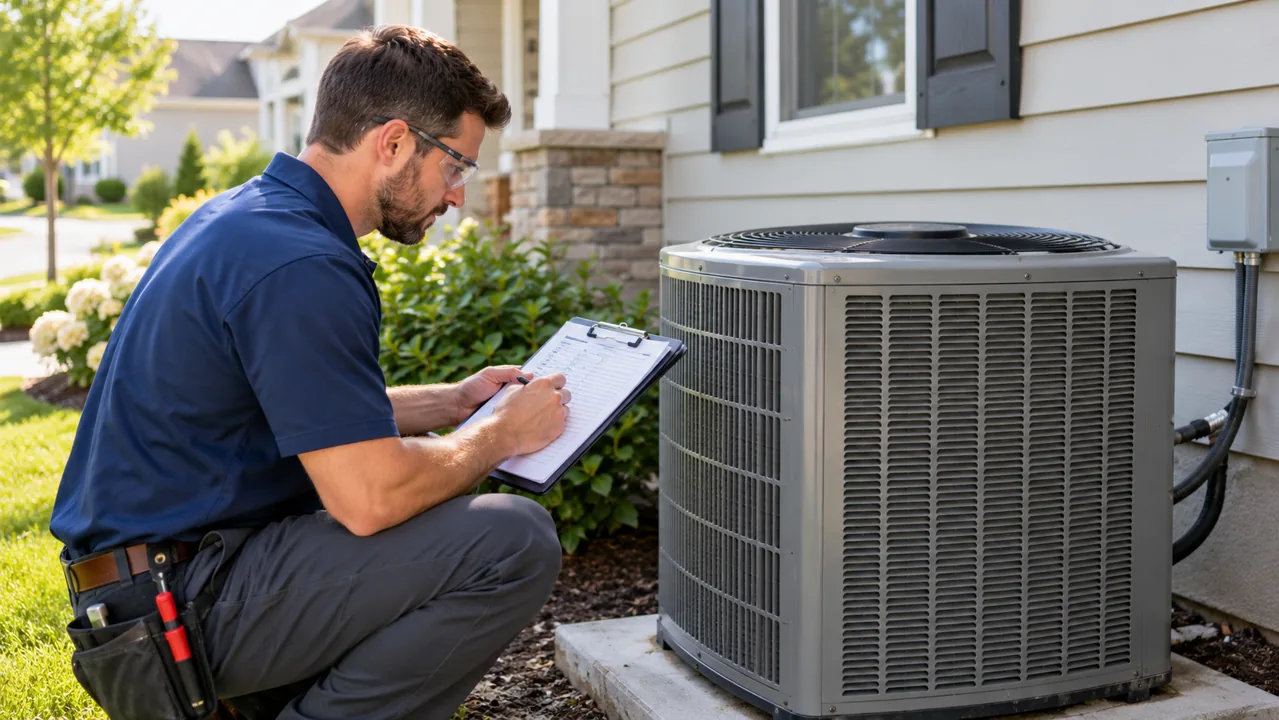

An HVAC inspection checklist is the record a technician completes on a service visit, covering equipment condition, measurements and what needs follow-up. It has 8 items: visit details, system identification, safety and access, indoor equipment, outdoor equipment, system-specific checks, evidence and findings. 5 preparation steps set the scope. Then come 7 indoor checks and the outdoor assessment. 4 equipment attachments cover gas furnaces, electric furnaces, heat pumps and ductless systems. Each finding records the next action. Residential and commercial versions name each covered asset. ENERGY STAR recommends a spring cooling checkup and a fall heating checkup, which means 2 visits a year for a home with both systems.
What are the 8 items on an HVAC inspection checklist?
An HVAC inspection checklist contains 8 record sections that document the authorized visit from identification through findings. Inspection evaluates conditions. Maintenance performs defined upkeep. Repair corrects a fault. Commissioning verifies operation against design and startup requirements.
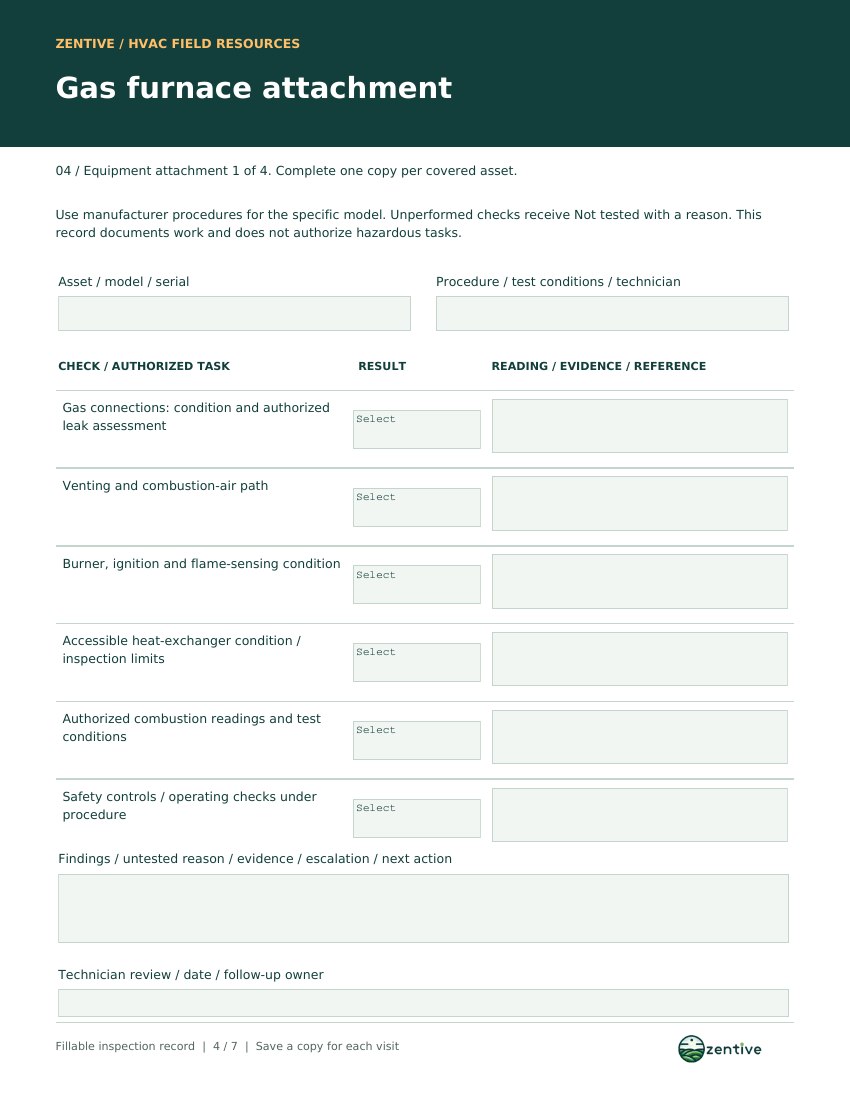
The PDF previews below show the visit record and gas furnace attachment. The download includes the indoor and outdoor checks, findings record, and separate electric furnace, heat pump and ductless attachments. Fields accept typed entries, and each task has a result selector.
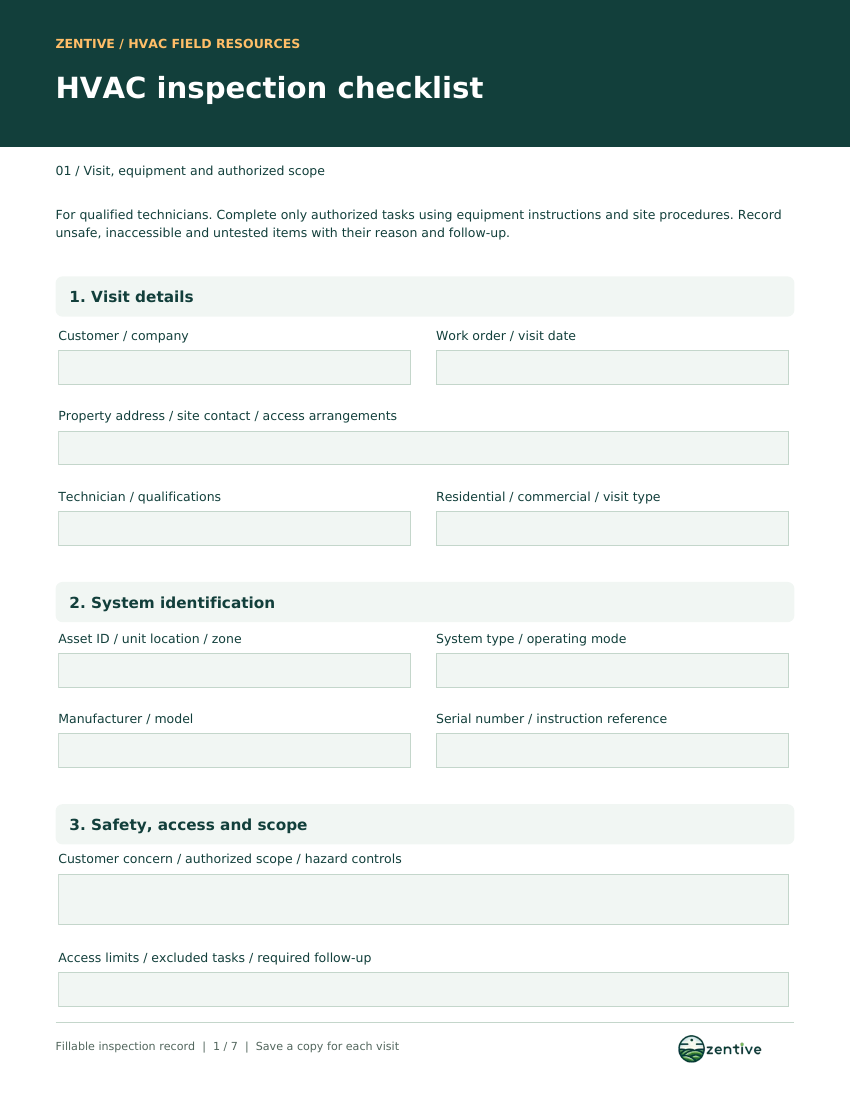
The checklist records visit details, system identification, safety and access, indoor equipment, outdoor equipment, system-specific checks, measurements and evidence, and findings and action. The diagram below groups those eight items into the inspection workflow.
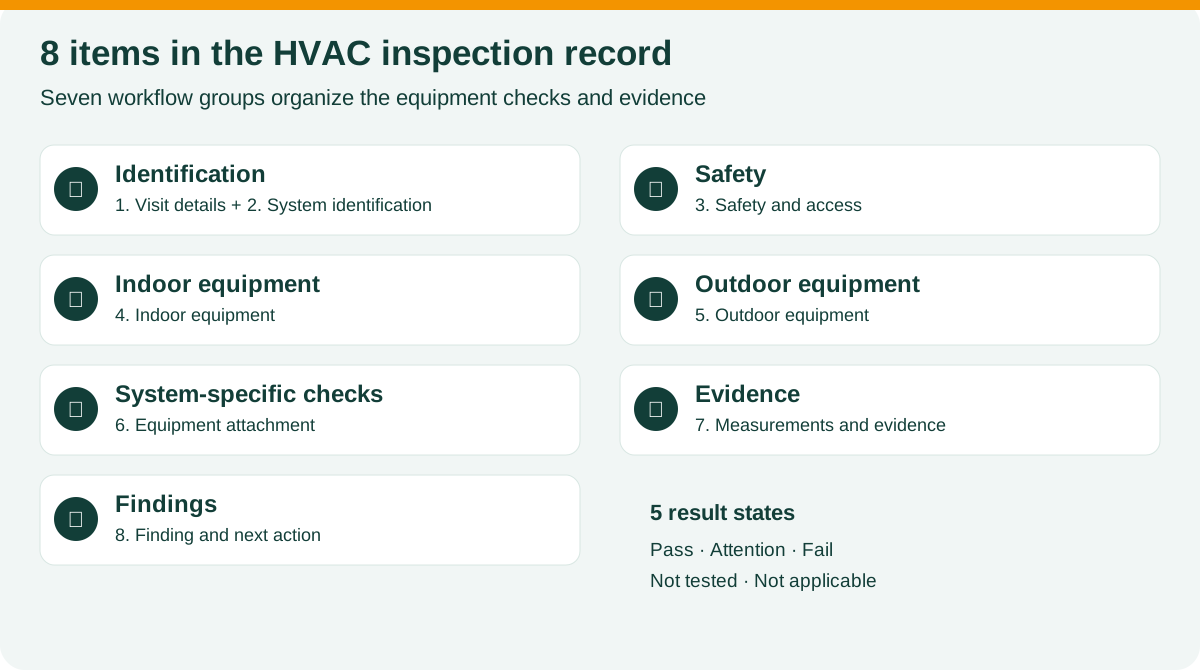
Each task receives one of 5 result states: pass, attention, fail, not tested or not applicable. A reading includes its unit, test conditions and equipment reference. An untested item includes the reason and required follow-up.
Record the check. Record the limits.
| Item | Result | Reading / evidence / action |
|---|---|---|
| Visit details | Pass / Attention / Fail / Not tested / N/A | Customer, property, date, technician, authorized scope, customer concern. |
| System identification | Pass / Attention / Fail / Not tested / N/A | System type, location, manufacturer/model, identifying details, applicable instructions. |
| Safety and access | Pass / Attention / Fail / Not tested / N/A | Hazards, required controls, access limits, tasks not authorized or unsafe to test. |
| Indoor equipment | Pass / Attention / Fail / Not tested / N/A | Filter, accessible blower/coil, condensate, supply/return, ducts, controls. |
| Outdoor equipment | Pass / Attention / Fail / Not tested / N/A | Condition, access/clearances, mounting, coil/fan, visible line insulation. |
| System-specific checks | Pass / Attention / Fail / Not tested / N/A | Qualified, authorized checks appropriate to heat pump, gas, electric or ductless equipment. |
| Measurements and evidence | Pass / Attention / Fail / Not tested / N/A | Reading, unit, test conditions, reference used, photo or observation. |
| Finding and action | Pass / Attention / Fail / Not tested / N/A | Separate observation, interpretation, recommended next action and customer authorization. |
ACCA’s ANSI/ACCA 4 QM–2019 (R2024), Maintenance of Residential HVAC Systems, establishes minimum maintenance-inspection tasks. The contractor selects the applicable equipment tasks and records the manufacturer’s procedure with the completed form.
What are the 5 steps before an HVAC inspection?
HVAC inspection preparation is a five-step review of scope, hazards, procedures, instruments and access limitations. It establishes the conditions for the authorized service visit.
- Confirm the customer, property, covered equipment and authorized scope.
- Identify hazards and the required controls for each task.
- Review the equipment instructions and service history.
- Verify instrument ratings, calibration and technician qualifications.
- Record inaccessible equipment and tasks outside the approved scope.
Under OSHA 29 CFR 1910.147, covered servicing and maintenance requires hazardous-energy control procedures, employee training and periodic inspections. The technician applies the employer’s procedure where unexpected energization or stored energy creates exposure. Electrical work follows the applicable electrical-safety requirements and task-specific procedure.
HVAC business setup establishes the credentials, insurance and operating processes for field service. The guide to starting an HVAC company article covers that preparation.
What are the 7 indoor HVAC inspection checks?
Indoor HVAC inspection checks are 7 component reviews covering the filter, blower and coils, condensate system, supply and return, ducts, controls and ventilation. Each record identifies the accessible component and the observed condition.
| Check | Observation or record |
|---|---|
| 1. Filter | Type, dimensions, fit, condition and service performed |
| 2. Blower and accessible coils | Visible condition, contamination and equipment-specific findings |
| 3. Condensate system | Drain and pan condition, leakage and authorized functional checks |
| 4. Supply and return | Accessible restrictions and measured airflow context |
| 5. Ducts and insulation | Visible damage, disconnection and deterioration |
| 6. Thermostat and controls | Settings, reported issue and authorized operating checks |
| 7. Ventilation | Installed components, observed condition and access limitations |
Lennox’s static-pressure guidance describes 0.5–0.8 in. w.c. as a common residential design range. The equipment’s published blower data establishes the reference for the inspected system. The record includes total external static pressure, measurement locations, blower setting and the applicable maximum.
ACCA’s A Split in Diagnosis calculates a 16.5°F cooling temperature difference for its example at 85°F outdoor temperature, 75°F entering dry bulb, 67°F entering wet bulb and 1,000 CFM. Manufacturer performance data, indoor humidity and airflow establish the expected split for each inspection. The checklist retains both measured temperatures and those operating conditions.
What are the outdoor HVAC inspection checks?
Outdoor HVAC inspection checks are equipment-condition records for access, mounting, coils, fans, insulation, controls and authorized cooling operation. These seven checks establish the observed outdoor condition and test context.
| Check | Observation or record |
|---|---|
| 1. Access and clearances | Measured clearance and manufacturer requirement |
| 2. Mounting and cabinet | Support, level, visible damage and corrosion |
| 3. Coil condition | Visible debris, damage and airflow obstruction |
| 4. Fan condition | Visible condition and authorized operational observations |
| 5. Line insulation | Coverage, deterioration and exposed sections |
| 6. Electrical and controls | Condition and permitted measurements under the task procedure |
| 7. Cooling operation | Ambient conditions, readings, operating mode and reference data |
ENERGY STAR’s maintenance checklist includes coil condition, refrigerant-charge checks and blower-component assessment. EPA Section 608 requires the applicable certification for regulated refrigerant service, including attaching gauges to measure pressure. The visit record identifies the technician, equipment and readings associated with that work.
A visible condition record identifies its evidence (photographs, component location, measured clearance). An operating assessment records its test procedure and equipment specification. Restricted access or unsuitable test conditions receives a “not tested” status and an explanation.
What are the 4 system-specific HVAC inspection checks?
System-specific HVAC inspection checks are 4 equipment attachments for gas furnaces, electric furnaces, heat pumps and ductless systems. Each attachment records the tasks and references for that equipment type.
| System | Inspection context | Reference recorded |
|---|---|---|
| 1. Gas furnace | Combustion, venting, gas connections and safety-control checks within the authorized scope | Manufacturer procedure and locally adopted fuel-gas code |
| 2. Electric furnace | Heating elements, controls, electrical readings and airflow | Manufacturer electrical and airflow specifications |
| 3. Heat pump | Operating mode, outdoor conditions, defrost controls and auxiliary heat | Manufacturer heating and cooling performance data |
| 4. Ductless system | Indoor-unit access, condensate, controls, filters and outdoor equipment | Model-specific service instructions |
NFPA 54/ANSI Z223.1, National Fuel Gas Code, addresses fuel-gas equipment installation, operation, maintenance, inspection and combustion-product venting. The contractor records the locally adopted code edition and manufacturer instructions used for the gas-furnace assessment.
Gas-leak, combustion and carbon-monoxide findings trigger the employer’s emergency procedure and qualified assessment. The report records the observed condition, escalation, customer notification and equipment status.
How does a technician document HVAC inspection findings?
HVAC inspection findings are evidence-based records connecting an observation, its interpretation and the proposed next action. Each finding identifies the asset, location, result, supporting evidence and approval status.
| Finding | Evidence | Next action |
|---|---|---|
| Filter requires attention | Photo, dimensions and observed condition | Record replacement within the accepted scope |
| Component remains untested | Access restriction and affected task | Arrange access and record the follow-up task |
| Further diagnosis required | Reported symptom and completed checks | Obtain approval for the specified diagnostic work |
A technician’s documentation skills connect measurements and photos with the service history. The HVAC technician skills guide explains technical reporting and communication.
Zentive connects customer records, job notes, scheduling, estimates and invoices. The device image below shows the dashboard, service calendar and route used to organize those visits. The office records the next appointment and approved repair scope against the customer’s job history.
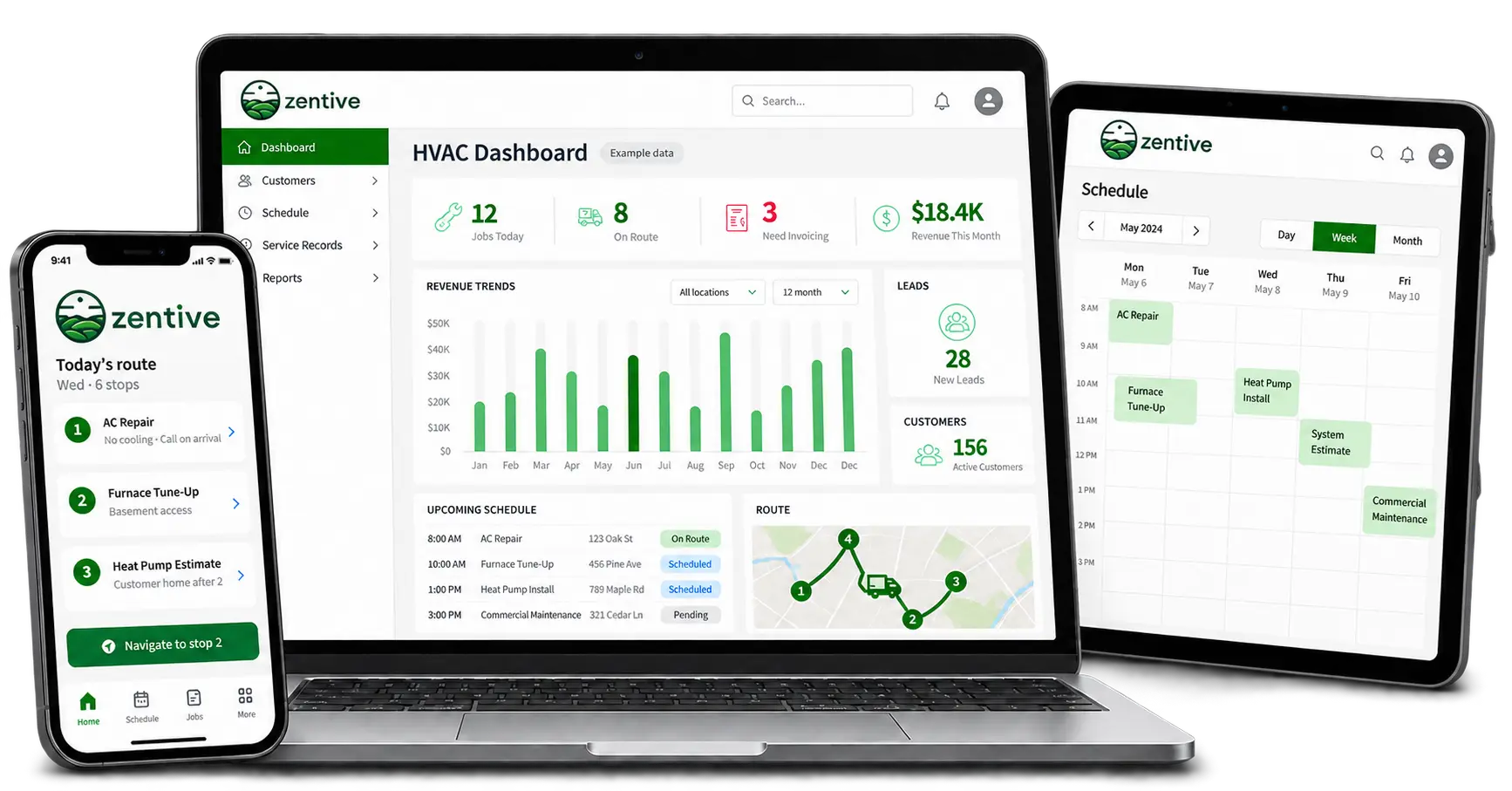
Zentive dashboard with job and revenue totals, tablet service schedule and phone route.
How does an HVAC inspection checklist differ for residential and commercial visits?
Residential and commercial HVAC checklists differ in asset identification and reporting requirements. A residential record identifies the home’s covered system, while a commercial record identifies each unit, zone, site contact and operating restriction.
| Record | Residential visit | Commercial visit |
|---|---|---|
| Equipment identity | Address and listed home system | Property, asset ID, zone and unit number |
| Access | Homeowner appointment | Site contact, security and restricted areas |
| Schedule | Customer appointment window | Business hours and equipment downtime |
| Findings | System condition and next actions | Asset-level status and management reporting |
ACCA identifies Standard 4 for residential maintenance and ANSI/ASHRAE/ACCA Standard 180 for commercial building HVAC inspection and maintenance. The checklist records the standard and equipment instructions used for the property.
HVAC business software organizes customer, property and scheduled-work records. The heating and cooling business software page describes Zentive’s workflow for dispatching visits and retaining customer history.
What else affects an HVAC inspection?
HVAC inspection scope follows the equipment and service agreement. The task list determines instruments and scheduling.
Should an inspection be included in a maintenance agreement?
Yes. An HVAC service contract defines the inspection tasks, covered equipment and visit frequency. The HVAC service contract template provides the agreement fields.
Do technicians need specialist inspection tools?
Yes. An HVAC toolkit includes instruments matched to the inspection, such as electrical meters, manometers and temperature probes. The HVAC tools list lists the equipment categories.
How often should an HVAC system be inspected?
ENERGY STAR recommends 2 seasonal checkups for homes with heating and cooling equipment. Manufacturer instructions and operating conditions determine additional tasks and intervals.
How does HVAC software support inspection visits?
HVAC software connects inspection follow-up with the customer’s job history. Zentive keeps job notes, repair estimates, scheduled work and invoices together, while service agreements organize recurring visits. The office turns recorded findings into an estimate and schedules the approved work. Zentive for HVAC businesses supports that follow-up workflow.