
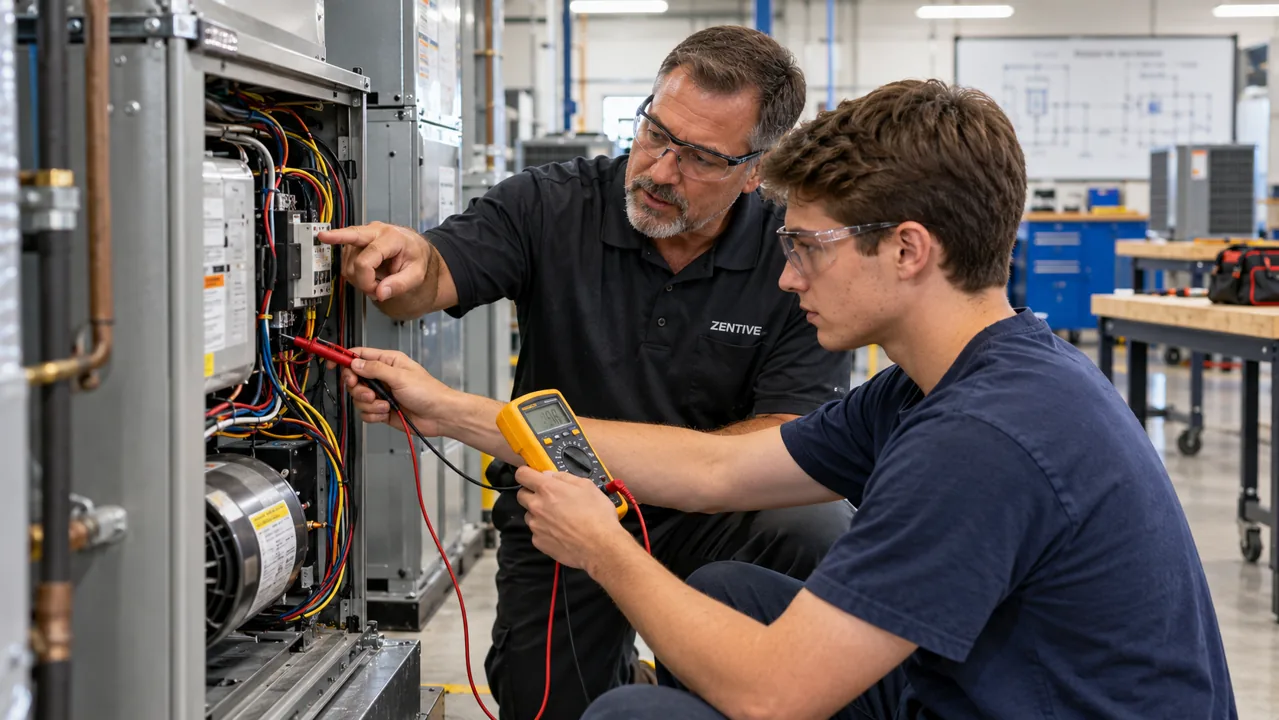

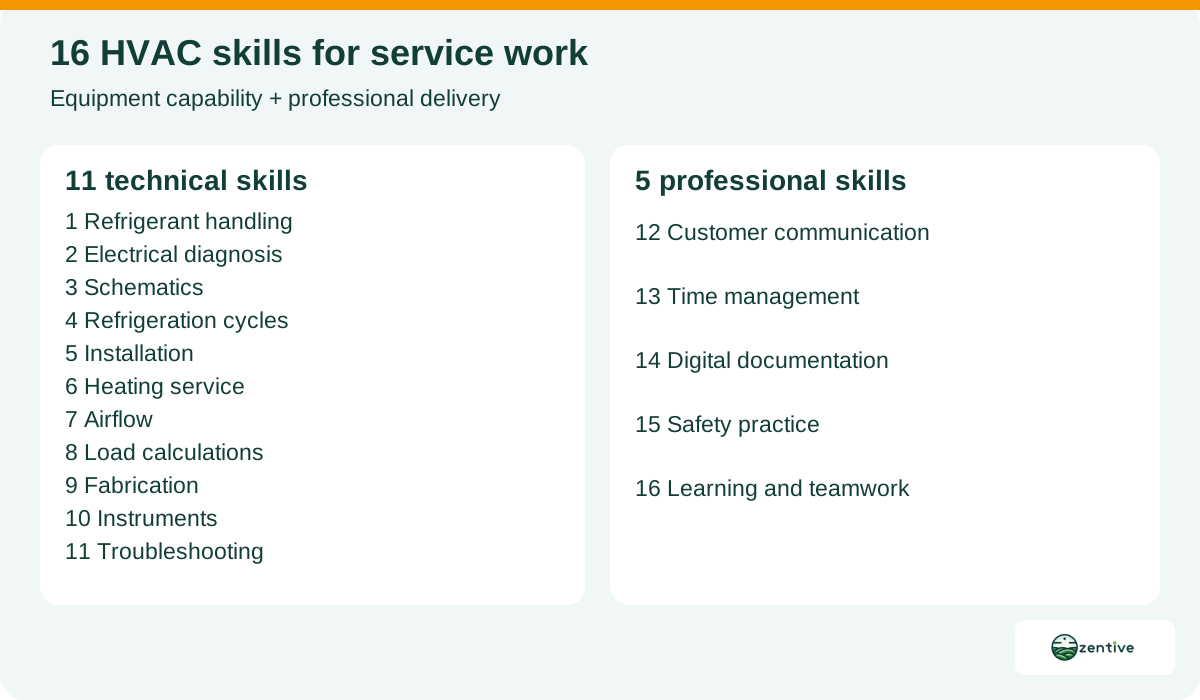
HVAC skills are the technical and professional abilities a technician uses to install, diagnose, maintain and document heating and cooling systems. The 16 skills are refrigerant handling, electrical diagnosis, schematic reading, refrigeration-cycle knowledge, installation, heating service, airflow assessment, load calculation, fabrication, instrument use, troubleshooting, communication, time management, documentation, safety and teamwork. The diagram below splits them into 11 technical and 5 professional skills. Demand for these skills is growing. The BLS Occupational Outlook Handbook counts 440,900 HVACR jobs in 2025 and projects 11% growth through 2035. NATE certification tests the technical knowledge. Service records and supervised work show employers how a technician applies it.
What are the 16 HVAC skills employers assess?
HVAC hiring skills are 16 demonstrated capabilities spanning equipment work and service delivery. The technical skills appear first, followed by customer communication, scheduling, records, safety and teamwork.
- Handle refrigerants and recovery equipment
- Diagnose electrical faults safely
- Read HVAC schematics and wiring diagrams
- Understand refrigeration and heat-pump cycles
- Install and commission HVAC equipment
- Service heating systems
- Evaluate airflow and duct systems
- Perform load calculations
- Work with tubing, joints and sheet metal
- Use HVAC tools and test instruments
- Troubleshoot problems systematically
- Communicate clearly with customers
- Manage time and service appointments
- Document service work digitally
- Follow safety standards and local requirements
- Keep learning and work well with the team
1. Handle refrigerants and recovery equipment
Handling refrigerants and recovery equipment means servicing HVAC refrigerant circuits with the required credentials, tools and procedures. The EPA's Section 608 program requires certification for covered stationary refrigeration and air-conditioning work.
EPA identifies 4 certification types. Type I covers small appliances. Type II covers high- and very-high-pressure appliances except small appliances and motor-vehicle air conditioning. Type III covers low-pressure appliances. Universal covers all three equipment categories. EPA Section 608 certification establishes the technician's covered equipment scope.
A field record identifies the refrigerant, equipment and completed recovery task. An interview example describes the technician's certification type, supervised work and measured result.
2. Diagnose electrical faults safely
Diagnosing electrical faults safely uses circuit knowledge, measurements and hazard controls to identify HVAC electrical problems. OSHA 29 CFR 1910.147 governs hazardous-energy control during covered servicing and maintenance. OSHA 29 CFR 1910.333 addresses electrical safe-work practices, including deenergizing exposed live parts subject to its stated exceptions.
A technician uses the equipment's wiring diagram, verifies instrument ratings and records the conditions for each measurement. A hiring demonstration explains the suspected fault, the measurement that tested it and the procedure used to protect workers.
3. Read HVAC schematics and wiring diagrams
Reading HVAC schematics and wiring diagrams connects symbols, terminals and operating sequences to the installed equipment. It establishes the intended circuit behavior used during diagnosis.
A technician identifies the power supply, controls, protective devices and loads on the manufacturer's diagram. An interview example follows a control signal through the drawing and explains how the measured circuit behavior identified the fault.
4. Understand refrigeration and heat-pump cycles
Understanding refrigeration and heat-pump cycles explains how HVAC components transfer heat and how a heat pump changes refrigerant flow. A heat pump changes refrigerant flow to provide heating or cooling.
A technician records operating mode, indoor and outdoor conditions, pressures and temperatures before interpreting performance. A hiring example connects those readings to the manufacturer's operating data and the diagnosis reached.
5. Install and commission HVAC equipment
Installing and commissioning HVAC equipment assembles the system to its design and verifies operation against specified requirements. The installation record identifies equipment models, connections, startup settings and test results.
A technician checks placement, clearances, accessories, electrical supply and the required startup documentation. An interview example states the technician's assigned installation work and the measurements recorded at handover.
6. Service heating systems
Servicing heating systems inspects and maintains HVAC heating equipment using its manufacturer procedures and required qualifications. Gas furnaces, electric furnaces, boilers and heat pumps have different components and test requirements.
A technician identifies the appliance, service history, observed condition and authorized scope. A hiring example explains the finding, the procedure followed and the action taken when work required a different qualification.
7. Evaluate airflow and duct systems
Evaluating airflow and duct systems connects HVAC comfort and capacity problems with measured air movement and system pressure. The assessment includes the filter, blower, duct connections and distribution path.
A technician records measurement location, units, operating mode and the equipment specification used for comparison. An interview example explains the complaint, test sequence and evidence supporting the airflow finding.
8. Perform load calculations
Performing load calculations estimates the heating and cooling capacity an HVAC installation requires from verified building inputs. ACCA Manual J, Eighth Edition, provides the residential load-calculation method for dwellings with their own heating and cooling systems.
A preparation checklist groups the inputs into 8 categories drawn from residential load-calculation requirements.
- Design temperatures and local climate
- Building dimensions and orientation
- Wall, roof and floor assemblies
- Window and door properties
- Infiltration and ventilation
- Occupancy and internal gains
- Duct location and leakage
- Room-by-room distribution requirements
The technician records input evidence and identifies the approved calculation method. A hiring example describes the building measurements collected and how the resulting load informed equipment selection.
9. Work with tubing, joints and sheet metal
Working with tubing, joints and sheet metal means preparing and connecting HVAC materials to the required dimensions and specifications. Work includes tubing preparation, flaring, brazing and duct fabrication within the technician's training and authorization.
A technician identifies material compatibility, joint preparation and the inspection or test required for the connection. An interview example names the process completed and the documented quality check.
10. Use HVAC tools and test instruments
Using HVAC tools and test instruments means selecting suitable equipment, checking its condition and interpreting its measurements. The diagnostic set includes 7 instruments used for electrical, temperature, pressure and airflow measurements.
- Multimeter for circuit measurements
- Clamp meter for current measurements
- Temperature probes for contact and air readings
- Manometer for pressure measurements
- Anemometer for air-velocity measurements
- Psychrometer for humidity and air-property measurements
- Combustion analyzer for qualified fuel-burning-appliance tests
A technician checks ratings, compatible test conditions and calibration requirements against the manufacturer's instructions. A hiring example explains the instrument choice, recorded units and decision supported by the reading.
An HVAC tool kit is the equipment assigned to the technician's service scope. The HVAC service toolkit guide describes the tool categories and their tasks.
11. Troubleshoot problems systematically
Troubleshooting problems systematically traces an HVAC complaint through recorded evidence to a diagnosis and verified result. The work sequence records the complaint, service history, observed conditions, test results, diagnosis and completed verification.
A technician tests a specific suspected cause and records the finding before selecting the next action. An interview example explains how the evidence supported or rejected the initial diagnosis and how operation was checked after the work.
12. Communicate clearly with customers
Communicating clearly with customers explains HVAC findings, service options and approval requirements in understandable terms. The service conversation distinguishes observed conditions, recommended work, price and the next action.
A technician records the customer's description and explains the approved scope before additional work. An interview example presents a diagnosis and repair option using the same terms shown on the estimate.
13. Manage time and service appointments
Managing time and service appointments coordinates HVAC job duration, travel, site access and office updates. The schedule records arrival windows, technician assignments and known site constraints.
A technician reports changes to job duration and documents the reason for the schedule update. A hiring example describes the handling of an urgent call alongside previously scheduled work and the handoff to the office.
14. Document service work digitally
Documenting service work digitally records HVAC observations, approved work, measurements and follow-up in the customer job record. Records include equipment details, notes, photos and time entries relevant to the completed work.
A technician reviews assigned job details and adds the findings needed by the office or next technician. An interview example uses a training record with the issue, evidence, completed work and next action.
An HVAC inspection checklist defines the observations and result fields for a service visit. The HVAC inspection record organizes those records.
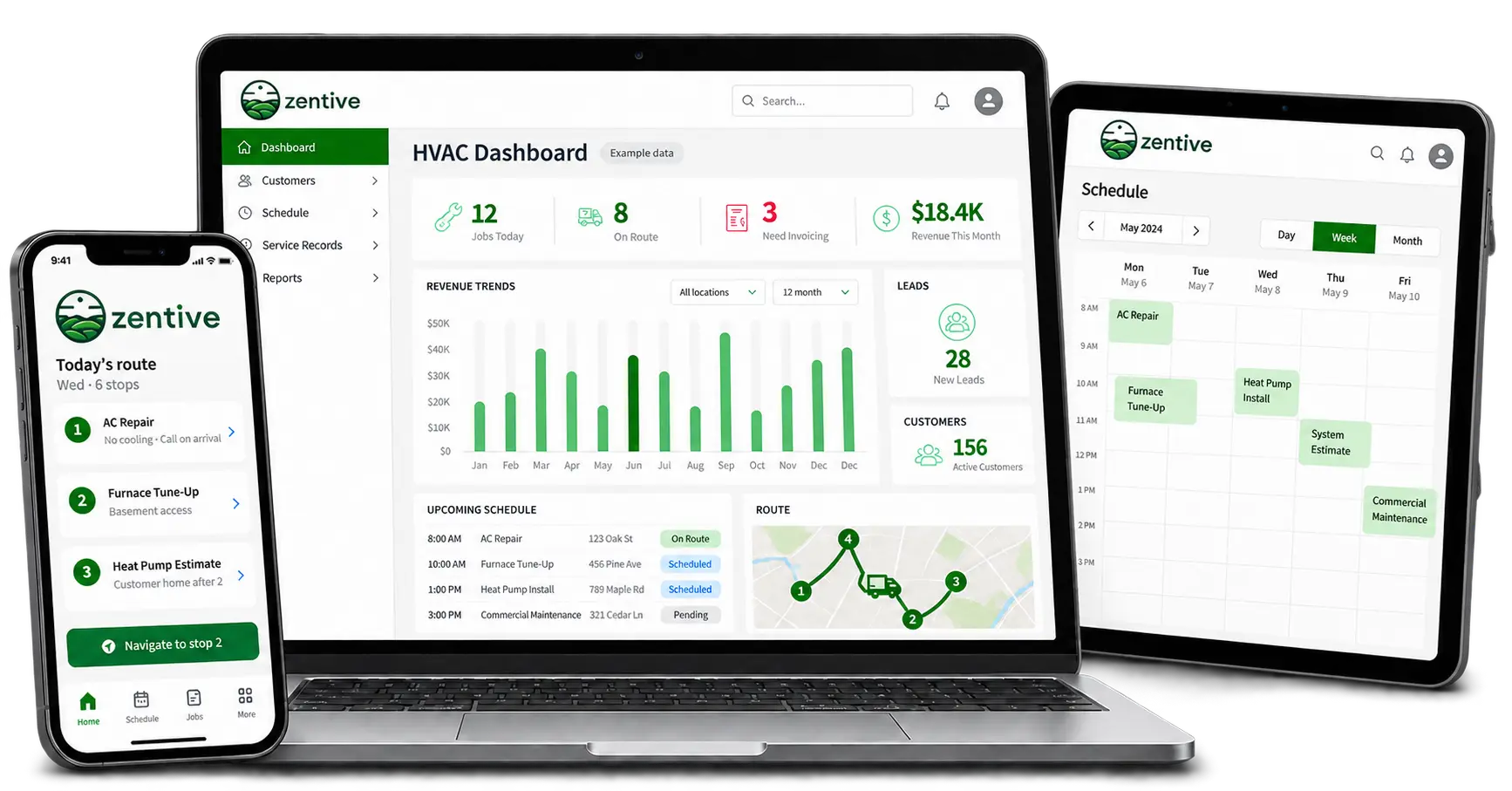
Zentive connects customer records, assigned work and schedules. The device image shows the dashboard, service calendar and mobile route that organize the office-to-field workflow.
15. Follow safety standards and local requirements
Following safety standards and local requirements applies the hazard controls, procedures and qualifications required for HVAC work. OSHA 29 CFR 1910.147 requires an energy-control program for covered servicing and maintenance, including procedures, training and periodic inspections.
A technician follows the employer's job-specific controls for energy isolation, access and protective equipment. A hiring example explains the hazard identified, the procedure applied and the report made to the responsible supervisor.
16. Keep learning and work well with the team
Keeping HVAC knowledge current and working well with the team means continuing to learn and providing complete handoffs to colleagues. NATE's Certified HVAC Professional pathway assesses 5 domains through its CHP-5 exams covering fundamentals, electrical and controls, comfort and airflow, installation, and service.
NATE requires CHP-5 certification renewal every 2 years through its recertification process. A technician records completed training and the equipment or procedure covered. An interview example describes feedback received, the change made and the result checked with the supervisor.
How are HVAC skills shown on a technician resume?
An HVAC technician resume connects technical skills with credentials, training and work examples. Each experience bullet names the task, equipment or instrument, and recorded result. Entry-level candidates use supervised employment, apprenticeship or laboratory work and identify that setting.
Download the HVAC Technician Resume Example (PDF)
The one-page example contains a professional summary, technical and professional skills, certifications, experience and education. Its candidate, employers and training provider are fictional. Applicants replace those details with their own history and list only credentials and work they have completed.
- Summary states the target role and relevant experience.
- Skills name equipment, diagnostic methods, instruments and service-record tools.
- Certifications identify the credential, type and completion date.
- Experience describes the task, supervision and documented outcome.
- Education records the program, provider and completion date.
A resume bullet such as “Recorded return and supply temperatures during supervised heat-pump maintenance and added findings to the service record” demonstrates instrument use and documentation. Software experience names the system used and the completed tasks, such as reviewing assignments, updating job notes and recording customer approvals.
What else affects an HVAC skills application?
An HVAC application records demonstrated skills. Training, credentials and work examples support those claims.
Is HVAC work experience required before listing skills?
No. Classroom, laboratory and apprenticeship projects provide evidence of HVAC skills. The application identifies the task, training setting and supervision.
Do advanced HVAC skills lead to higher pay?
Yes. Advanced skills support roles with greater responsibility. BLS reports a $61,010 median and $95,210 90th-percentile HVACR salary across employers and experience levels in May 2025. The HVAC wage comparison compares compensation figures.
What is the most important HVAC credential for refrigerant service hiring?
EPA requires Section 608 certification for covered refrigerant service. The certification type determines the equipment categories within its scope.
Do business owners need skills beyond HVAC service work?
Yes. Starting an HVAC business requires licensing, cost control, pricing, scheduling and customer-management skills. The heating and cooling business startup guide covers the launch requirements.
How does HVAC software support technician skills?
HVAC software supports recordkeeping and service coordination. Zentive connects customer information and schedules with estimates and invoices. The HVAC contractor software page explains Zentive’s connected workflow.