


An HVAC business installs, maintains and repairs heating, ventilation and air conditioning systems for residential or commercial customers. Starting one involves 10 steps ranging from choosing services to getting the first customers. Biz2Credit’s March 2026 plumbing and HVAC launch guide estimates startup costs of $15,000–$100,000, based on location, company size and service scope. The SBA’s startup-cost framework divides the company budget into one-time expenses and operating costs. Experience, working capital and service capacity determine the ownership model.
HVAC business software is a system for managing customer records, estimates, scheduled jobs and invoices. Zentive brings these workflows together for HVAC owners in the software overview below.
What does an owner need to start an HVAC business?
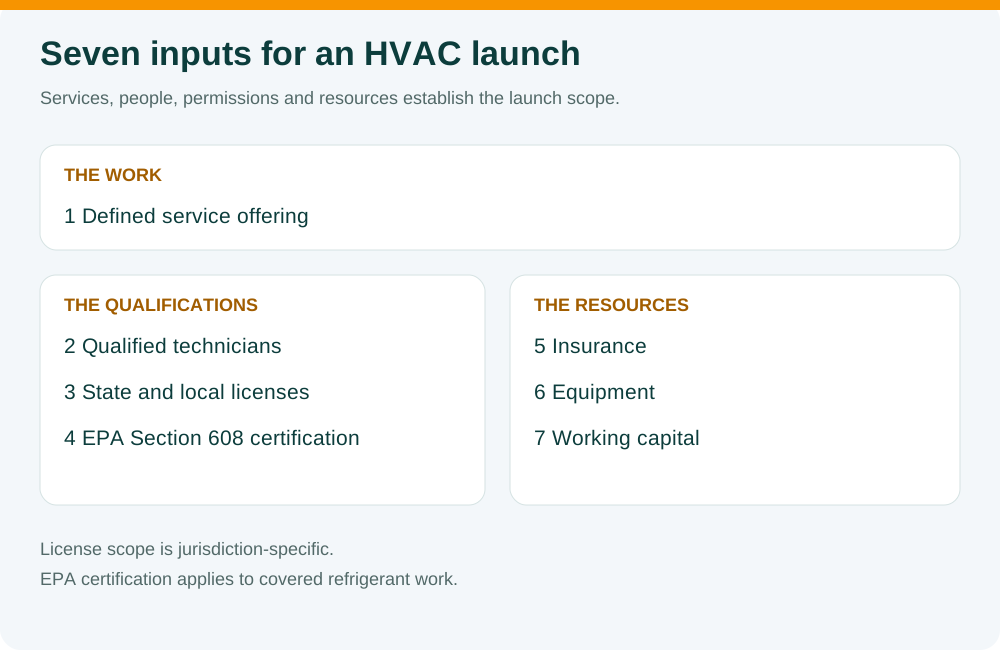
An owner needs 7 things to start an HVAC business. These are a defined service offering, qualified technicians, state and local licenses, EPA Section 608 certification, insurance, equipment and working capital. An HVAC business is a company that installs, maintains and repairs heating, ventilation and air conditioning systems. Licensing depends on jurisdiction and scope. The EPA requires Section 608 certification for technicians performing covered refrigerant work.
The startup requirements diagram below groups these seven inputs into the work, the qualifications and the resources needed to deliver it.
What are the 10 steps to start an HVAC business?
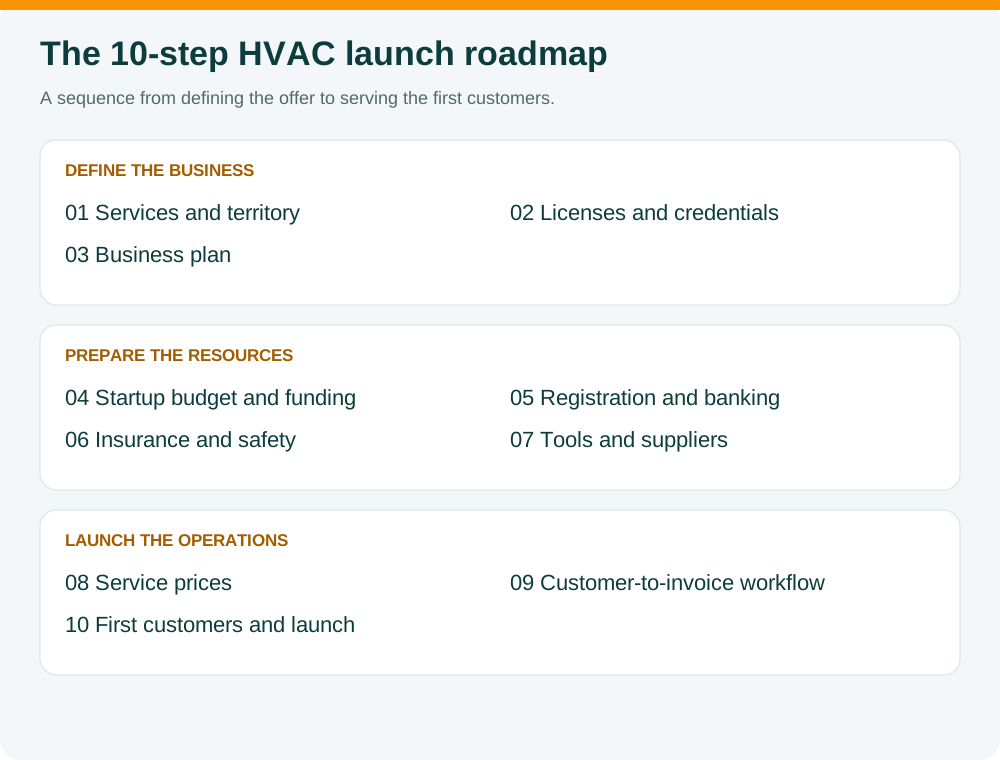
The 10 steps below take an HVAC business from a defined service offering to its first customer jobs.
- Choose HVAC services and a service area
- Get the licenses needed to start an HVAC business
- Write the HVAC business plan
- Estimate HVAC business startup costs and secure funding
- Register the business and set up banking
- Arrange insurance and safe working procedures
- Buy essential tools and choose suppliers
- Set profitable HVAC service prices
- Set up customer records, scheduling and invoicing
- Find the first customers and launch
The launch roadmap below shows the same sequence in three phases: define the business, prepare its resources and launch its operations.
1. Choose HVAC services and a service area
Choosing HVAC services defines the work the business sells, while choosing a service area defines its territory and target customers. These choices determine the travel involved, equipment needed and customers targeted.
- Customers: homeowners, rental-property managers or commercial building operators.
- Services: diagnostics, repairs, seasonal maintenance, replacements or new installations.
- Territory: named towns or ZIP codes, with travel time and return visits included in scheduling.
- Equipment: the heating and cooling systems supported by the team’s qualifications and tools.
A residential repair business and a commercial installation company have different labor, purchasing and scheduling needs. The launch scope records those differences. Territory research covers local competitors, property types, supplier access and travel costs.
2. Get the licenses needed to start an HVAC business
Getting the licenses needed to start an HVAC business establishes the credentials and approvals required for its regulated work. Business registration, permission to contract and permission to perform a particular job are separate requirements.
The six approval types are contractor licenses, contractor classes, technician registrations, refrigerant certifications, job permits and voluntary certifications.
| Approval | What it covers | Named authority and example |
|---|---|---|
| Contractor license | Contracting within an authorized trade scope | California Contractors State License Board: C-20 covers warm-air heating, ventilation and air-conditioning work within its classification |
| Contractor class | Equipment scope attached to the license | Texas Department of Licensing and Regulation: Class A permits any equipment size. Class B is limited to cooling systems of 25 tons and under and heating systems of 1.5 million BTU/hour and under |
| Technician registration | A technician’s state registration | Texas Department of Licensing and Regulation maintains a separate ACR technician registration process |
| Refrigerant certification | Covered refrigerant service activities | EPA Section 608: Type I for small appliances, Type II for high-pressure equipment within its scope, Type III for low-pressure equipment, and Universal for all three |
| Job permit | Approval for a particular project | Austin Development Services requires the licensed, registered trade contractor assigned to the work to request a required mechanical permit |
| Voluntary certification | Evidence of technical knowledge | North American Technician Excellence describes NATE certification as voluntary. Government agencies issue licenses |
A credentials register records the holder, issuing authority, permitted scope, expiration date and renewal owner. Credentials (EPA 608, NATE and state journeyman credentials where applicable) serve different purposes. The listed scope identifies the services authorized by each credential.
Under Texas Department of Licensing and Regulation rules, an ACR company must employ an ACR contractor at each permanent location.
3. Write the HVAC business plan
Writing an HVAC business plan connects the company’s services, customers, costs and revenue assumptions in one operating document. The plan establishes what the business will sell and the resources needed to deliver it.
The initial plan records six decisions that determine the launch model.
- The customers and territory the business will serve.
- The services and equipment types it will support.
- The reasons customers will choose the business, supported by its actual qualifications and service offer.
- The startup purchases, monthly expenses and cash reserve.
- The pricing method, expected job volume and available working hours.
- The customer-acquisition and retention activities.
The operating forecast reconciles job volume with available technician hours, travel time and job duration. Completed-job results provide the basis for updating those inputs.
A business plan template organizes the service model and financial forecast. The HVAC Business Plan Template: 7 Sections, Startup Costs and Cash Flow provides worksheets for recording assumptions and updating them with job results.
4. Estimate HVAC business startup costs and secure funding
Estimating HVAC startup costs identifies the purchases and working capital required before customer payments, while securing funding supplies that cash. The cash requirement depends on the assets already owned, service scope and timing of payments.
Biz2Credit’s March 2026 plumbing and HVAC launch guide estimates startup costs of $15,000–$100,000, based on location, company size and service scope. The SBA’s startup-cost framework bases the opening budget on the company’s equipment purchases and operating expenses. A business purchasing new vehicles, hiring immediately or carrying a larger reserve needs a budget reflecting those commitments.
The SBA separates startup costs into one-time costs and ongoing expenses. Zentive’s Cedar Route worked budget uses an existing service vehicle and $22,500 in owner funding. The following setup payments total $12,500, leaving $10,000 in operating cash. Source entries identify published prices and the amounts assigned to this model.
| Setup item | Amount | Source and scope |
|---|---|---|
| Existing service vehicle acquisition | $0 | Cedar Route model uses an already-owned vehicle |
| Initial vehicle fit-out | $2,000 | Cedar Route model input |
| Tools and testing equipment | $6,000 | Cedar Route model input, including TruTech Tools’ $457.99 TruBlu XL Starter Kit with BluVac+ Micro example |
| Initial parts and consumables | $1,500 | Cedar Route model input, including 10 SupplyHouse CAP050450440RTP capacitors at $43.78 each, totaling $437.80 |
| Federal EIN | $0 | IRS direct application |
| Contractor license application | $115 | Texas Department of Licensing and Regulation ACR application |
| Registered technician application | $20 | Texas Department of Licensing and Regulation application |
| First general liability installment | $101 | Insureon HVAC customer-policy median monthly cost |
| Other setup, professional fees and coverage deposits | $1,764 | Cedar Route model input |
| Website and launch materials | $1,000 | Cedar Route model input |
| Total setup payments | $12,500 | Sum of the listed payments |
| Opening operating cash | $10,000 | Owner funding less setup payments |
| Owner funding | $22,500 | Cedar Route model input |
Ford lists the 2026 Transit Cargo Van at a starting MSRP of $48,400, excluding destination, taxes, options and upfitting. A new-vehicle purchase changes the acquisition and financing lines in the budget. TruTech Tools marked the listed $457.99 evacuation kit sold out on October 23, 2026.
The cash forecast records down payments and near-term installments. The business plan records the full financing balance and repayment schedule. The owner’s living-expense budget sits alongside business working capital.
The funding comparison includes available savings, borrowing costs, repayment dates and a slower-sales scenario. Funding approval and terms are lender-specific.
5. Register the business and set up banking
Registering the HVAC business establishes its legal identity, while setting up business banking creates accounts for company transactions. The SBA’s business guide covers entity registration, tax IDs and business banking as setup tasks.
The registration and banking process contains five tasks.
- Check the proposed business name against state records, trademark records and domain availability.
- Select the ownership structure and complete the applicable entity or trading-name filing.
- Record applicable registrations (EIN, sales tax and contractor registration) with the issuing agencies.
- Open the business bank account using the documents required by the bank.
- Set up bookkeeping categories, receipt storage and payment approval controls.
The IRS provides EINs free of charge and identifies corporations, partnerships and businesses with employees among the businesses that need one. State tax agencies determine sales-tax registration obligations for the services and products sold.
An HVAC business name identifies the company on registrations and customer documents. The heating and cooling business name ideas collection provides names for the registration and trademark review. Bookkeeping records distinguish purchases, customer payments, owner contributions and withdrawals.
6. Arrange insurance and safe working procedures
Arranging HVAC insurance establishes coverage for business risks, while safe working procedures define controls for job-site hazards. The insurance schedule identifies covered activities. The safety program identifies hazards, responsibilities and procedures.
Insureon’s HVAC contractor insurance data lists general liability policy limits of $1 million per occurrence and $2 million aggregate. Texas Department of Licensing and Regulation sets its own coverage requirements by ACR license class.
The insurer’s review covers general liability, commercial auto, tools and equipment, and employee-related coverage. The application describes installations, refrigerant work, subcontracting and commercial-site work. Policy records include exclusions, deductibles and renewal dates.
OSHA’s Control of Hazardous Energy standard, 29 CFR 1910.147, requires an energy-control program for covered servicing and maintenance, including procedures, employee training and periodic inspections. Its applicability and exceptions depend on the activity. The safety program records the applicable energy-isolation procedure, required protective equipment and escalation process for each work category. EPA Section 608 governs covered refrigerant-handling activities.
7. Buy essential tools and choose suppliers
Buying essential HVAC tools equips the business for its selected services, while choosing suppliers establishes access to compatible parts and equipment. Supplier selection establishes where the company obtains compatible equipment, parts and support.
- Hand tools, lighting, measurement and fastening tools.
- Electrical and diagnostic instruments rated for the work.
- Refrigeration service, recovery and evacuation equipment matched to the equipment serviced.
- Personal protective equipment and task-specific safety equipment.
- Vehicle storage, consumables and initial replacement parts.
An HVAC tool inventory records the equipment used for service and installation. The HVAC Tools List: 27 Essential Tools for Service Technicians organizes the equipment register by task. Instrument records include model, rating, condition, calibration requirements and storage location.
The supplier comparison covers parts availability, lead times, returns, warranty administration and technical support. Written purchase quotes establish the launch equipment budget and the cost of later service additions.
8. Set profitable HVAC service prices
Setting profitable HVAC service prices means covering labor, materials, travel and overhead while including the target profit. A pricing model connects the cost of delivering the job with the amount charged to the customer.
The following published benchmarks provide context for reviewing a price book. Each source describes the figure’s scope.
| Benchmark | Published figure | Named source and interpretation |
|---|---|---|
| Diagnostic or service-call fee | $75–$200 | HomeGuide, HVAC Repair Costs. Published consumer price range |
| HVAC hourly service rate | $75–$150 per hour | HomeGuide, HVAC Repair Costs. Billed service rate, billed to customers |
For a worked example, a job with $280 in recoverable costs and a target margin of 30% on that cost basis requires a selling price of $280 ÷ (1 − 0.30) = $400. A 30% markup on $280 produces $364. The company’s annual net profit margin uses total annual revenue and expenses.
The price book records diagnostic fees, hourly rates, flat-rate services and installation estimates with their included scope. Job-cost reviews compare labor hours, materials, travel and callbacks with completed-job revenue. A pricing guide explains how job costs translate into selling prices. The HVAC pricing guide shows the labor-recovery and parts-markup calculations.
9. Set up customer records, scheduling and invoicing
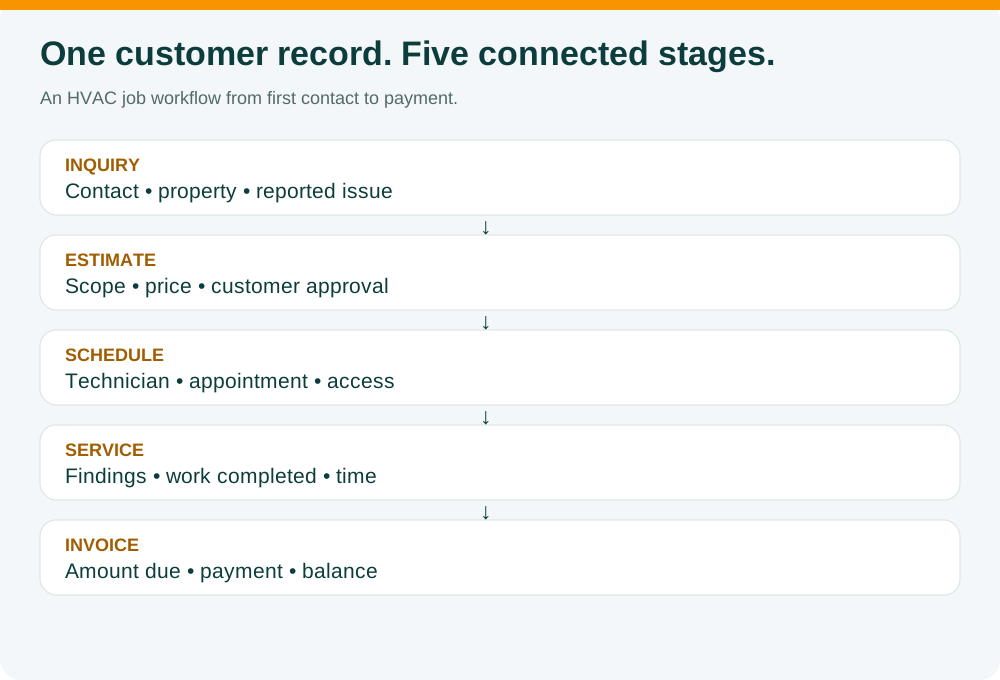
Setting up customer records, scheduling and invoicing connects HVAC customer information with assigned visits and payment requests. Each stage preserves the information needed for the next action.
| Stage | Information retained | Next action |
|---|---|---|
| Inquiry | Contact details, property, reported issue and urgency | Confirm service fit |
| Estimate | Scope, price, exclusions and approval | Arrange authorized work |
| Schedule | Technician, duration, access and travel | Share visit details |
| Service | Findings, completed tasks, photos and time | Record the outcome |
| Billing | Invoice, payment and balance | Track collection |
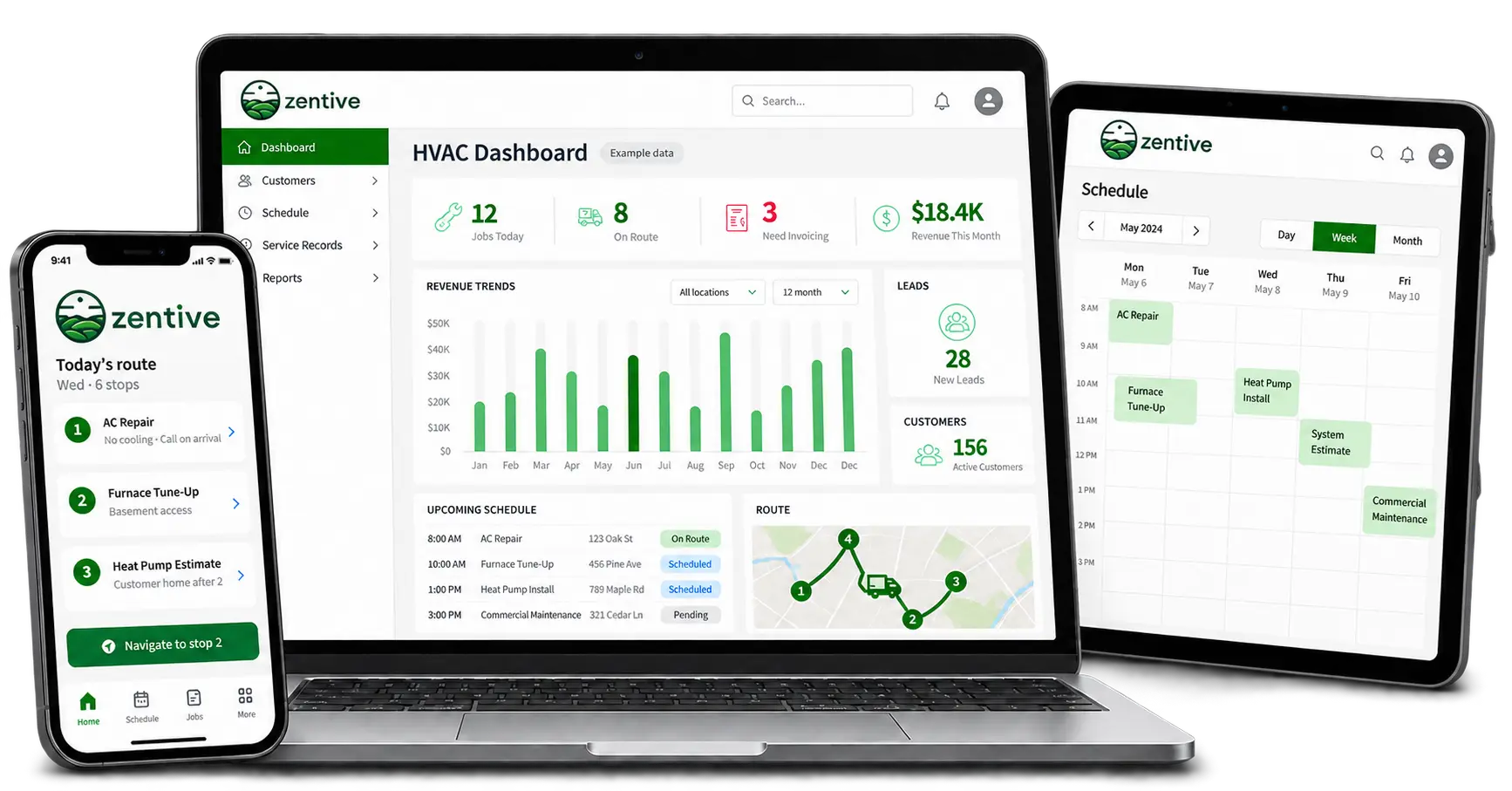
The device image below shows the Zentive dashboard, service schedule and phone route used to organize HVAC work.
The operating plan assigns responsibility for capturing inquiries, confirming appointments, recording job completion and following up on unpaid invoices. A sample job tests the complete process before launch.
10. Find the first customers and launch
Finding the first HVAC customers and launching means converting service inquiries into booked work within the business’s available capacity. The launch connects that plan to the business’s available appointment capacity.
Acquisition channels (website, Google Business Profile, referrals, local partnerships and paid search) connect the company with its target customers and service area. Channel records track cost, inquiries, accepted estimates and completed jobs. The resulting job contribution provides the basis for reviewing acquisition spending.
HVAC marketing connects the company’s services with customers in its service area. The HVAC marketing plan guide explains how to build the channel plan. The campaign plan records a spending limit and an inquiry-response owner.
The launch check verifies active approvals, insurance documents, available tools, supplier arrangements, written prices and tested customer handoffs. Initial bookings follow the team’s service capacity. Completed jobs supply the first results for the forecast review.
The launch-check diagram below follows the customer record from the first inquiry through payment.
What else do new HVAC business owners need to know?
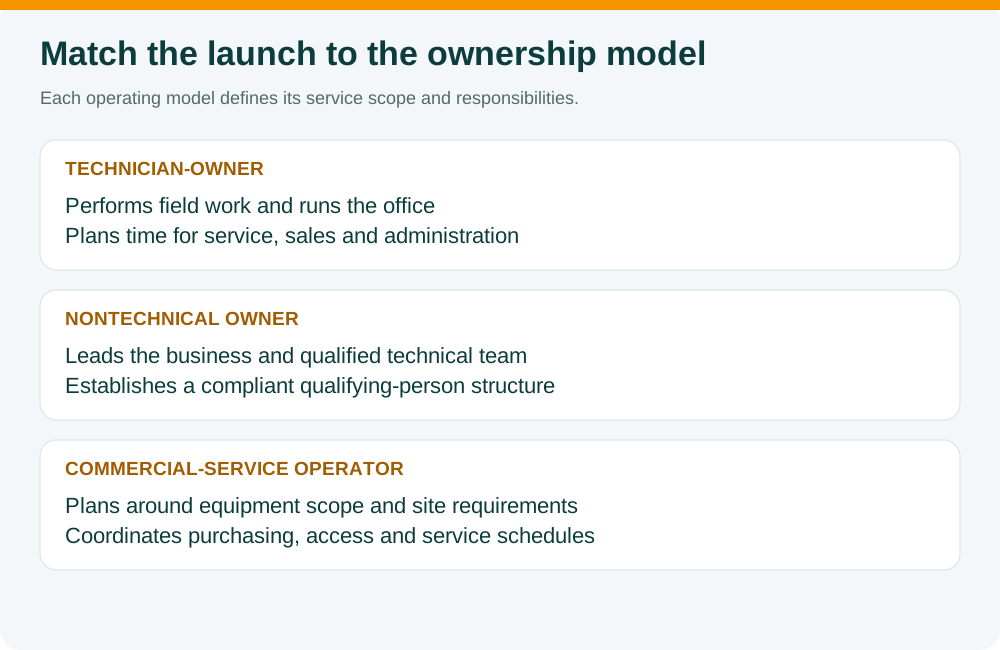
Experience, cash and capacity shape the HVAC launch model. The comparison below shows technician-owner, nontechnical-owner and commercial-service responsibilities.
Can an owner start an HVAC business without experience?
Yes. The ownership model must meet local licensing and supervision rules, including Texas TDLR’s contractor requirement at each permanent location. HVAC skills and credentials remain necessary for regulated field work. The HVAC technical and professional skills guide describes the required capabilities.
Can an owner start an HVAC business with a small budget?
Yes. Existing assets and cash must cover the chosen service scope and launch expenses. Biz2Credit’s March 2026 guide estimates $15,000–$100,000 for plumbing and HVAC startups, depending on scope, size and location.
Is HVAC a good business to start?
Yes, when qualifications, local demand and operating costs support the business model. BLS projects 11% HVACR employment growth from 2025 to 2035. Technician salaries and owner earnings reflect different responsibilities. The HVAC Technician Salary in 50 States: Hourly Pay and Owner Earnings compares compensation figures.
Is a maintenance agreement suitable for a new HVAC business?
Yes. A maintenance agreement fits when pricing and technician capacity cover its promised visits. An HVAC service contract records that scope, schedule and payment terms. The HVAC service agreement template provides the agreement fields.
Do new HVAC businesses need SEO and paid ads?
No. Referrals and local partnerships provide other launch channels. HVAC SEO develops organic search visibility as the business builds its website. The HVAC search optimization guide explains the website work.
How does HVAC software support a new business?
HVAC software connects customer records, estimates, scheduled visits and invoices. Zentive supports that workflow from the business’s first jobs. The HVAC business management software page explains Zentive’s connected workflow.