

HVAC technician salary is the gross pay a technician earns for installing, maintaining and repairing heating and cooling equipment. The Bureau of Labor Statistics puts the May 2025 median at $61,010 a year, or $29.33 an hour. Pay rises across 3 levels: entry, experienced and lead. By state, BLS medians run from $48,110 in Arkansas to $77,430 in Alaska. The District of Columbia is higher still at $84,390. Specialization and benefits change the full package. Owner earnings depend on business results. Employers set a pay range in 5 steps: duties, local wages, employment costs, progression and legal requirements.
How much do HVAC technicians make?
HVAC technician pay has a $61,010 annual median, according to BLS May 2025 Occupational Employment and Wage Statistics for occupation 49-9021. BLS reports a median of $29.33 per hour and a mean of $64,780 annually, or $31.14 hourly. The median divides workers into equal higher-paid and lower-paid groups. The mean is the arithmetic average.
What is HVAC pay per hour, week, month and year in 2026?
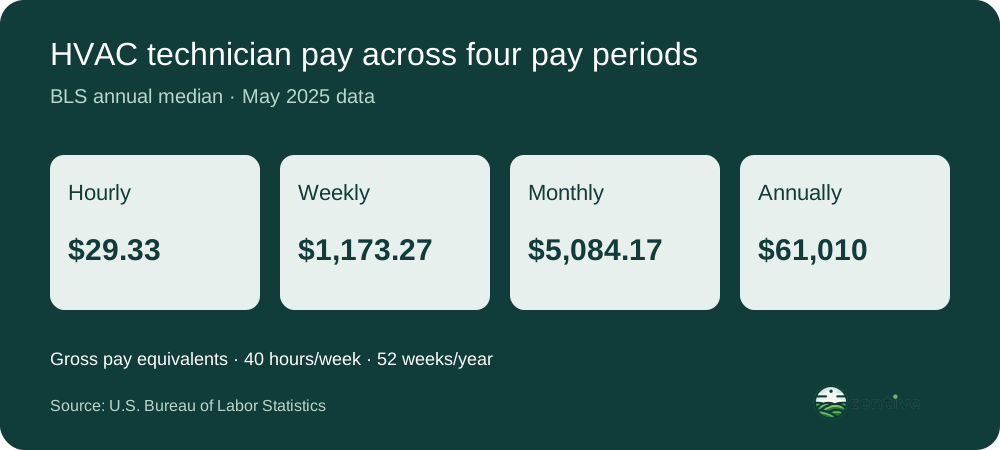
HVAC pay-period equivalents express the same annual salary across different schedules. The BLS May 2025 median is the latest published national benchmark available for this 2026 guide.
| Pay period | Gross pay equivalent |
|---|---|
| Hourly | $29.33 |
| Weekly | $1,173.27 |
| Every two weeks | $2,346.54 |
| Monthly | $5,084.17 |
| Annually | $61,010 |
Weekly, two-week and monthly figures divide $61,010 by 52, 26 and 12. The hourly equivalent uses 2,080 hours per year, or 40 hours over 52 weeks. Figures are rounded independently and represent gross pay before deductions.
BLS measures straight-time gross wages, including certain commissions and production incentives. Overtime premiums, employer benefit costs and self-employed earnings sit outside this wage measure. Actual paychecks reflect paid hours, overtime, incentives and deductions.
How much do HVAC technicians make at 3 experience levels?
HVAC experience levels describe 3 responsibility stages for hiring and pay progression. Entry-level workers perform supervised tasks, experienced technicians complete authorized service independently, and lead technicians coordinate complex work and other technicians.
PayScope’s September 2026 analysis reports the following central pay ranges in U.S. job postings collected through August 31, 2026. The ranges cover the middle half of advertised base salaries for each level. Hourly equivalents divide annual pay by 2,080 hours.
| Experience level | Annual salary range | Hourly equivalent |
|---|---|---|
| 1. Entry-level technician | $38,500–$65,520 | $18.51–$31.50 |
| 2. Experienced technician | $61,942–$80,049 | $29.78–$38.49 |
| 3. Lead technician | $74,000–$100,000 | $35.58–$48.08 |
The source includes 50 entry, 34 mid-level and 61 lead postings. Mid-level postings list 3–10 years of experience. Entry and lead postings do not specify a consistent year range. Senior specialist postings have a separate $79,040–$100,000 range across 68 postings, with 4–10 years of experience. Role titles and experience requirements overlap.
Zentive's annual-pay calculation uses a $30 hourly wage and 2,080 paid hours. Multiplying those inputs produces $62,400 in straight-time annual pay. Paid hours, overtime premiums and incentives are recorded individually in the compensation offer.
What is the HVAC technician salary in all 50 states?
State HVAC salaries are local wage medians for the same occupation and reporting period. The BLS May 2025 table below includes all 50 states and the District of Columbia.
Among states, the five highest BLS medians are Alaska $77,430, Illinois $77,410, Massachusetts $77,300, Connecticut $76,610 and Minnesota $76,350. The five lowest are Arkansas $48,110, Alabama $48,370, Mississippi $48,680, West Virginia $48,850 and New Mexico $50,270. The District of Columbia median is $84,390.
| State | Median hourly wage | Median annual wage |
|---|---|---|
| Alabama | $23.26 | $48,370 |
| Alaska | $37.23 | $77,430 |
| Arizona | $28.56 | $59,400 |
| Arkansas | $23.13 | $48,110 |
| California | $34.88 | $72,560 |
| Colorado | $31.35 | $65,200 |
| Connecticut | $36.83 | $76,610 |
| Delaware | $29.96 | $62,320 |
| District of Columbia | $40.57 | $84,390 |
| Florida | $27.24 | $56,670 |
| Georgia | $27.11 | $56,390 |
| Hawaii | $31.47 | $65,450 |
| Idaho | $27.04 | $56,240 |
| Illinois | $37.21 | $77,410 |
| Indiana | $29.05 | $60,430 |
| Iowa | $29.17 | $60,680 |
| Kansas | $29.07 | $60,460 |
| Kentucky | $28.18 | $58,620 |
| Louisiana | $28.20 | $58,650 |
| Maine | $30.37 | $63,170 |
| Maryland | $33.67 | $70,020 |
| Massachusetts | $37.16 | $77,300 |
| Michigan | $29.26 | $60,850 |
| Minnesota | $36.71 | $76,350 |
| Mississippi | $23.41 | $48,680 |
| Missouri | $28.82 | $59,950 |
| Montana | $29.26 | $60,850 |
| Nebraska | $28.77 | $59,850 |
| Nevada | $29.09 | $60,510 |
| New Hampshire | $35.51 | $73,850 |
| New Jersey | $35.79 | $74,450 |
| New Mexico | $24.17 | $50,270 |
| New York | $35.78 | $74,430 |
| North Carolina | $27.53 | $57,260 |
| North Dakota | $35.81 | $74,490 |
| Ohio | $30.06 | $62,510 |
| Oklahoma | $27.67 | $57,560 |
| Oregon | $30.26 | $62,940 |
| Pennsylvania | $30.00 | $62,400 |
| Rhode Island | $32.39 | $67,370 |
| South Carolina | $27.22 | $56,610 |
| South Dakota | $29.51 | $61,390 |
| Tennessee | $26.68 | $55,490 |
| Texas | $27.77 | $57,760 |
| Utah | $28.24 | $58,730 |
| Vermont | $29.88 | $62,150 |
| Virginia | $28.72 | $59,730 |
| Washington | $36.38 | $75,660 |
| West Virginia | $23.49 | $48,850 |
| Wisconsin | $29.67 | $61,710 |
| Wyoming | $26.30 | $54,700 |
A local pay comparison uses the metropolitan area, job duties, scheduled hours and benefit package. Housing costs, travel requirements and seasonal hours affect the value of the offer. State medians combine employers and job types within each jurisdiction.
How do 5 HVAC specializations affect pay?
HVAC specializations define 5 work categories with different equipment, qualifications and scheduling demands. The BLS Occupational Outlook Handbook identifies specialization in areas such as commercial refrigeration and testing and balancing. The table identifies the responsibilities an employer prices into each role.
| Specialization | Work that shapes the pay range | Compensation details |
|---|---|---|
| 1. Residential service | Fault diagnosis, customer communication and emergency response | Base wage, on-call pay and service incentives |
| 2. Installation | Equipment placement, connection, startup and crew coordination | Helper, installer and lead responsibilities |
| 3. Commercial and industrial | Larger systems, site access and operating-hour constraints | Site qualifications and shift coverage |
| 4. Refrigeration | Food-storage systems, refrigerant handling and urgent failures | Certification, response time and call rotation |
| 5. Controls | Programming, commissioning and system integration | Platform knowledge and project responsibility |
The BLS June 2026 Employer Costs for Employee Compensation release reports private-industry benefits of $14.07 per hour worked, representing 30.0% of total compensation. This broad private-industry measure covers benefits beyond HVAC. Employer packages include paid leave, insurance, retirement contributions and legally required benefits.
The offer records guaranteed wages, commission formulas, bonus conditions, paid training, vehicle use and tool allowances. The on-call policy states the rotation, response obligation and compensation for callouts.
What factors affect HVAC technician pay?
HVAC technician pay reflects the role’s skills, responsibilities, local labor market and compensation terms. BLS separates wages by location and employer industry, while its Occupational Outlook Handbook describes training, specialization and irregular work schedules. An employer’s pay review covers the following factors.
| Pay factor | Details assessed in the offer |
|---|---|
| Experience and independence | Apprenticeship progress, diagnostic ability and work completed without supervision |
| Education and credentials | Trade-school training, apprenticeships, EPA certification, NATE credentials and applicable state licenses |
| Location and local demand | State, metropolitan area, cost of living, available technicians and competing job offers |
| Specialization and system complexity | Residential service, commercial systems, refrigeration, controls and commissioning |
| Employer and customer type | Contractor size, employer industry, commercial accounts and public-sector work |
| Union or negotiated pay scale | Contract wage steps, apprenticeship progression and negotiated benefit contributions |
| Leadership and responsibility | Crew supervision, mentoring, project coordination and customer accountability |
| Hours, shifts and seasonality | Paid hours, seasonal workload, overtime, night shifts and emergency-call rotation |
| Performance and incentives | Documented workmanship, callbacks, productivity, commissions and bonus terms |
| Benefits and allowances | Insurance, retirement, paid leave, training, tools, vehicle use and travel allowances |
| Employment arrangement | Employee wages, contractor fees and owner earnings with their different expenses |
Credentials document qualifications for assigned work. The employer’s wage schedule or offer establishes any associated pay increase. A full compensation comparison records guaranteed base pay, variable earnings, benefits and employee-paid expenses.
How much do HVAC business owners make?
HVAC owner earnings are compensation from business operations, including salary and distributions under the company's structure. ZipRecruiter's October 9, 2026 “Hvac Owner” salary estimate is $86,197 annually. Its estimate draws on job postings and third-party salary data. Owner distributions require the company's accounting records to measure.
Revenue is the value of sales. Profit is revenue less the expenses included in the calculation. Cash available for an owner reflects taxes, debt principal, equipment purchases and reserves as well as operating profit.
Zentive's owner-compensation example uses $500,000 in annual revenue and $390,000 in expenses before owner compensation and income taxes. The balance is $110,000 before those remaining commitments. An owner working as a field technician records a labor allowance when assessing the business's return on ownership.
An ownership comparison includes employee benefits, business capital, management hours and exposure to losses. A profitable company funds owner compensation from the surplus remaining after its obligations.
How do HVAC employers set a pay range in 5 steps?
An HVAC pay range is a compensation band tied to duties, local labor supply and the business's employment cost. The five steps define the role, compare wages, calculate costs, document progression and verify wage requirements.
- Define the duties, qualifications and supervision level.
- Compare current local offers with BLS occupation and area data.
- Calculate benefits, employer taxes and paid nonbillable time.
- Document progression criteria and review dates.
- Verify applicable wage, overtime and pay-disclosure requirements with the relevant labor agency.
Billable utilization is the share of recorded technician hours charged to customer work. The company's time records establish the denominator and achieved rate.
Zentive's worked labor-cost example uses $30 in wages and $10 in employer costs per paid hour, producing $40 in employment cost. At a measured utilization input of 75%, $40 ÷ 0.75 produces $53.33 per billable hour. The $10 benefit input and 75% utilization are the inputs to this calculation. The BLS benefit measure above provides a published compensation comparison.
HVAC job pricing converts labor, materials and allocated overhead into a selling price. The HVAC service pricing guide develops the cost and margin calculations.
What else affects HVAC earnings?
HVAC earnings vary with skills, location and responsibility. Business ownership adds operating risk and management duties.
Do better HVAC skills increase earning potential?
Yes. Advanced HVAC skills support diagnostic, controls and supervisory roles with greater responsibility. The HVAC skills overview describes the required capabilities.
Does starting an HVAC business offer higher earnings than employment?
Yes, when business profit exceeds employee compensation. Starting an HVAC business brings capital requirements, operating risk and management duties. The HVAC company launch guide covers the launch requirements.
What is the highest-paying state for HVAC technicians?
BLS May 2025 OEWS lists Alaska as the highest state median at $77,430 annually. The District of Columbia reaches $84,390.
How much do HVAC technicians make per hour?
BLS May 2025 OEWS reports a $29.33 median hourly wage for HVAC technicians. At 40 hours per week, the annual median equals approximately $1,173.27 per week before deductions.
How does HVAC software connect technician pay with jobs?
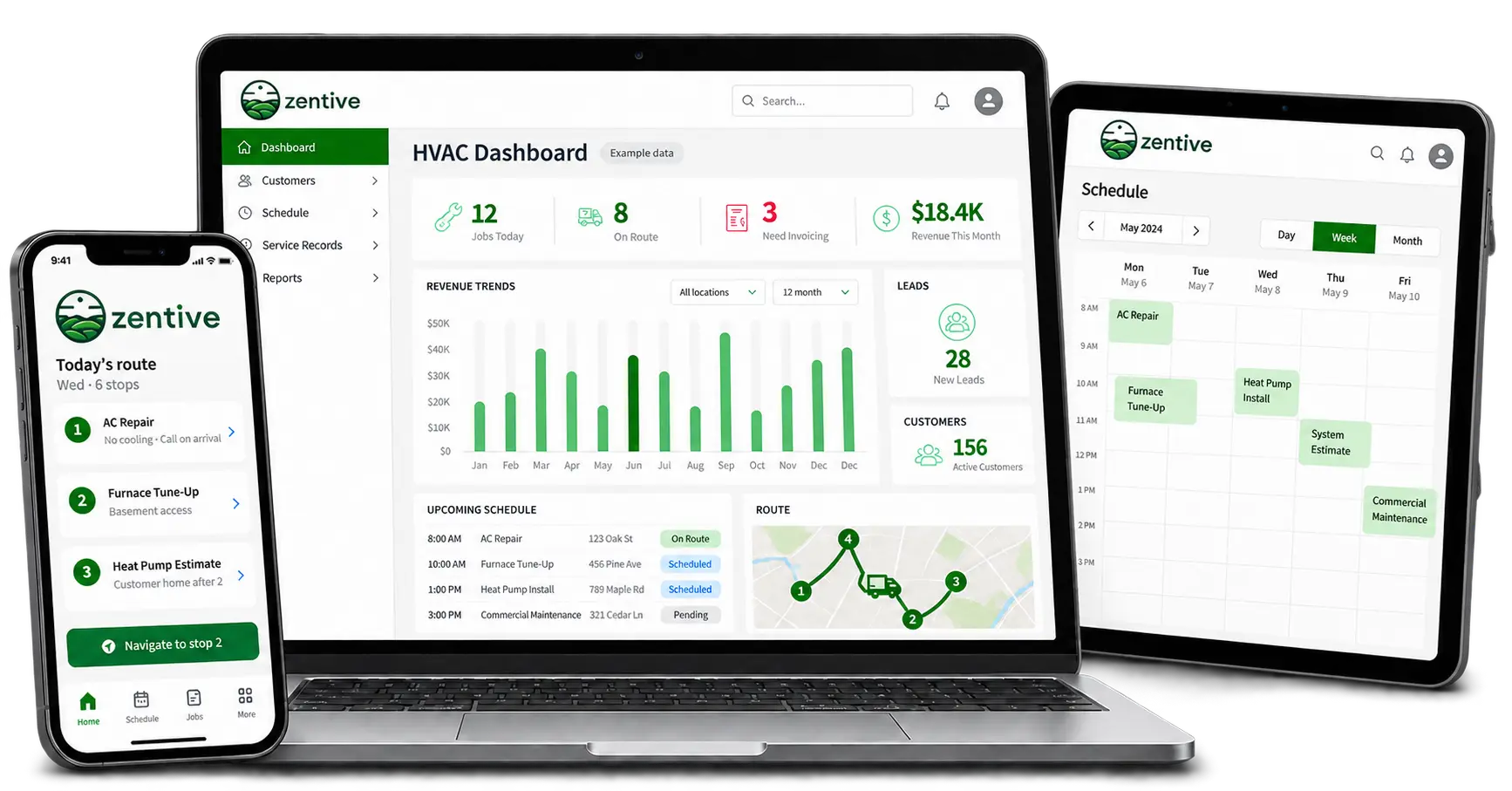
HVAC software connects assigned jobs with customer records, estimates and invoices. Zentive organizes that office and field workflow. The HVAC service management software page explains Zentive’s connected workflow. The device image below shows the dashboard, service schedule and route views.