


HVAC job pricing is how a contractor turns a job’s costs, scope and profit target into a selling price. Published price ranges exist for service visits, repairs, maintenance, ductwork and installed equipment. Contractors use 3 pricing models: time and materials, flat rate and hybrid. The price itself comes from 5 steps: billable labor cost, landed materials and subcontractors, overhead allocation, target profit margin and the customer estimate. In Zentive’s worked repair example, $280 in recoverable costs becomes a $400 price at a 30% job margin.
What are average 2026 HVAC prices for services and equipment?
HomeGuide’s current cost guides report residential HVAC prices from $75–$200 for a diagnostic visit to $10,000–$25,000+ for an installed air-source heat pump. The table groups service visits, repairs, maintenance, ductwork and equipment installations.
| Service or product | Published price range | Pricing basis |
|---|---|---|
| Service visits and labor | ||
| Diagnostic appointment | $75–$200 | Per visit |
| Standard service labor | $75–$150 | Per hour |
| Emergency service labor | $140–$250 | Per hour |
| Maintenance | ||
| Seasonal tune-up | $70–$200 | Per service |
| Annual maintenance agreement | $150–$300 | Per year |
| Repairs and replacement parts | ||
| New thermostat fitted | $75–$575 | Replacement job |
| New capacitor fitted | $100–$250 | Replacement job |
| Condensate drain cleared | $75–$250 | Service job |
| Blower motor repaired | $150–$700 | Repair job |
| Blower motor replaced | $300–$900 | Replacement job |
| Cooling-system refrigerant recharge | $100–$600 | Service job |
| Refrigerant leak fixed | $200–$1,500 | Repair job |
| Outdoor fan motor replaced | $200–$700 | Replacement job |
| Compressor replaced | $1,300–$2,500 | Replacement job |
| Furnace gas valve replaced | $200–$800 | Replacement job |
| Ductwork | ||
| Duct system cleaned | $450–$1,000 | Residential service |
| Duct system replaced | $1,400–$5,600 | Residential project |
| Installed HVAC systems | ||
| Central AC, standard efficiency | $5,000–$8,300 | Installed, 2,000-square-foot home, duct changes excluded |
| Central AC, mid-range | $8,300–$12,500 | Installed, same home-size basis |
| Furnace, standard efficiency | $3,500–$7,500+ | Installed |
| Air-source heat pump | $10,000–$25,000+ | Installed, including air handler |
| Single-zone mini-split | $2,500–$6,000 | Installed |
| Multi-zone mini-split | $6,500–$15,000+ | Installed, zone count affects price |
| Equipment only | ||
| Central AC equipment | $2,800–$7,500 | Unit only |
| Electric furnace equipment | $1,000–$3,500 | Unit only |
Starting an HVAC business establishes the service scope, operating budget and customer workflow used in pricing. The guide to starting an HVAC company covers those launch decisions.
Which HVAC pricing model fits each job?
An HVAC pricing model defines how the contractor charges for its work. The three models are time and materials, flat rate and hybrid.
| Model | Price calculation | Suitable work and approval |
|---|---|---|
| Time and materials | Billable hours at the agreed rate plus priced materials | Uncertain repair scope, with rates and authorization limits agreed |
| Flat rate | Fixed selling price for a defined task | Repeatable repairs, tune-ups and specified installations |
| Hybrid | Flat rates for defined tasks and hourly billing for uncertain work | Diagnostic fee followed by an approved repair price or hourly scope |
The estimate identifies minimum charges, diagnostic-fee credits and emergency rates. Commercial estimates specify access and operating hours. Residential estimates identify the equipment and included work.
How does a contractor calculate the price of an HVAC job in 5 steps?
An HVAC job-price calculation converts recoverable cost into selling price using a defined profit target. The five steps calculate billable labor, add landed materials and subcontractors, allocate overhead, apply the target margin and document the estimate.
Cost to selling price
Calculated selling price before applicable tax.
- Calculate billable labor cost
- Add materials, equipment and subcontractors
- Recover overhead and job-specific costs
- Apply the target profit margin
- Check scope and present the estimate
1. Calculate billable labor cost
Calculating billable labor cost divides the HVAC employer’s loaded technician cost by the hours billed to customers. Loaded cost includes wages, employer payroll taxes and benefits.
The U.S. Bureau of Labor Statistics reports a median HVACR wage of $61,010 per year in May 2025. Zentive’s worked labor calculation combines that wage with $16,990 in example employer taxes and benefits to produce $78,000 in annual loaded cost. At 1,300 billable hours, $78,000 ÷ 1,300 produces $60 per billable hour.
The contractor calculates available billable hours after training, meetings, parts collection and other nonbillable activities. Travel expense follows a documented recovery method, such as billable time, a service fee or overhead allocation. Each expense appears once in the cost base.
HVAC technician compensation is the wage paid to the employee. The HVAC pay and owner earnings guide explains wage benchmarks and ownership income.
2. Add materials, equipment and subcontractors
Adding materials, equipment and subcontractors captures the purchased items and outside work required for the HVAC job. Subcontractor charges enter the estimate under their agreed scope.
The contractor records purchase cost, selected markup and selling price as individual fields. Freight, consumables and disposal enter the landed cost when attributable to the job.
HVAC Parts Markup: Chart, Formula and Calculator
HVAC parts markup is the percentage added to a part’s landed cost to calculate its selling price. Landed cost includes the purchase price and attributable freight or handling costs.
Parts selling price = landed cost × (1 + markup percentage ÷ 100).
Markup percentage = (selling price − landed cost) ÷ landed cost × 100. Gross margin percentage = (selling price − landed cost) ÷ selling price × 100.
The chart compares selected markup percentages on a $100 landed part cost. Each row shows the resulting selling price, gross profit and parts gross margin before labor and other business expenses.
| Parts cost | Selected markup | Selling price | Gross profit | Parts gross margin |
|---|---|---|---|---|
| $100 | 25% | $125 | $25 | 20% |
| $100 | 50% | $150 | $50 | 33.3% |
| $100 | 75% | $175 | $75 | 42.9% |
| $100 | 100% | $200 | $100 | 50% |
| $100 | 150% | $250 | $150 | 60% |
The HVAC parts markup calculator applies the contractor’s entered cost and markup percentage. A $150 landed cost with 50% markup produces a $225 selling price, $75 gross profit and 33.3% parts gross margin.
Parts cost to selling price
Selling price
Gross profit: $75.00 · Parts gross margin: 33.3%
Before applicable tax, labor and other business expenses.
A job-wide margin calculation uses the original landed costs as its cost base. A parts selling price belongs in the revenue calculation. This treatment preserves the relationship between supplier cost, customer price and profit.
Installation estimates record equipment model, accessories, freight, subcontracted tasks and disposal before the selling price is calculated.
3. Recover overhead and job-specific costs
Recovering overhead and job-specific costs includes the HVAC business’s allocated operating expenses and costs attributable to the individual job. These costs include office administration, insurance, vehicle ownership, software, rent and nonbillable support.
The contractor calculates its overhead percentage as overhead expense divided by revenue, then selects an allocation basis for job costing.
Zentive’s worked overhead calculation divides $48,000 in annual overhead by 1,600 company billable hours to produce $30 per hour overhead. This calculation uses company overhead and company billable hours from the same period.
Job-specific charges include permits, specialist equipment, additional travel, subcontractors and disposal. The estimate assigns each charge to its scope item. Costs already recovered through the hourly allocation remain within that allocation.
4. Apply the target profit margin
Applying the target profit margin calculates the HVAC selling price that leaves the intended share of revenue after defined job costs. Markup is profit divided by cost. Both calculations use the same defined cost base.
Selling price = cost × (1 + markup rate).
Selling price = cost ÷ (1 − target margin).
Zentive’s worked comparison applies both methods to a $1,000 cost base. A 30% markup produces $1,300, with $300 in profit and a margin of 23.1%. A 30% margin produces $1,428.57 from $1,000 ÷ 0.70.
The formula diagram below compares the two selling prices and their resulting margins side by side.
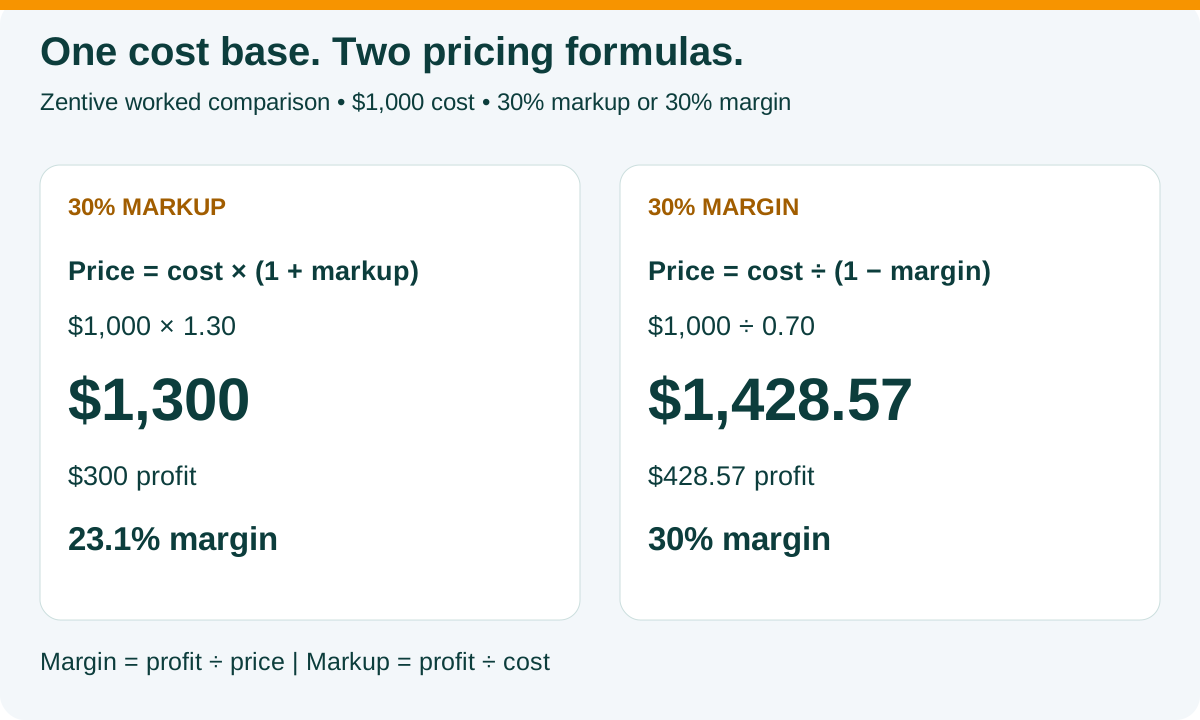
The cost base identifies the expenses included in each calculation. A job margin that includes allocated overhead measures the remainder after those assigned expenses. Company net profit includes the remaining business expenses for the accounting period.
The calculator applies the margin formula to the entered cost and target percentage. Completed-job records establish whether estimated labor, materials and allocated expenses matched the delivered work.
5. Check scope and present the estimate
Checking the scope and presenting the estimate gives the HVAC customer the work description, price, exclusions and terms for approval. The estimate records the equipment, work, taxes, warranty terms, payment schedule, validity period and approval process.
- Equipment models and included accessories.
- Services and installation tasks.
- Exclusions and scope limits.
- Taxes applicable to the transaction.
- Warranty terms for equipment and workmanship.
- Payment amounts and due dates.
- Validity dates and additional-work authorization.
What is a good–better–best HVAC proposal?
A good–better–best HVAC proposal presents three priced options for the same customer need, with differences in equipment, comfort features and included work. Each option identifies its equipment specifications, installation scope, warranty terms and total price.
| Proposal option | Example replacement scope | Customer comparison |
|---|---|---|
| Good | Correctly sized base system, standard controls and required installation work | Essential heating and cooling at the base package price |
| Better | Higher-efficiency equipment and upgraded compatible controls | Efficiency ratings, comfort controls and added price |
| Best | Premium compatible equipment, advanced controls and specified comfort upgrades | Performance features, included upgrades and total package price |
All three options include the work required for a compliant installation. The contractor calculates each option’s labor, equipment, materials, overhead and target profit. The proposal lists exact efficiency ratings and warranty terms for each selected model.
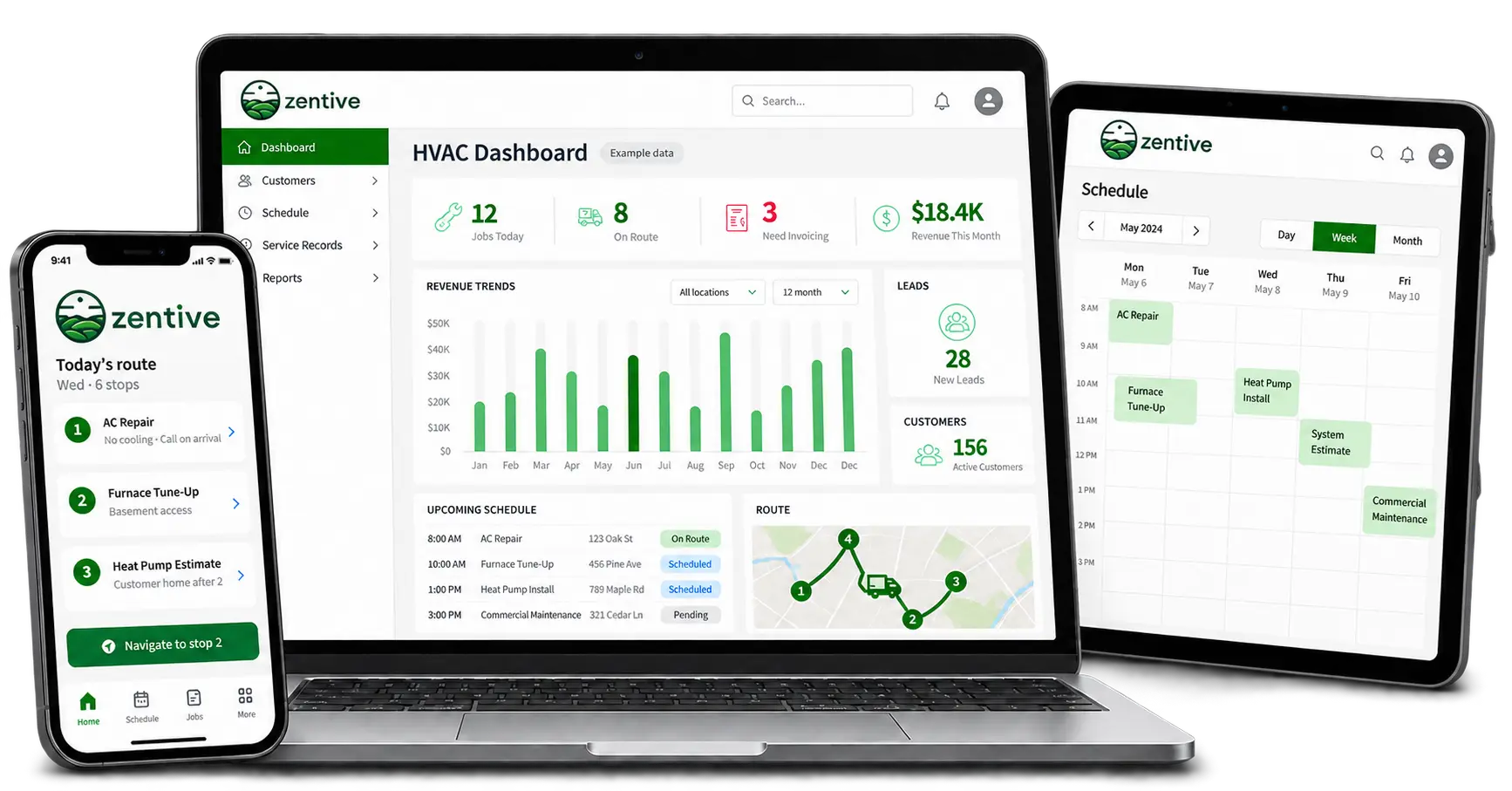
HVAC quoting software organizes the scope, price and approval of customer proposals. Zentive supports quotes with multiple options, so HVAC businesses offer good–better–best proposals within one quote. The HVAC business software overview explains Zentive’s quoting and job-management workflows.
The device mockup below shows a Zentive dashboard, a service schedule and the technician’s daily route.
What are 5 HVAC pricing examples by job type?
HVAC pricing examples are cost-to-price calculations for a defined service scope. The five job types below are diagnostic visits, repairs, maintenance, installations and commercial service, with cost inputs listed in calculation order.
Zentive’s worked examples use the margin formula above and a 30% job margin for each calculation.
| Job type | Cost inputs in order | Total cost | Selling price |
|---|---|---|---|
| 1. Diagnostic visit | Labor $60 + consumables $5 + allocated overhead $30 | $95 | $135.71 |
| 2. Repair | Labor $120 + parts $90 + consumables $20 + allocated overhead $50 | $280 | $400 |
| 3. Maintenance | Labor $90 + consumables $15 + allocated overhead $45 | $150 | $214.29 |
| 4. Installation | Equipment/materials $4,500 + labor $1,200 + subcontractor $400 + disposal/permit allowance $300 + allocated overhead $600 | $7,000 | $10,000 |
| 5. Commercial service | Labor $180 + parts $80 + site coordination $40 + allocated overhead $90 | $390 | $557.14 |
The repair calculation assigns two billable hours at $60 per hour to labor. Its $50 overhead allocation follows the repair’s defined cost base, matching the repair example in the startup article. The installation calculation divides $7,000 by 0.70 to produce $10,000 before applicable tax.
Each job record identifies the costs and allocation method used. Diagnostic visits specify the assessment scope. Maintenance specifies system count and tasks. Installations specify equipment, access and disposal. Commercial service specifies operating hours, documentation and site coordination.
What is an HVAC price book?
An HVAC price book is the contractor’s service-price reference containing scope, standard time, cost basis and selling price. Its entries record service codes, included work, time, materials, cost calculations, approved prices and review dates.
| Field | Recorded information |
|---|---|
| Service code | Unique identifier for the service |
| Scope | Included tasks and equipment coverage |
| Standard time | Measured task allowance |
| Parts and consumables | Included items and quantities |
| Cost basis | Labor, landed materials and overhead allocation |
| Selling price | Approved customer price |
| Review date | Date, reviewer and version |
An HVAC price-book template provides the fields for maintaining those entries. The HVAC Price Book CSV Template contains editable service and pricing columns.
Supplier-price changes, wage changes and revised service scope trigger a price review. Completed-job costs reveal recurring differences between estimated and actual work. Version history preserves the price and terms used in each issued estimate. Emergency and after-hours fees appear in the customer’s approved terms.
What else affects HVAC pricing?
HVAC pricing reflects service scope, costs and profit targets. Maintenance plans, discounts and diagnostic fees apply those decisions.
Should HVAC maintenance plans have different pricing?
Yes. Maintenance-plan prices reflect visit frequency, included tasks and delivery costs. An HVAC service contract records the scope and payment terms. The HVAC Service Contract Template: 10 Sections and Agreement Guide provides the agreement fields.
Should an HVAC contractor lower prices to win more jobs?
No. Lower prices require a cost-supported offer and a defined acquisition objective. HVAC marketing connects that offer with suitable customers. The HVAC Marketing: 8 Strategies, a Plan Template and Campaign Ideas organizes the acquisition plan.
What is the difference between HVAC markup and margin?
Markup divides profit by cost, while margin divides profit by selling price. Adding 30% to $1,000 produces $1,300 and a 23.1% margin. A 30% margin requires $1,428.57 on the same cost base.
What is a typical HVAC diagnostic fee?
HomeGuide reports $75–$200 for an HVAC diagnostic or service call. The contractor specifies the assessment scope and any credit toward repairs.
How does HVAC software support consistent job pricing?
HVAC software connects estimates, customer records and invoices. Zentive supports the workflow from an agreed job price to scheduled work and billing. The heating and cooling business software page explains Zentive’s connected workflow.