


HVAC marketing is how a contractor promotes heating, ventilation and air conditioning services to customers in its service area. The plan template covers 7 fields: service, audience, offer, capacity, channel, responsibility and results. The 8 strategies are website conversion, local search, paid ads, reviews and referrals, email follow-up, social content, local partnerships and seasonal campaigns. One number ties them together. Cost per booked job compares what a campaign spent with the work it put on the schedule.
What is an HVAC marketing plan?
An HVAC marketing plan is a customer-acquisition plan that connects a service offer with an audience, delivery capacity and a measurable result. The 7 fields identify the service, audience, offer, capacity, channel, responsible employee and success measure in that order.
| Plan field | Cedar Route HVAC example |
|---|---|
| 1. Service | Residential heat-pump replacement estimates |
| 2. Audience | Homeowners with aging systems in the service area |
| 3. Offer | Replacement assessment with a written installation scope |
| 4. Capacity | Six additional estimate appointments this month |
| 5. Channel | Search campaign followed by estimate follow-up |
| 6. Responsibility | Office coordinator qualifies inquiries and records outcomes |
| 7. Success measure | Qualified appointments, approved estimates and completed-job contribution |
The monthly plan assigns a spending limit, campaign dates and an inquiry owner. Capacity includes assessment time, installation availability and the supplier's equipment lead time. A replacement campaign and a repair campaign use different service pages and qualification questions.
Which HVAC marketing channels fit each goal?
An HVAC marketing channel connects a service offer with a customer’s route to discovering or choosing a contractor. The comparison below covers organic search, paid search, local-service ads, paid social and referrals.
| Channel | Main purpose | Cost structure | Results to track |
|---|---|---|---|
| SEO and Google Business Profile | Reach people researching local HVAC services | Website, content and profile-management work | Qualified calls, forms and organic bookings |
| Google Search ads | Reach people searching for a named service | Paid clicks plus creative and campaign management | Search terms, qualified leads, bookings and completed-job contribution |
| Google Local Services Ads | Generate local service inquiries | Pay-per-lead plus administration | Valid leads, service-area fit, booking rate and completed jobs |
| Meta ads on Facebook and Instagram | Introduce maintenance and replacement offers | Campaign budget, creative and management | Qualified form submissions or calls, appointments and acquired customers |
| Customer referrals and local partnerships | Generate introductions from existing relationships | Referral-program costs, materials and staff time | Referral source, qualification, booked jobs and repeat work |
Google describes Search ads as pay-per-click and Local Services Ads as pay-per-lead. Meta Blueprint describes campaign budgeting for auction-based advertising. Total acquisition cost includes the creative, management and follow-up costs assigned to the campaign.
The contractor chooses channels around the service, local demand, staffing and appointment capacity. Campaign records identify the source of each inquiry and use the same definition of a booked job across channels.
What are the 8 HVAC marketing strategies?
HVAC marketing strategies are 8 customer-acquisition methods that connect the contractor's services with local demand. The strategies progress from the website and discovery channels to customer relationships and seasonal planning.
- Improve HVAC website conversion
- Build local-search visibility
- Run paid HVAC campaigns
- Earn customer reviews and referrals
- Use email and customer follow-up
- Publish HVAC social content
- Build local partnerships and offline campaigns
- Match campaigns to seasonal demand
1. Improve HVAC website conversion
Improving HVAC website conversion helps service-page visitors complete the next action, such as calling or requesting an estimate. A repair page identifies the equipment serviced, operating territory, availability and next action.
The page organizes the information a customer needs before contacting the business.
- Services (AC repair, heating maintenance, heat-pump installation) identify the work offered.
- Locations (towns, ZIP codes, service boundaries) identify coverage.
- Qualifications (licenses, certifications, insurance) identify documented credentials.
- Evidence (project photos, customer reviews, equipment experience) supports the service description.
- Contact controls (phone button, service form, estimate request) connect the customer with the office.
A mobile form records the customer's name, contact details, location and service need. The confirmation states what happens next. The office records the inquiry and assigns follow-up responsibility. Form testing includes field labels, keyboard operation, error messages and delivery to the correct inbox.
2. Build local-search visibility
Building local-search visibility helps customers discover an HVAC business in map results and organic search. Google's “Tips to improve your local ranking on Google” identifies relevance, distance and prominence as the three main local-ranking factors.
Google's “Guidelines for representing your business on Google” requires accurate business identity, categories and address or service-area information. A service-area contractor's profile reflects the territory actually served and the hours customers receive service. Website service pages explain scope, equipment types and contact options.
An HVAC SEO plan organizes keyword intent, profile management, website content and technical checks. The local SEO guide for HVAC contractors article defines that work in sequence.
3. Run paid HVAC campaigns
Running paid HVAC campaigns purchases service-specific exposure through search, social and local-service advertising. Search campaigns address existing demand for a named service. Social campaigns introduce planned services, including replacement assessments and seasonal maintenance.
LocaliQ's 2025 home-services search-advertising report lists an average cost per lead of $127.74 for air conditioning installation and repair and $129.02 for heating and furnaces. These categories include Google and Microsoft search campaigns in the report's sample.
The campaign records service, territory, spending cap, destination page and lead outcome. Qualification fields capture equipment type, location, requested work and appointment availability. Outcomes distinguish out-of-area inquiries, unsuitable services, booked appointments and completed jobs.
An HVAC ad is a paid message with a service offer and response action. The HVAC advertising guide provides examples for search, social, seasonal and print campaigns.
What does a simple HVAC Meta ad include?
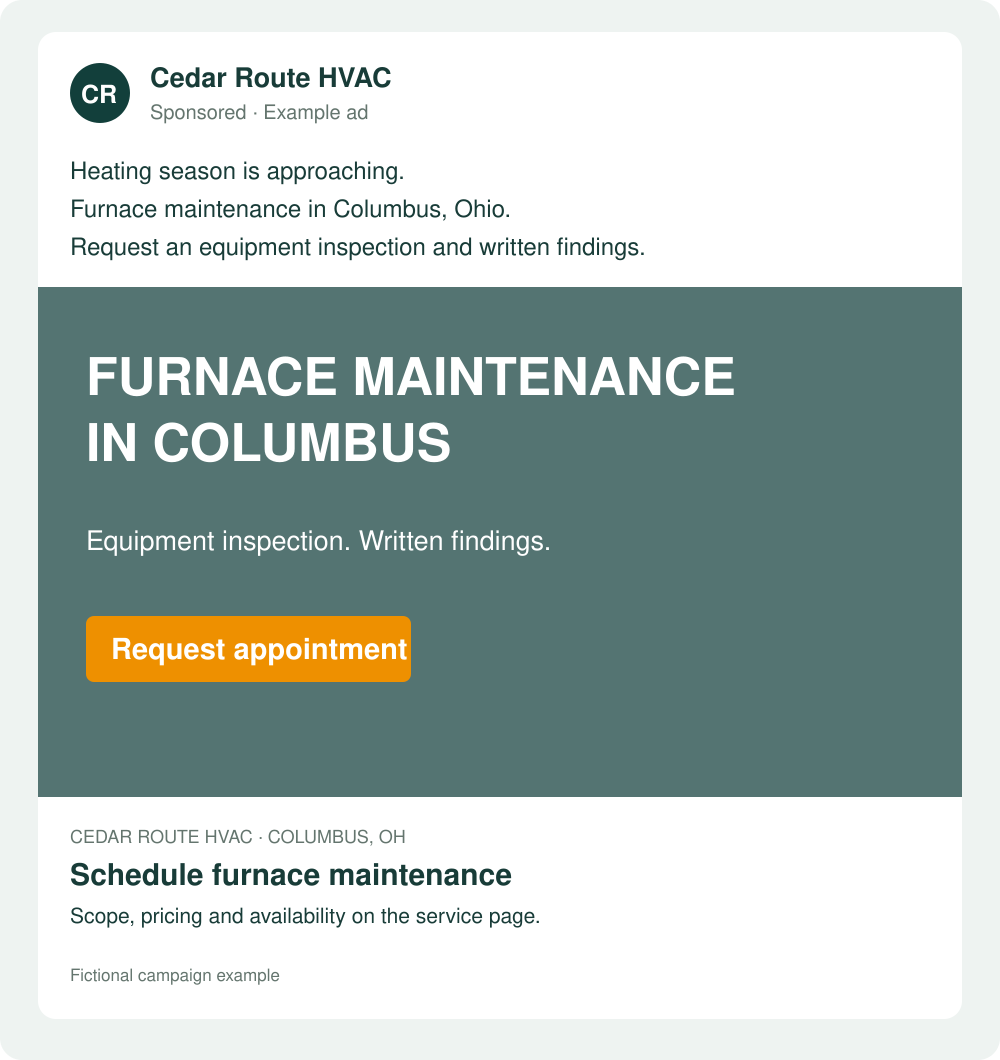
An HVAC Meta ad promotes a specific service on Facebook or Instagram with an image, offer and response action. A maintenance campaign identifies the service area, included work and appointment request. The example below shows an ad for the fictional Cedar Route HVAC business.
| Ad element | Example content |
|---|---|
| Primary text | Heating season is approaching. Cedar Route HVAC offers furnace maintenance in Columbus, Ohio. Request an appointment for an equipment inspection and written findings. |
| Image headline | Furnace maintenance in Columbus |
| Supporting copy | Equipment inspection. Written findings. |
| Call to action | Request appointment |
| Destination | A furnace-maintenance page with service scope, price, exclusions and appointment request |
The office records the campaign source and follows each inquiry through qualification, booking and completed work. The creative and destination page use the same offer. The published ad states any price conditions and service-area limits.
4. Earn customer reviews and referrals
Earning customer reviews and referrals gathers published HVAC service feedback and introductions to prospective customers. BrightLocal's 2026 Local Consumer Review Survey reports that 71% of consumers use Google to read local business reviews.
Google's “Tips to get more reviews” prohibits incentives for posting, changing or removing reviews. Google's Maps contribution policy prohibits selectively soliciting positive reviews. A consistent request process follows completed service and reaches customers regardless of the expected rating.
A review request identifies the completed service and provides the review destination. The response process acknowledges the issue, records follow-up and protects customer information. Referral records identify the referring customer, referred contact, service requested and resulting job. Any referral-program payment has written terms independent of the review process.
5. Use email and customer follow-up
Using email and customer follow-up connects HVAC customers with relevant estimate updates, maintenance appointments and renewal information. The customer's previous work and current service need determine the message.
| Message | Audience | Content and next action |
|---|---|---|
| Seasonal reminder | Customers with maintenance due | Equipment, included work and appointment request |
| Estimate follow-up | Customers with an open proposal | Scope, outstanding questions and approval process |
| Agreement review | Customers approaching renewal | Covered equipment, visit frequency, price and renewal terms |
The FTC's CAN-SPAM compliance guide requires accurate headers and subject lines, advertising identification, a postal address and an opt-out method in commercial email. The FTC requires opt-out requests to be honored within 10 business days. Under FCC rule 47 CFR 64.1200, covered telemarketing robocalls and robotexts require prior express written consent. Contact records retain consent and opt-out status.
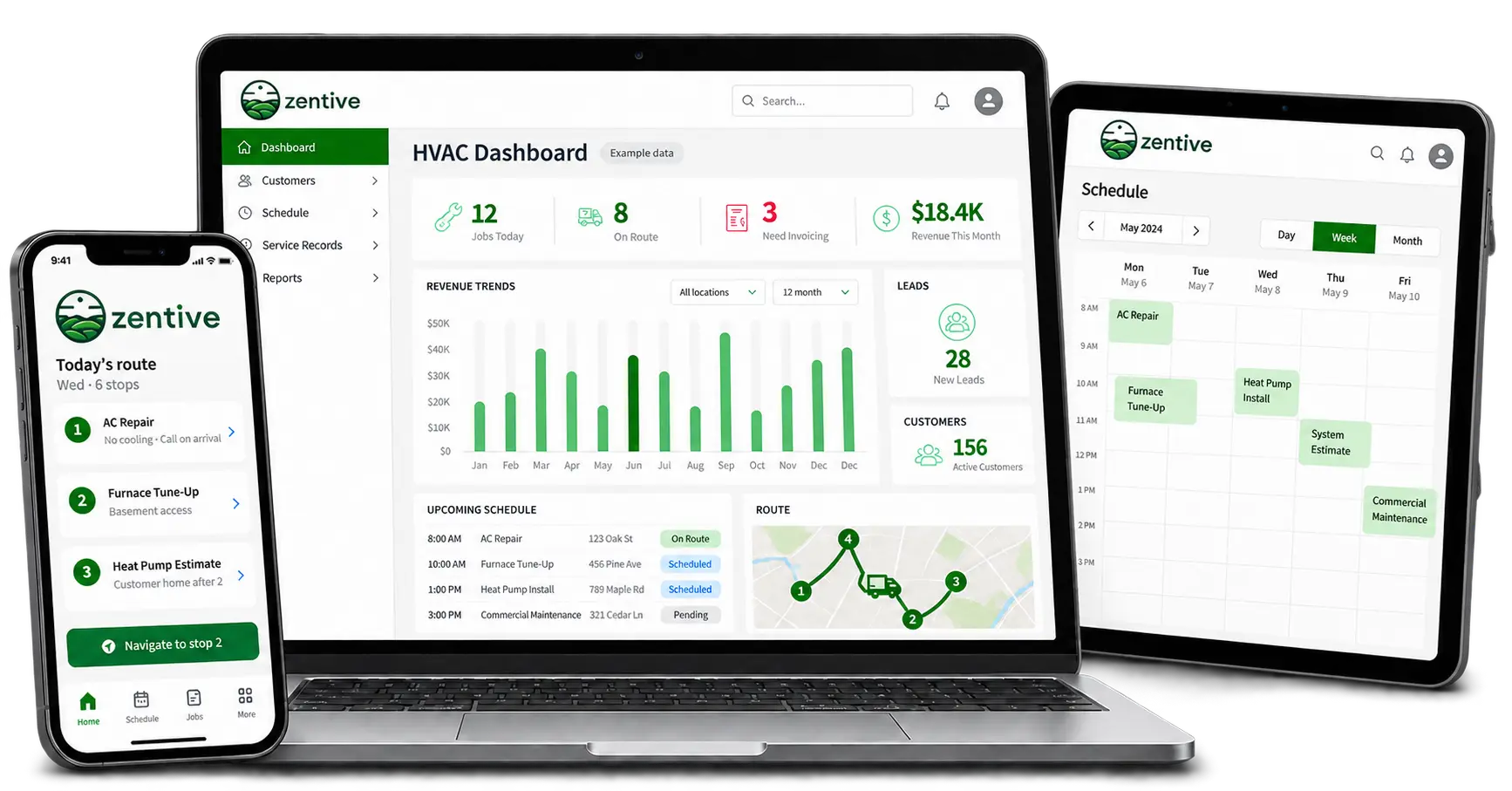
HVAC business software stores customer records, estimates, schedules and invoices. Zentive's HVAC business software connects these records with follow-up and approved work. The device image below shows the dashboard, service schedule and route used to organize work after an inquiry.
6. Publish HVAC social content
Publishing HVAC social content shows the contractor’s work, personnel and service process to prospective customers. Posts answer customer questions and show documented jobs with permission.
| Content type | Subject | Customer action |
|---|---|---|
| Service explanation | Maintenance scope and equipment types | Read the service details |
| Project record | Completed work and installation context | Request an assessment |
| Technician introduction | Role and documented qualifications | Contact the service team |
| Seasonal reminder | Equipment checks and appointment windows | Request maintenance |
The FTC's Endorsement Guides require disclosure of material connections between advertisers and endorsers. Paid creator posts identify the sponsorship. Customer statements retain their original meaning, and performance claims have supporting evidence.
A publishing schedule records the subject, image permission, service destination and response owner. Results include qualified inquiries and appointments associated with the post.
How do funny HVAC memes fit a social-content plan?
Funny HVAC memes use familiar heating and cooling situations to create lighthearted social posts. A contractor’s meme connects the joke with a relevant service topic, such as filter checks, seasonal maintenance or thermostat settings. The original meme below turns a dust-covered filter into a character.
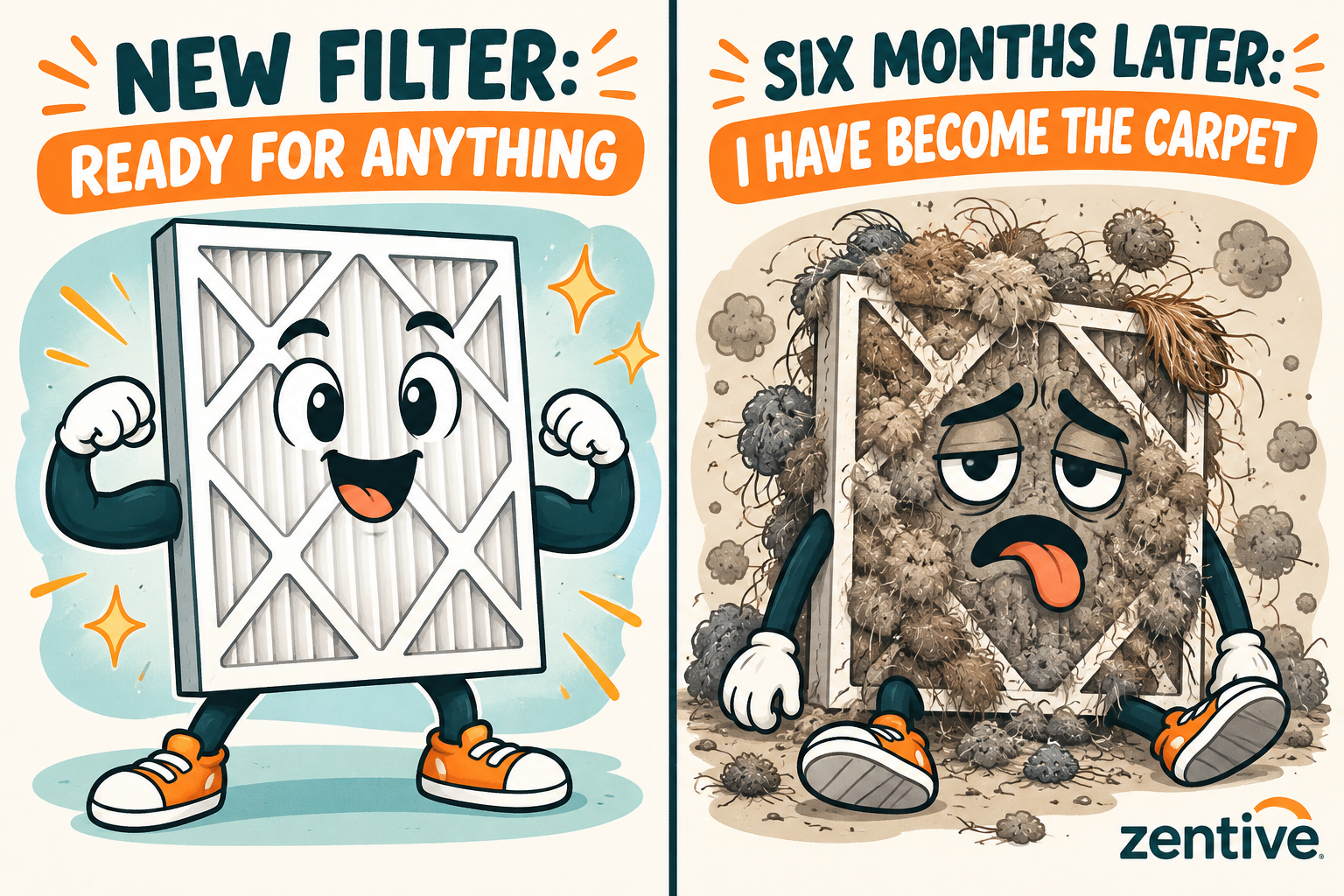
A caption connects this joke to maintenance: “This filter has collected more than memories. Filter checks follow the equipment manufacturer’s schedule and the conditions in the home.” The six-month setup is part of the joke. Filter replacement timing follows the equipment instructions and observed condition.
| HVAC meme idea | Relevant service connection |
|---|---|
| A dusty filter announcing its retirement | Filter checks and maintenance appointments |
| A thermostat caught between two preferred temperatures | Comfort settings and system assessment |
| An air conditioner awaiting the first hot day | Pre-season cooling maintenance |
Original artwork and licensed images keep the posting rights clear. Customer photos require permission. The publishing calendar balances humor with service explanations, job photos and appointment offers, then tracks local inquiries and booked work associated with each post.
7. Build local partnerships and offline campaigns
Building local partnerships and offline campaigns connects the HVAC business with referral sources and customers in its territory. Property managers, builders and complementary trades have defined service requirements, access procedures and approval contacts.
USPS Every Door Direct Mail distributes eligible marketing flats to selected carrier routes. As checked in October 2026, USPS lists EDDM Retail postage at $0.26 per piece for flats up to 3.3 ounces. Design, printing and preparation add to postage.
A direct-mail campaign records the route, household count, offer, response destination and total cost. A dedicated landing page or campaign code identifies inquiries. Vehicle graphics and printed materials use the same company name, service description and contact details as the website. An HVAC business name identifies the contractor across those materials. The HVAC company name ideas guide helps owners choose a consistent name for their local brand.
8. Match campaigns to seasonal demand
Matching campaigns to seasonal demand aligns HVAC maintenance and replacement offers with local heating and cooling needs. NOAA's National Weather Service calculates heating and cooling degree days against a 65°F baseline to describe temperature-related energy demand.
| Operating period | Campaign focus | Capacity record |
|---|---|---|
| Before cooling demand | AC maintenance and replacement assessments | Cooling-service appointments and installation availability |
| Before heating demand | Furnace and heat-pump maintenance | Qualified technicians and equipment-specific visit time |
| Peak demand | Repair availability and service coverage | Open appointments and response ownership |
| Lower-demand periods | Planned replacement and agreement follow-up | Available labor and contribution per job |
The campaign calendar combines local degree-day history with prior-year calls, current staffing and supplier lead times. Offer records state included work, system limits, dates and exclusions. Published availability changes when the schedule reaches its planned capacity.
How does an HVAC business turn inquiries into booked jobs?
HVAC lead follow-up is the process of recording an inquiry, checking service fit, assigning a response and confirming an appointment. Each stage has an owner and a recorded outcome.
| Stage | Action | Record |
|---|---|---|
| Capture | Collect the caller’s name, contact information, service address and issue | Campaign source and inquiry time |
| Qualify | Check territory, equipment type, requested service and urgency | Qualified lead or reason for declining |
| Respond | Answer questions and return missed calls | Assigned employee, next action and contact attempts |
| Book | Confirm an available appointment and service expectations | Agreed time, address, scope and customer confirmation |
| Deliver and measure | Record completion, invoice and campaign outcome | Completed work, revenue and contribution after marketing |
A missed-call queue gives the office a named contact owner and a next-action deadline. The office reviews unreturned calls and unconfirmed requests before increasing campaign spending. A requested appointment becomes a booked job after its time and service details are confirmed.
How will Zentive’s Quo integration support an AI phone receptionist?
Zentive’s Quo integration is in development to connect an AI phone receptionist with the HVAC customer workflow. The planned experience lets the receptionist answer calls, collect service details and help book jobs while the owner works in the field. Caller information and follow-up connect with Zentive so the owner and office see the next action. Scheduling permissions, availability and booking behavior depend on the completed integration and configured workflow.
How much should an HVAC business spend on marketing?
An HVAC marketing budget is the revenue allocation for customer acquisition and retention. The operating plan allocates that budget across media, creative work, website support and follow-up.
HVAC marketing budget calculator
An HVAC marketing budget calculator estimates an acquisition-cost ceiling from job contribution, the amount retained after marketing, conversion rates and available appointments. Job contribution is revenue less fulfillment costs before acquisition spending. The retained amount funds remaining overhead, reserves and profit.
Set a cost ceiling around job economics
All figures use the same campaign period. Total ceiling includes media, creative and campaign management.
Allowable cost per completed job = job contribution − retained contribution. Allowable cost per booked job = allowable completed-job cost × completion rate. Allowable cost per qualified lead = allowable booked-job cost × lead-to-booking rate. The capacity-based campaign budget equals allowable booked-job cost × open job slots.
The defaults use $250 contribution, $100 retained contribution, a 50% booking rate, a 90% completion rate and 6 open slots. They produce a $150 completed-customer acquisition ceiling, $135 per booking, $67.50 per qualified lead and an $810 total campaign ceiling. The ceiling includes assigned advertising, creative and management costs. Conversion rates are planning inputs, and actual spending follows measured results and cash availability.
How are HVAC campaign costs measured?
HVAC campaign cost measurement follows spending through inquiries, qualified leads, bookings and completed work.
Zentive's worked campaign spends $1,000 to generate 20 inquiries, 12 qualified leads and 6 booked jobs. That produces $50 per inquiry, $83.33 per qualified lead and $166.67 per booked job. The funnel diagram below shows the same spending and conversion sequence.
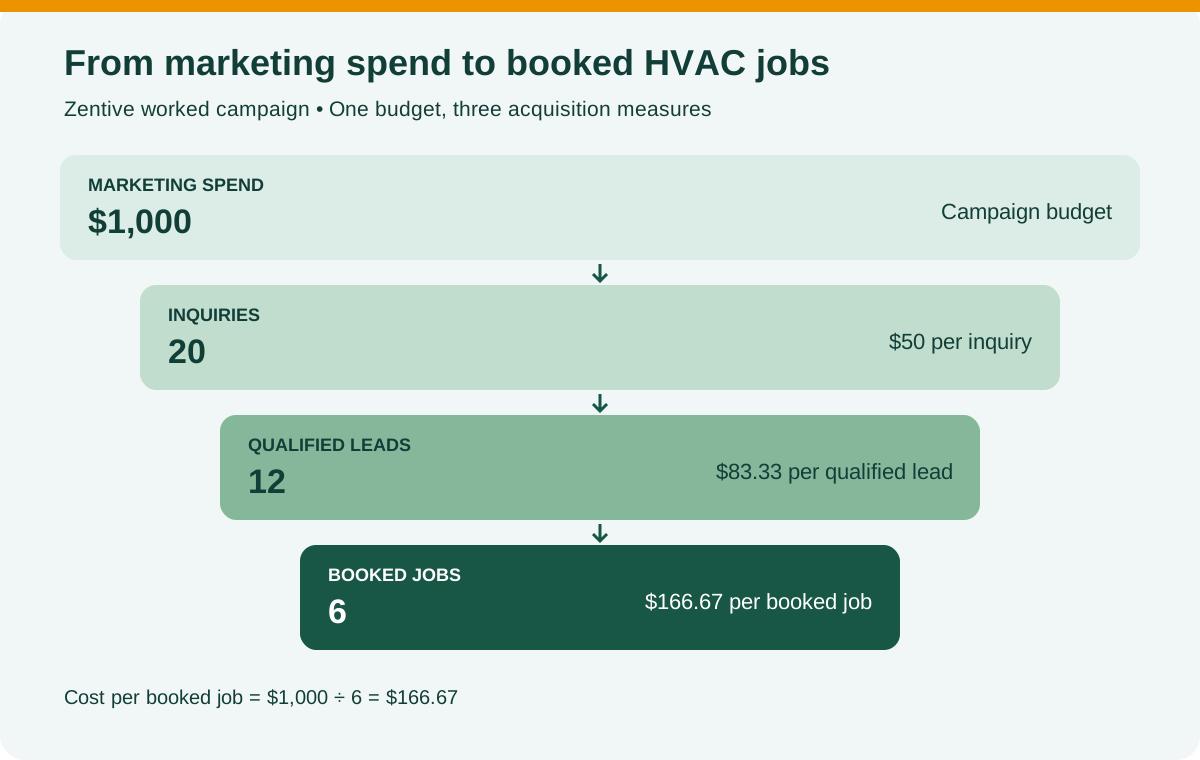
In this calculation, six completed jobs contribute $250 each after fulfillment costs. Their $1,500 contribution less $1,000 of campaign spending leaves $500 before any remaining business expenses.
The reporting table records the measures used at each stage.
| Measure | Calculation | Recorded outcome |
|---|---|---|
| Cost per inquiry | Campaign spend ÷ inquiries | All incoming contacts |
| Cost per qualified lead | Campaign spend ÷ qualified leads | Service and territory fit |
| Cost per booked job | Campaign spend ÷ booked jobs | Work added to the schedule |
| Cost per completed job | Campaign spend ÷ completed jobs | Work delivered |
| Contribution after marketing | Job contribution − campaign spend | Amount remaining before other expenses |
Campaign records use a consistent attribution method and count each job once. The owner reviews cancellations, unapproved estimates and collection outcomes alongside booked work.
What else affects HVAC marketing?
HVAC marketing depends on channel timing and service capacity. Maintenance relationships support repeat work.
Should an HVAC business invest in SEO or advertising first?
Advertising suits a business ready to fund and handle new inquiries. SEO suits a website needing stronger organic visibility. The choice depends on budget, capacity and existing search demand.
Can maintenance agreements support repeat business?
Yes. An HVAC service contract schedules recurring visits under an agreed scope and price. The HVAC maintenance agreement template provides the agreement fields.
What is a good cost per lead for HVAC marketing?
LocaliQ’s 2025 search-advertising sample reports $127.74 per lead for AC installation and repair and $129.02 for heating and furnaces. A viable lead cost depends on close rate and completed-job contribution.
How does HVAC software connect marketing with booked work?
HVAC software connects estimates, scheduled work and invoices after marketing generates an inquiry. Zentive supports the customer workflow established when starting an HVAC business. The HVAC business setup guide covers the launch requirements.