


An HVAC business plan is the document that sets out who the company serves, what it sells, how it delivers the work and how it pays for it. The plan has 7 sections: executive summary, company and services, market research, pricing and marketing, operations, financial forecast, and funding risks and milestones. Biz2Credit’s March 2026 financing guide puts HVAC startup costs at $15,000–$100,000, depending on location, size and scope. Zentive’s Cedar Route example starts with $22,500 in owner funding and ends month 12 with $75,000 in cash on the stated revenue and payment inputs. A monthly review checks job volume, capacity, costs, collections, financing and open assumptions.
What are the 7 sections of an HVAC business plan?
The 7 sections cover the summary, company, market, sales, operations, finances and funding. The previews show the planning workbook and completed Cedar Route financial example.
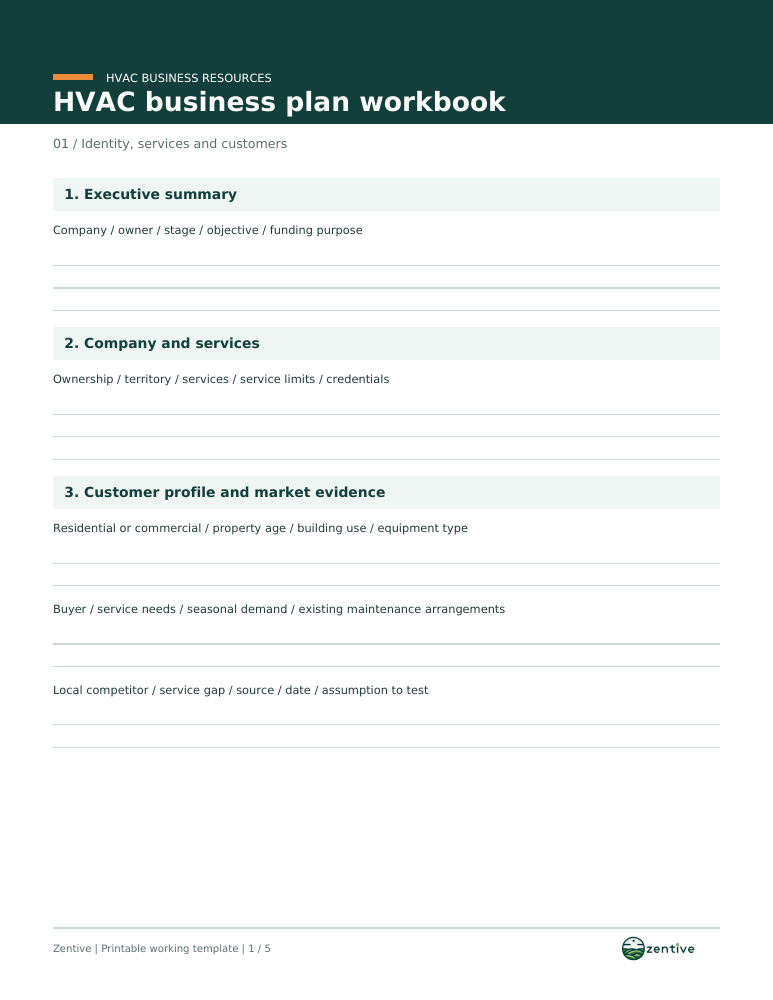
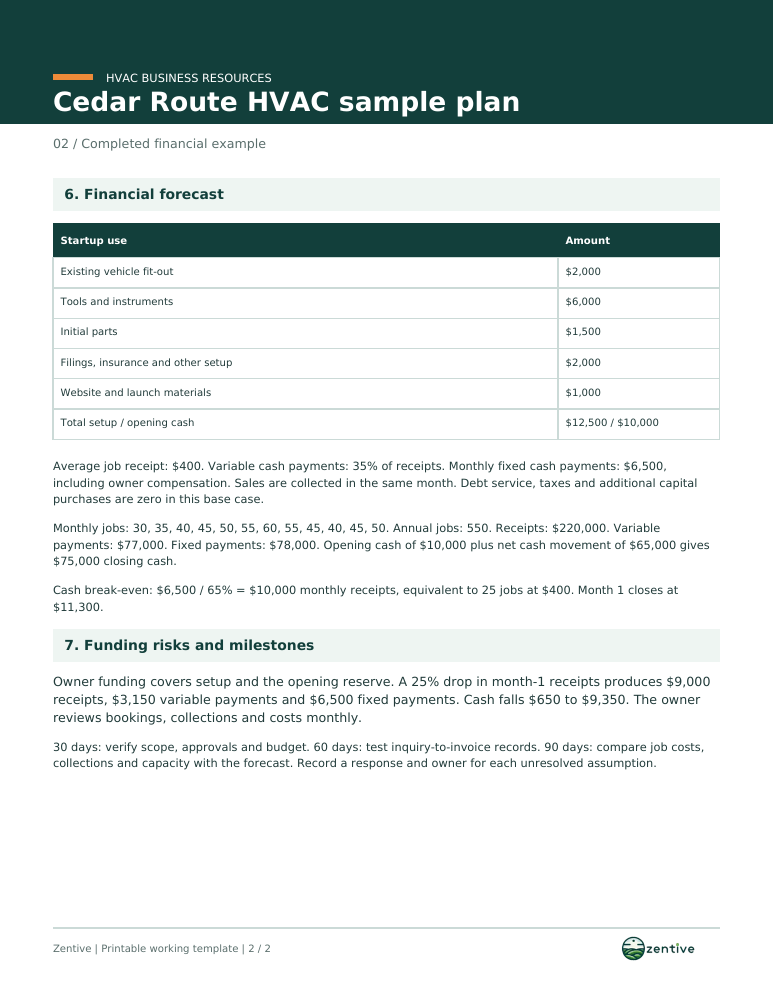
The completed Cedar Route HVAC business plan shows all seven sections in two pages.
- Write the executive summary
- Define the company and HVAC services
- Research customers and local competition
- Plan pricing, sales and marketing
- Set up staffing and daily operations
- Forecast startup costs, profit and cash flow
- Define funding needs, risks and milestones
1. Write the executive summary
Writing the executive summary introduces the HVAC company’s services, customers, leadership and immediate business objective. Cedar Route HVAC is the example owner-operated residential repair and maintenance business in this plan. It starts with one qualified field technician, scheduled administrative time and an existing service vehicle. The owner contributes $22,500 to cover $12,500 of setup payments and $10,000 of opening operating cash.
An HVAC company name identifies the business on registrations, estimates and customer communications. The HVAC company name ideas collection provides naming categories and availability checks.
2. Define the company and HVAC services
Defining the company and HVAC services records its ownership, territory, customers, qualifications and scope of work.
| Decision | Information recorded |
|---|---|
| Ownership and stage | Legal structure, owners and launch status |
| Customer type | Residential, commercial or a defined combination |
| Territory | Named service areas and travel limits |
| Services | Repair, maintenance, installation or selected specialties |
| Qualifications | Required licenses, technician credentials and permits |
| Service limits | Equipment and work categories outside the launch scope |
The plan records the authority, responsible person and renewal date for each required approval.
Cedar Route’s base case covers residential repair and maintenance. Installation projects require a project estimate and a capacity review before entering the operating forecast.
3. Research customers and local competition
Researching customers and local competition identifies HVAC demand, competing offers and the service area’s unmet needs.
| Research question | Evidence | Plan decision |
|---|---|---|
| Which properties need the service? | Housing, building and customer records | Customer segment |
| When does workload change? | Prior inquiries, climate patterns and supplier records | Staffing and reserve timing |
| What do competitors offer? | Dated service pages and published offers | Service scope and positioning |
| Which needs remain unresolved? | Repeated customer feedback and inquiry reasons | Delivery process |
| How do customers select a contractor? | Inquiry and estimate records | Sales message and response process |
The customer profile records residential or commercial use, property age, equipment type and service needs. Each research entry records its source, date and implication. A forecast then states job volume, booking rate and collection timing for the selected customer group.
4. Plan pricing, sales and marketing
Planning HVAC pricing, sales and marketing connects job costs and selling prices with the channels and follow-up used to win work.
Zentive’s worked repair calculation uses $280 in recoverable job costs and a 30% target margin to produce a $400 selling price. The Cedar Route cash-flow model uses that same $400 as its average completed-job receipt. A pricing guide defines the cost and margin calculations behind the price book. The HVAC markup and margin guide shows the shared repair calculation.
The sales record tracks the channel, inquiry, accepted estimate, completion and payment.
5. Set up staffing and daily operations
Setting up staffing and daily operations assigns responsibility for HVAC inquiries, field work, billing and customer follow-up.
| Stage | Responsible role | Required record |
|---|---|---|
| Inquiry | Office or owner | Contact, property and requested service |
| Estimate | Qualified estimator | Scope, exclusions and approved price |
| Schedule | Dispatcher or owner | Technician assignment and visit details |
| Field work | Qualified technician | Findings, completed work, time and photos |
| Billing | Office or owner | Invoice, payment and balance |
| Follow-up | Named account owner | Open issue or next visit |
The supplier record names the primary and backup supplier, ordering owner, reorder point and replenishment timing. Capacity includes paid time for travel, training, callbacks, administration and parts collection. HVAC technician compensation is the wage and benefit cost of filling the field role. The HVAC technician salary guide provides the wage context for staffing costs.
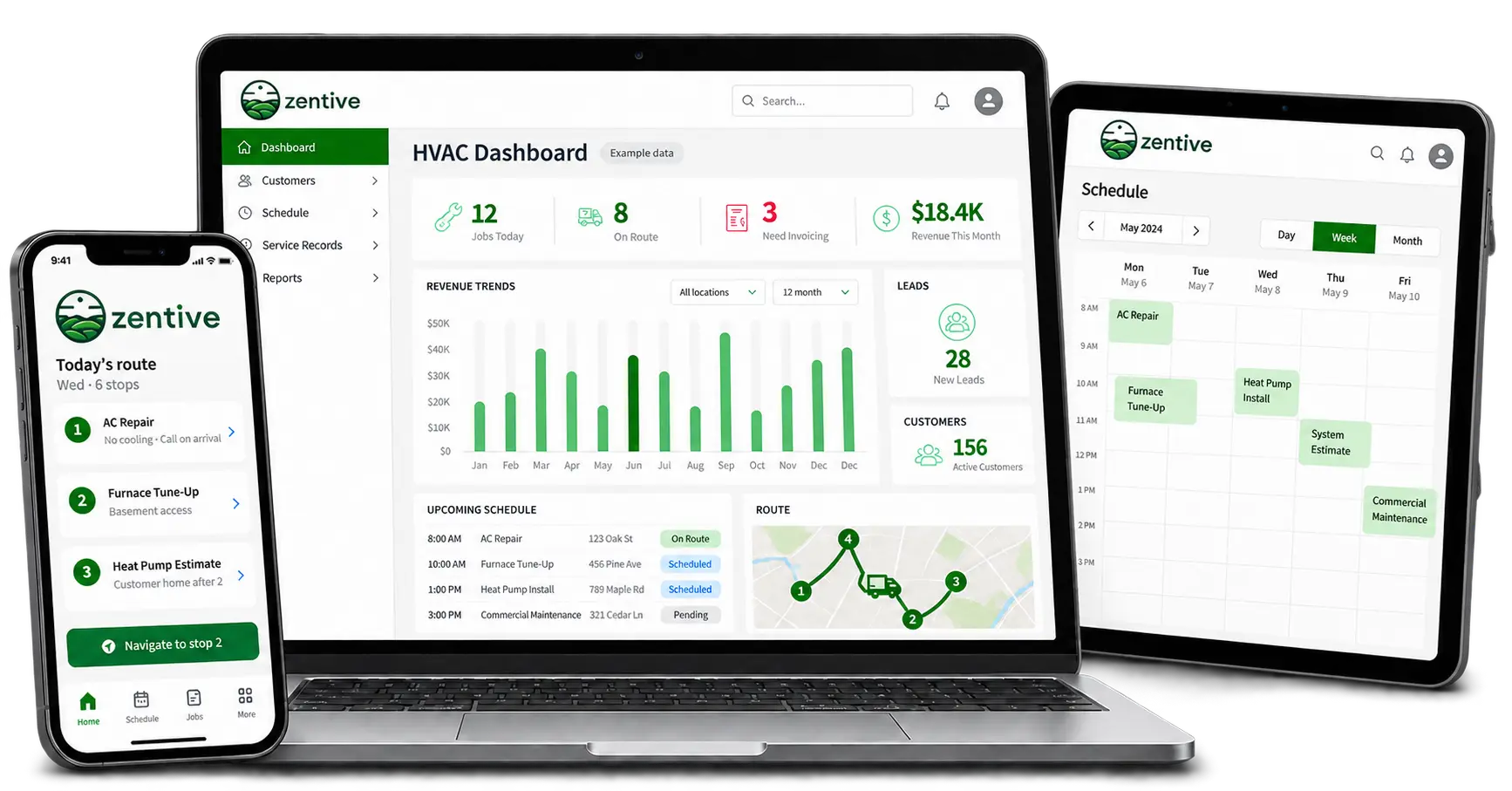
Zentive organizes customer records, quotes, technician schedules and invoices within the operating workflow. The device image below shows a job-and-revenue dashboard, service calendar and technician route.
6. Forecast startup costs, profit and cash flow
Forecasting startup costs, profit and cash flow models the HVAC business’s setup spending, earnings and available cash over time. The SBA’s startup-cost worksheet separates one-time purchases from ongoing expenses.
The table groups Cedar Route’s setup inputs into five spending categories.
| Cedar Route startup input | Amount |
|---|---|
| Vehicle fit-out, using an existing vehicle | $2,000 |
| Tools and instruments | $6,000 |
| Initial parts | $1,500 |
| Filings, insurance and other setup | $2,000 |
| Website and launch materials | $1,000 |
| Total setup payments | $12,500 |
| Opening operating cash | $10,000 |
| Owner funding | $22,500 |
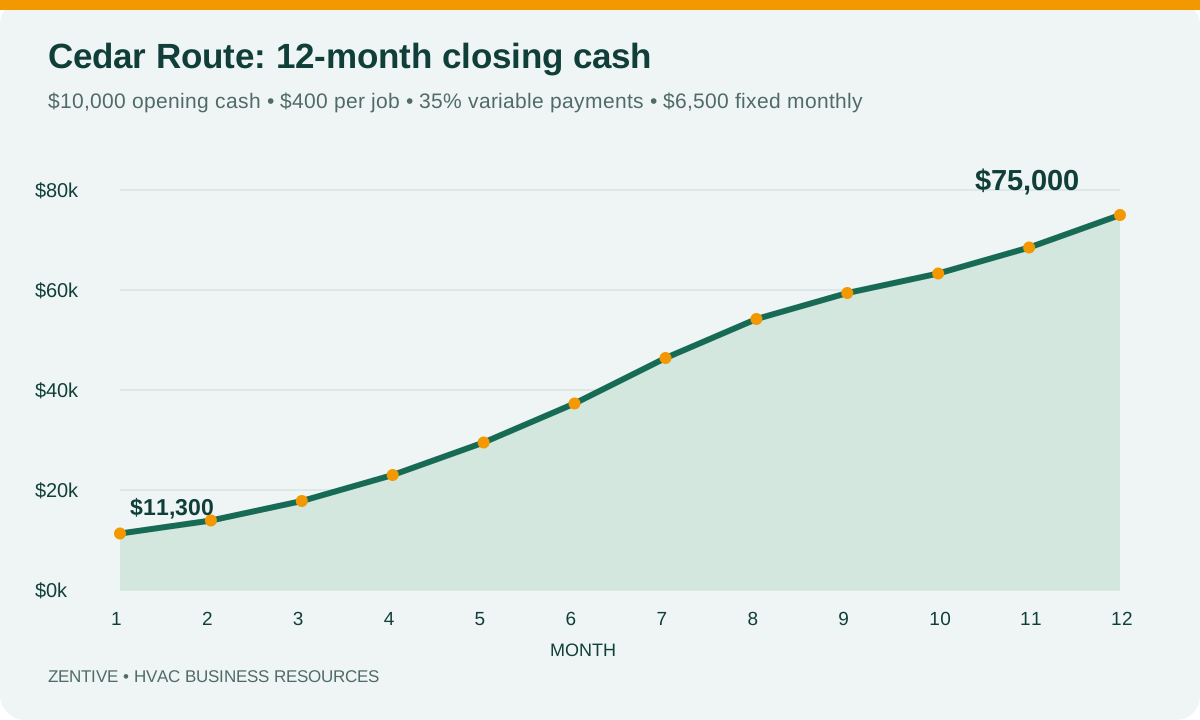
The operating model assigns $400 per completed job, variable cash costs of 35% of receipts and $6,500 in monthly fixed cash payments. The fixed amount includes the model’s owner-compensation allowance. All monthly sales are collected in the same month. Debt service, tax payments and additional capital purchases are set to zero in this base case.
The closing-cash chart below shows the result of these inputs over twelve months, followed by the complete monthly table.
| Month | Jobs | Receipts | Cash payments | Opening cash | Closing cash |
|---|---|---|---|---|---|
| 1 | 30 | $12,000 | $10,700 | $10,000 | $11,300 |
| 2 | 35 | $14,000 | $11,400 | $11,300 | $13,900 |
| 3 | 40 | $16,000 | $12,100 | $13,900 | $17,800 |
| 4 | 45 | $18,000 | $12,800 | $17,800 | $23,000 |
| 5 | 50 | $20,000 | $13,500 | $23,000 | $29,500 |
| 6 | 55 | $22,000 | $14,200 | $29,500 | $37,300 |
| 7 | 60 | $24,000 | $14,900 | $37,300 | $46,400 |
| 8 | 55 | $22,000 | $14,200 | $46,400 | $54,200 |
| 9 | 45 | $18,000 | $12,800 | $54,200 | $59,400 |
| 10 | 40 | $16,000 | $12,100 | $59,400 | $63,300 |
| 11 | 45 | $18,000 | $12,800 | $63,300 | $68,500 |
| 12 | 50 | $20,000 | $13,500 | $68,500 | $75,000 |
The monthly calculator below changes job volume, price, costs and the share of sales collected to show their effect on cash.
MONTHLY CASH FLOW CALCULATOR
Adjust one month of jobs, prices, costs and collections. Results update immediately.
Variable costs are paid on all completed jobs this month. Uncollected sales remain receivables. Add taxes, loan payments, owner withdrawals and other cash outflows to fixed payments as applicable. Opening receivable collections are zero.
At a 65% contribution rate, monthly cash break-even is $6,500 ÷ 0.65 = $10,000 revenue, or 25 jobs at $400 each. Month 12 closes at $75,000.
A cash-flow forecast records the opening balance, receipts, payments and closing balance for each month. The HVAC 12-Month Cash Flow Forecast CSV contains the same model. An operating forecast includes the company’s actual collection timing, supplier terms, payroll, taxes, loan payments and owner withdrawals.
7. Define funding needs, risks and milestones
Defining funding needs, risks and milestones identifies the HVAC company’s capital requirement, uncertainties and progress measures.
In Zentive’s downside calculation, a 25% reduction in month-1 receipts produces $9,000 revenue, $3,150 variable payments and $6,500 fixed payments. The monthly cash reduction is $650. The review records a response trigger for lower bookings, slower collections or higher job costs.
The workbook’s financing appendix tracks use of funds, qualifications, financial statements and supporting documents requested by the lender.
| Milestone | Responsible role | Evidence |
|---|---|---|
| First 30 days | Business owner | Scope, approvals and setup budget checked |
| First 60 days | Operations owner | Inquiry-to-invoice records tested |
| First 90 days | Owner and financial adviser | Job costs, collections and capacity compared with forecast |
How often should an HVAC business plan be reviewed?
A monthly review compares completed jobs, realized prices and technician capacity with the forecast. It reconciles cash and includes taxes, debt payments and owner withdrawals. Each unresolved assumption receives an owner and review date.
What else affects an HVAC business plan?
An HVAC business plan guides launch decisions. Actual operating results inform later revisions.
Is a business plan the same as starting an HVAC business?
No. A business plan defines the operating model and funding. Starting an HVAC business puts that plan into operation. The HVAC business startup guide covers the launch requirements.
Should pricing and marketing assumptions be tested before growth?
Yes. Job-cost estimates and HVAC marketing assumptions need comparison with completed, paid work. The HVAC customer-acquisition guide organizes the acquisition plan.
How long should an HVAC business plan be?
The SBA describes lean business plans as typically 1 page and traditional plans as dozens of pages. Lender requirements and operating complexity determine the detail.
How does HVAC software support the business plan?
HVAC software supports the customer, estimate, schedule and invoice workflows defined in the business plan. Zentive connects those daily operating steps. The HVAC Business Plan Editable Template provides editable planning fields.