
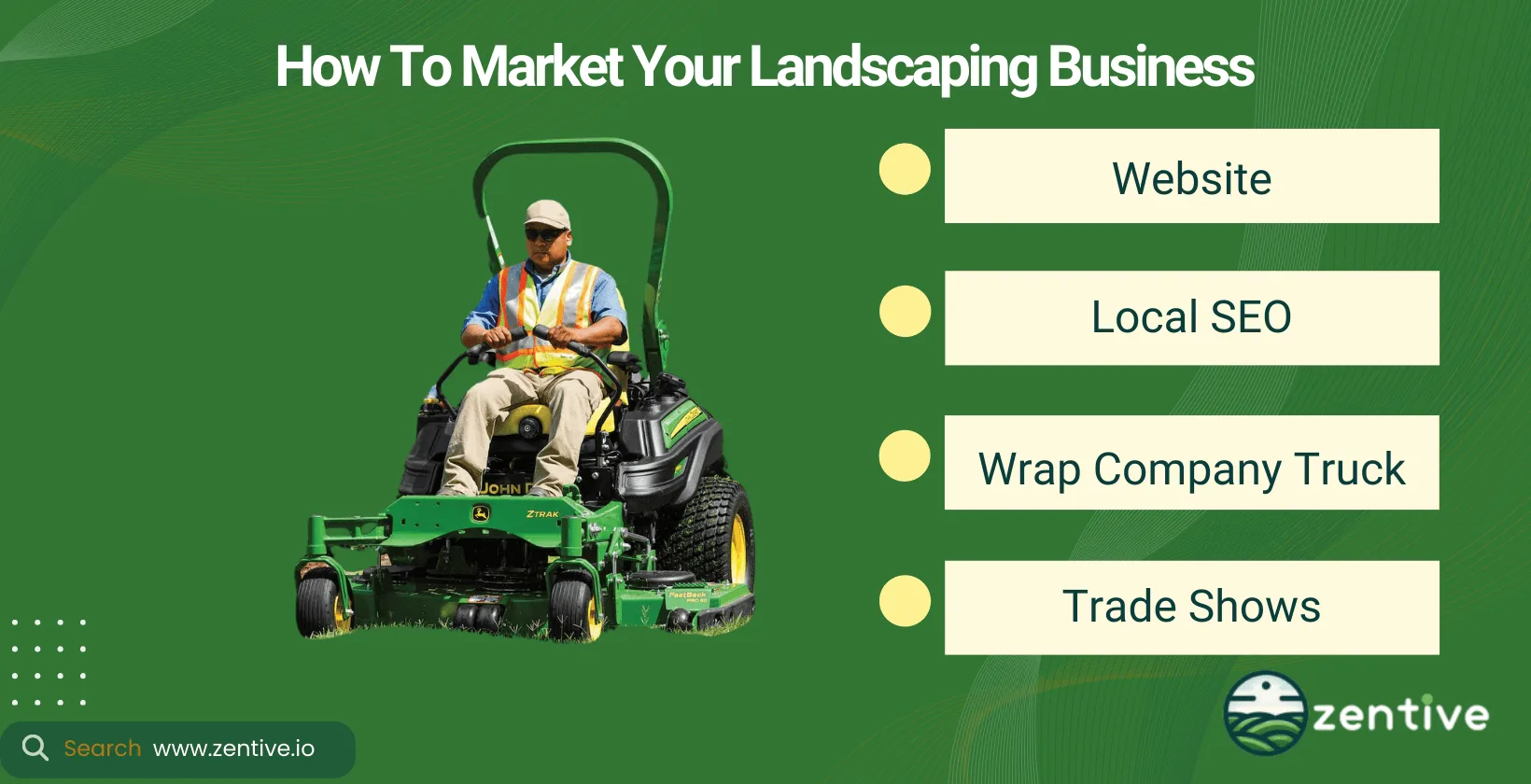
Landscape business marketing increases a landscaping company’s visibility to potential clients through digital and traditional outreach methods. Marketing is essential as it is the main method of acquiring new clients.
Various marketing strategies landscape businesses utilize include digital, traditional, referral (word-of-mouth), influencer, and community engagement.
Landscapers must address prerequisite factors before starting landscaping marketing. They must identify the target audience, determine their budget, identify resources, and set business goals.
This article provides a comprehensive guide to landscape marketing. We provide business advice for scaling a landscaping company, such as how landscaping software automates business operations.
The below table has 17 digital & traditional marketing strategies for landscaping companies to implement.
| Landscape Marketing Strategy | Description |
|---|---|
| Professional Website | A digital storefront displaying landscaping services, portfolio, and contact information. |
| Local SEO | Online optimization techniques targeting local search results for landscaping services. |
| PPC Strategy | Paid online advertising where businesses pay per click on their digital advertisements. |
| Email Marketing | Direct communication with subscribers through newsletters and promotional content. |
| Social Media Platforms | Content sharing on Facebook, Instagram, and other social networks to showcase services. |
| Influencer Marketing | Partnerships with social media personalities to promote landscaping services. |
| Local Magazine Advertising | Print advertisements placed in area-specific publications. |
| Outdoor Advertising | Physical promotional materials displayed in public spaces through billboards and yard signs. |
| Vehicle Wrapping | Branded designs applied to company vehicles for mobile advertising. |
| Cold Calling | Direct phone contact with potential clients to introduce services. |
| Direct Mail Marketing | Physical promotional materials sent directly to potential clients' mailboxes. |
| Referral Program | Incentive system rewarding existing clients for bringing new customers. |
| Promotions and Discounts | Special offers designed to attract new clients or retain existing ones. |
| Local Business Partnerships | Collaborative agreements with complementary businesses for mutual promotion. |
| Trade Show Networking | Participation in industry events to showcase services and build connections. |
| Community Events | Local engagement through event sponsorship or participation. |
| Brand Identity | Consistent visual and messaging elements across all marketing materials. |
1. Develop a Professional Website
A professional website showcases your services and expertise and is the digital storefront for your landscaping business. Search engines like Google and Bing direct potential clients to your website. The website should be visually appealing, easy to navigate, and optimized for mobile devices. It should include a portfolio of your past projects, customer testimonials, clear contact information, and an "About Us" page.
A well-designed landscaping website increases credibility and can significantly help grow your landscape business by providing a platform for potential clients to discover and explore your landscape services. A website requires some level of expertise to start and maintain. Freelancers from platforms like Upwork provide website development services to help you create and maintain your website.
Through a website, you'll be able to reach the thousands of potential landscaping customers who search online for landscaping services in your area.
A basic hosting service costs around $20-$50, and a freelancer can charge anywhere between $50 and $500 to create and maintain the website. Wix and WordPress enable DIY website creation. The ROI is relatively high as it serves as the main method to market your landscape services.
2. Optimize for Local SEO
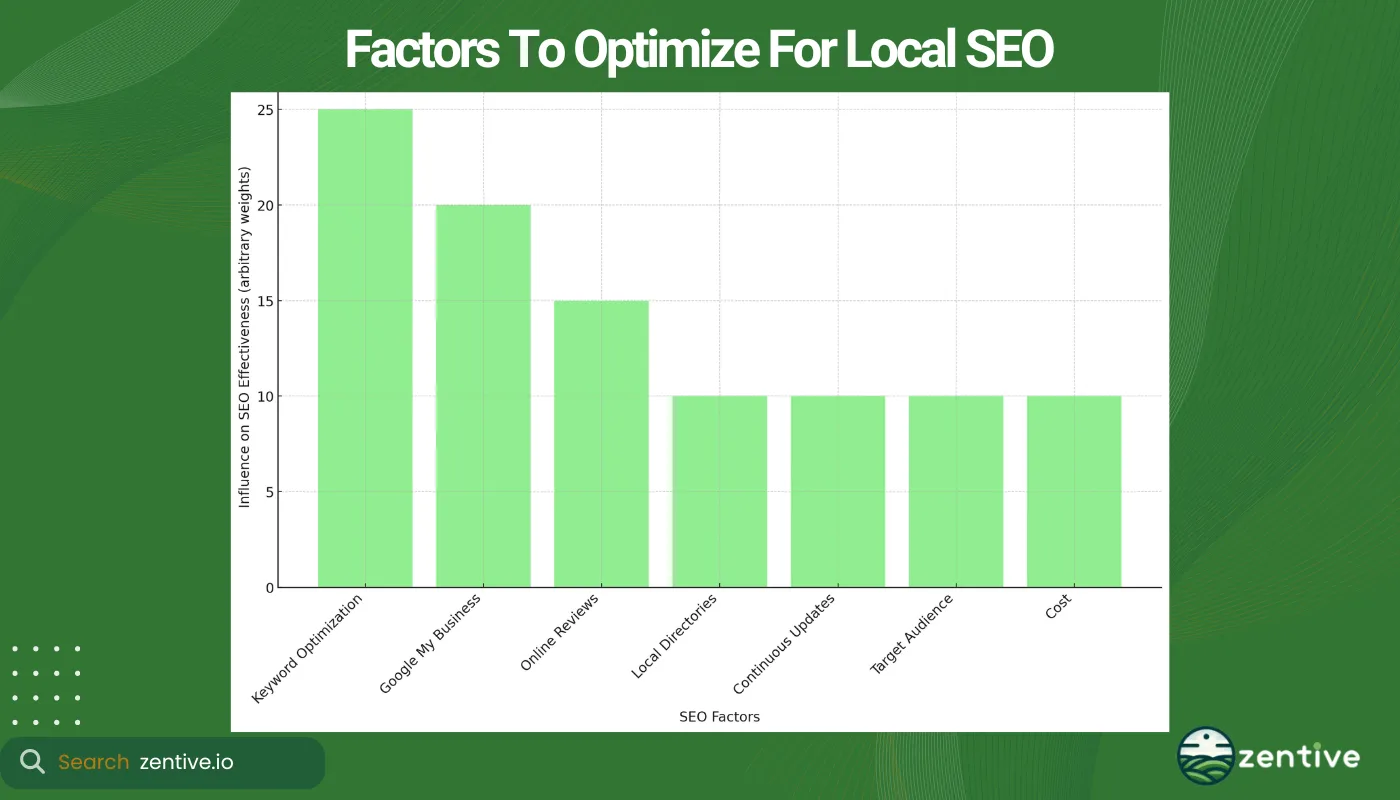
Local Search Engine Optimization (SEO) involves optimizing your online presence to appear in search results for local queries related to landscaping services. Local SEO ensures your landscaping business appears in search results when customers look for services in your area.
Local SEO includes keyword optimization. For instance, "Denver Landscaping Service," "Denver lawnmowing service," "landscaping services in Denver," and "lawnmowing Denver" if your services are in Denver. Claim and update your Google My Business listing and then ask people to leave online reviews (people trust other people's words and testimonials). Ensure your business appears in local directories, e.g., a website highlighting all the local services.
GMB Checklist
- Claim & verify Google Business Profile
- Add services & service areas
- Upload before/after photos weekly
- Request & reply to reviews
- Add booking/quote link
- Post promos/updates 2x per month
The main benefit of landscaping SEO is the improved visibility in local search results, leading to increased traffic and more potential business. SEO requires continuous effort and updates due to the changing algorithms of search engines. You'll either need to be adept at SEO or hire an SEO specialist to make this landscape marketing strategy truly effective.
The main target audience is local homeowners and businesses looking for landscaping services online. The cost of SEO can either be free if you take the DIY approach or can range between $50 to $1000 per month if you outsource it to a professional. When done correctly, it can be an exceptional asset in your landscaping marketing plan, leading to high ROI.
3. Launch Paid Ads (PPC) Strategy
Pay-per-click (PPC) is an advertising model in which you pay a fee each time one of your ads is clicked. You can use platforms like Google Ads to target specific demographics and locations, driving traffic to your website or landing page.
For instance, let's say you have a lawnmowing business and decide to launch a PPC marketing campaign. Your name will appear first on Google when people search for local lawnmowing services. PPC ads place your website at the top of search results, increasing the likelihood of customer clicks.
The main reason to use landscaping ads is that they provide immediate results and are highly targeted. PPC ads can be a costly marketing strategy for landscaping businesses if not managed properly, and the influx of leads may stop as soon as the campaign ends.
PPC landscaping ads are ideal to use for people who are actively searching for landscaping services or are browsing through local websites. It's important to monitor costs as they can start cheap - as little as $5 - but can run into a couple of thousand dollars if your type of landscaping service is popular. PPC offers a strong ROI due to its precise targeting capabilities.
4. Implement Email Marketing Campaigns
Email marketing involves sending out newsletters, promotional offers, and information to a list of subscribers to cultivate relationships and encourage repeat business. In order to advertise your landscape business through email marketing campaigns, you need to collect emails from clients and prospects at touchpoints like your website, current clients, or events. Use email marketing software to create and send regular communications to promote your landscape offers.
The main benefit of email landscaping marketing is that it keeps your business top-of-mind with your audience, builds loyalty, and can drive direct bookings.
On the downside, it takes a lot of work. You need to create compelling content and offers to prevent losing subscribers. Effective email marketing requires engaging content to reduce unsubscribes and improve customer retention.
The main target audience is existing customers and prospects interested in your services. Landscaping lead generation is cheaper than other marketing strategies, such as SEO. ROI is very low as roughly 1% of emails generate a new customer.
| Aspect | Details |
|---|---|
| Definition | Sending newsletters, promotional offers, and information to subscribers to cultivate relationships and encourage repeat business. |
| Email Collection | Collect emails from clients and prospects through your website, current clients, or events. |
| Tools Needed | Email marketing software to create and send regular communications. |
| Benefits | Keeps your business top-of-mind, builds loyalty, and can drive direct bookings. |
| Challenges | Requires compelling content to prevent losing subscribers. Recurring emails can annoy people, so emails must stand out. |
| Target Audience | Existing customers and prospects interested in your services. |
| Cost | Cheaper than other marketing strategies like SEO. Costs are primarily related to email marketing software. |
| ROI | Very low, with roughly 1% of emails generating a new customer. |
5. Engage on Social Media Platforms
Marketing through social media platforms involves using Facebook, YouTube, TikTok, Instagram, and Twitter to build relationships with customers and promote your landscape services. For landscaping social media marketing, you must post regular updates and engage with users through comments and messages. I would say the best way to utilize social media is to promote your services and specials and post before-and-after content of projects (people love seeing the type of difference your services can make).
Social media marketing increases brand awareness, engages local audiences, and improves customer loyalty. When you're social media account reaches a couple of thousand followers, you can even generate additional revenue from these accounts.
Social media marketing is time-consuming and requires consistent effort to maintain presence and engagement. I suggest you outsource your landscaping social media marketing to a social media specialist.
When done correctly, you can reach a broad audience, particularly younger homeowners who use social media frequently. Social media marketing has no cost unless you do paid ads. You can still achieve high visibility through an organic post; it just takes longer.
6. Collaborate with Influencers for Marketing
Influencer marketing refers to partnering with influential people on social media (people who have a lot of followers) to promote your landscaping services. Start by identifying influencers whose followers align with your target market and who post content that aligns with your niche. These influencers can showcase your work, review your services, or share content highlighting your business's quality and reliability.
Marketing with influencers is one of the best digital marketing strategies for quickly gaining exposure. Associating with trusted figures helps increase the credibility of your landscaping company. The downside is that it can be expensive depending on the influencer's reach and the risk of non-conversion if the influencer's audience doesn't align well with your brand.
The target audience is primarily younger homeowners active on social media platforms. Costs vary based on the influencer's popularity but can be anywhere from $100 to $1,000+. ROI is usually very good, especially when your brand matches well with the influencer's audience.
7. Advertise in Local Magazines
Advertising in local magazines involves placing ads in local print magazines that cater to your target demographic. This marketing idea works by designing attractive ads that highlight your landscaping services and special offers.
Choosing publications that are popular among local homeowners or related to home improvement is important. For instance, advertise your lawnmowing or hardscaping services in a landscaper or DIY magazine.
Advertising through local magazines ensures you reach a targeted local audience who may prefer traditional media. It's especially popular among older demographics, which works out great because they're often too old to conduct landscaping services themselves.
Print advertising can be costly, and tracking the direct impact on sales can be challenging. It's a high cost with a fairly average ROI. I suggest you consider some of the other landscaping marketing ideas before pursuing this one.
8. Invest in Outdoor Advertising
Outdoor advertising, such as yard signs, billboards, and banners, is an easy way to advertise your landscaping business. The most effective outdoor advertising strategy is to place signs in high-traffic areas or on properties where you've provided services, with permission. Use billboards to target specific neighborhoods or routes.
One of the best marketing strategies I've seen is that there was a yard completely neglected for a long time, with hundreds of cars driving by each day. One day, a lawn care service rehabilitated the yard and placed a large sign on the yard stating they performed the service. After that, business was booming.
Through outdoor advertising, you can increase local brand visibility while generating leads passively. Outdoor advertising can be expensive when placed in prime locations and requires strategic placement to ensure visibility to the right audience.
The target audience is local drivers and pedestrians, especially in areas where you want to increase your service footprint. Signs and banners incur moderate to high costs, depending on the location and size of the advertising. ROI is generally good, especially if your sign captures the audience's attention.
9. Wrap Company Vehicles for Visibility
Wrapping company vehicles refers to applying branded wraps that include your logo, contact information, and services offered. This turns your company vehicles into mobile billboards, advertising your landscaping business wherever they go. It's particularly effective when vehicles are driven or parked in high-visibility areas.
Vehicle wraps ensure that your business gains exposure every day, reaching a broad audience. The initial cost of wrapping vehicles is quite expensive - I suggest you do a trial run with one vehicle before wrapping all your vehicles to analyze the ROI.
10. Conduct Cold Calling Efforts
Cold calling connects businesses with prospects, generates leads, and converts sales. This proactive marketing strategy requires compiling a list of potential clients and effectively communicating how your services can benefit them.
When done correctly, cold calling leads to quick conversions. The success of cold calling depends on your sales pitch and the amount of client information you have available, allowing for a tailored approach.
The success rate on cold calling is fairly low and can be seen as intrusive. People often don't have time to listen to a cold call and usually just put the phone down or scold the caller. It requires a skilled approach to avoid rejection and foster positive engagement. While cost-effective when you do it yourself, the effectiveness of cold calling can vary greatly, making it a secondary option for many businesses.
11. Execute Direct Mail Marketing
Direct mail marketing reaches targeted audiences, delivers promotional content, and generates customer responses. Think of it as email marketing, but just more personalized. This traditional form of marketing is designed to catch the eye with attractive, informative content.
By targeting specific neighborhoods or demographics, direct mail can effectively reach potential clients who may not be as active online. This strategy works well for promotions and special offers.
The main challenge with direct mail is the significant cost of production and distribution. The response rates for direct mail are usually low if it's not a well-crafted flyer. That's why I suggest you hire a third-party professional landscape marketing agency to help you with direct mail marketing.
Direct mail marketing is a tried-and-tested tool for reaching certain demographics and generating good ROI.
12. Establish a Referral Program
Establishing a referral program incentivizes existing customers to refer new clients by offering rewards, such as discounts or free services. Referral programs are one of the most effective landscaping marketing strategies as they leverage the trust and satisfaction of your current clients to expand your customer base. People just trust recommendations from friends and family more than traditional advertising.
Referral programs are relatively cheap and yield quick results. The success of a referral program depends on the perceived value of the incentives and the satisfaction of your current clients. The marketing strategy only succeeds with quality landscaping service.
Overall, it's a low-cost marketing strategy with high ROI. But, success depends on the referral incentive you offer and the quality of your services.
13. Provide Promotions and Discounts
Offering promotions and discounts is a great way to attract new clients or boost sales when they're low. This can include seasonal discounts, loyalty rewards, or special pricing for new customers.
Promotions create a sense of urgency and can encourage clients to make decisions more quickly. You should use them to introduce new services and boost business during slower seasons.
While this strategy can temporarily reduce profit margins, if well-executed, it can increase overall revenue and customer loyalty. The key is to balance the offers to ensure they attract clients without significantly diminishing profits.
The effectiveness of this strategy depends on other marketing strategies—how else will you tell people about your promotions and discounts? Use SEO, PPC, outdoor advertising, and direct mail campaigns to ensure you target a large audience - everyone loves a good deal!
14. Forge Partnerships with Local Businesses
Forging partnerships with local businesses that share your target market but are not direct competitors can expand your reach. These partnerships can involve joint marketing efforts, shared promotions, or referral agreements. They not only increase your visibility but add credibility through association.
For example, collaborate with real estate agents. Chances are good that the property will need a bit of TLC before the agent can host an open house, so they will call you for the service, especially when you offer them a realtor discount. Alternatively, real estate agents can tell new homeowners about your services if they get a referral incentive out of the deal.
It's a very effective marketing strategy that works wonders and not many people do it. The costs are low, and the ROI is high. The main catch is finding partners that align with your brand values and customer base.
15. Network at Industry Trade Shows
Business networking for landscapers involves establishing professional relationships to exchange referrals, gain new clients, and share industry knowledge. Visit industry trade shows to meet potential clients, suppliers, and peers. This provides opportunities to showcase your services, learn about industry trends, and build professional relationships.
Trade shows can be particularly effective for reaching commercial clients and establishing your business as a key player in the landscaping industry. They offer a platform for direct engagement and can lead to valuable business opportunities.
Landscaping conferences are expensive as you need to pay fees for booth space and marketing materials. Not to mention that it takes a lot of your time - you need to be present for the entire duration of the show. Still, the potential returns justify the investment, especially for businesses looking to expand their professional network and industry presence.
16. Engage in Community Events
Engaging in community events means attending local sporting or charity events to increase your brand's visibility and connect with potential clients in a relaxed, informal setting. Sponsorships, participation, or hosting events can demonstrate your community involvement and commitment to local growth.
The main benefit of community events is that it builds goodwill and brand awareness, making your business a known entity within the community. It is especially effective for businesses that rely on local clientele. Your target audience is local residents who have value strong community.
The cost of engaging in community events is usually either free or cheap, depending on the level of sponsorship, but the long-term benefits of improved community relationships and local brand recognition can outweigh the initial investment.
I suggest you approach this marketing strategy as a secondary rather than a primary marketing method. For example, local sponsors gain more credibility for their advertisements (signs, vehicle wrappers, referrals) than they would if they didn't engage in community events.
17. Strengthen Company Brand Identity
Strengthening your company brand identity involves ensuring that all aspects of your business reflect a consistent and professional image. This includes everything from your business cards, logos, and uniforms to your social media profiles and advertising. Your brand identity reflects the level of your services. If you have a poorly designed logo or uniforms with holes in them, people will associate your brand with unprofessionalism, which is bad for business.
A strong brand identity is the key to help differentiate your business from competitors and build trust with potential clients. It requires a coherent branding approach across all channels. You need a good logo, well-designed clothes, and employees with good manners. It might not seem that way, but these all are marketing media.
While the costs associated with developing a strong brand identity can be considerable, the ROI is substantial in the long term. A well-defined brand attracts more clients and supports premium pricing by enhancing perceived value.
How To Pick A Marketing Strategy?
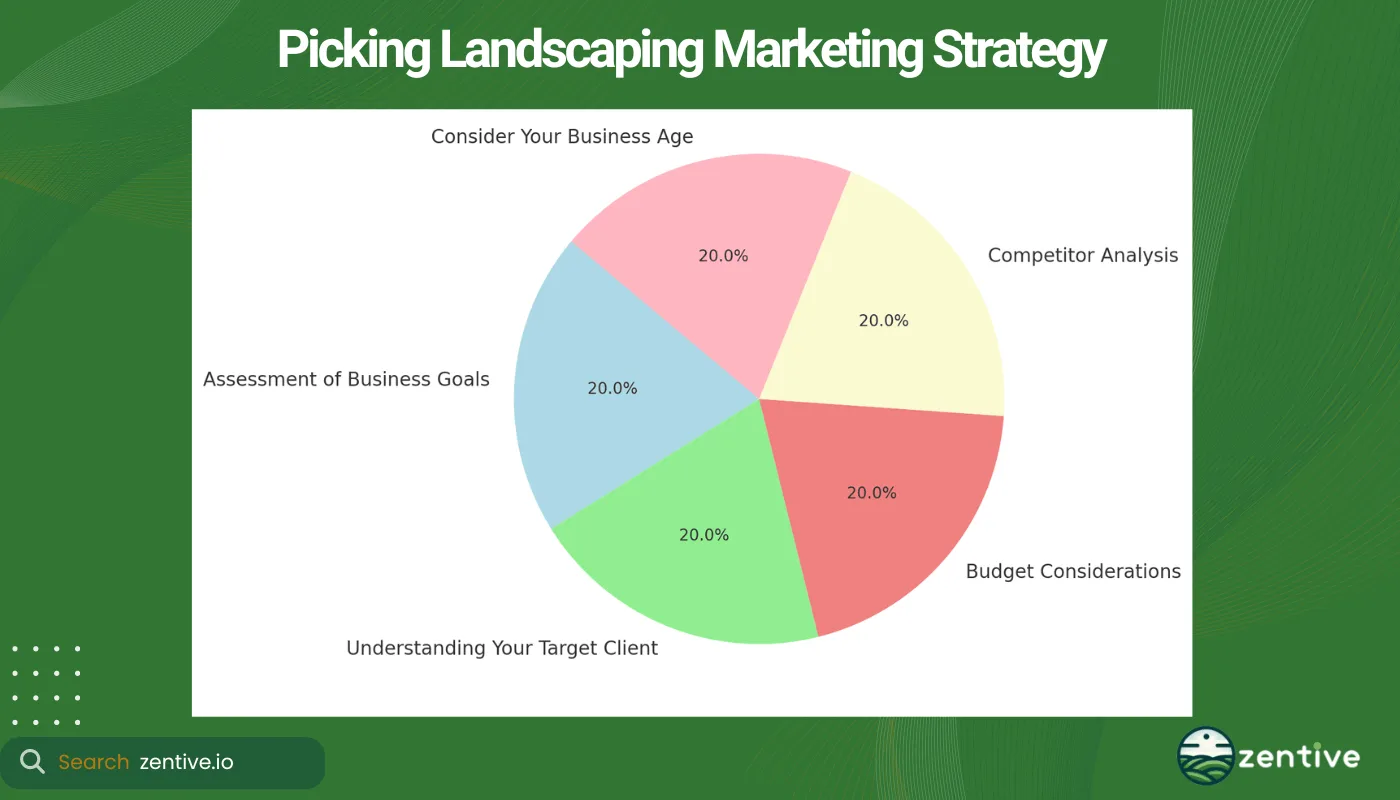
There are five steps you need to follow when picking a marketing strategy.
- Assessment of Business Goals: Define what you hope to achieve with your marketing efforts. New clients, increasing brand awareness, or boosting sales.
- Understanding Your Target Client (commercial or residential): Identify whether your primary audience consists of commercial clients or residential homeowners to tailor your marketing strategy.
- Budget Considerations: Determine how much you can afford to spend on marketing without jeopardizing other areas of your business.
- Competitor Analysis: Look at what your competitors are doing to attract clients and consider how you can differentiate your offerings.
- Consider Your Business Age: Younger businesses need aggressive marketing to build brand recognition, while established ones should rather focus on loyalty and retention.
Landscapers looking for professional marketing assistance can contact the Zentive team to inquire about our comprehensive marketing services. We're great at what we do, so let us help you show the world how great you are at what you do - landscaping!
How To Market Landscaping To Commercial Clients?
Marketing to commercial landscaping clients involves creating strategies that appeal to commercial clients, such as offering bulk discounts, subscription-based discounts, visiting trade shows, etc. Commercial clients include businesses, government agencies, and any non-residential entity that requires landscaping services for their properties.
Commercial clients are tricky. They don't just hand out their partnership without careful consideration. This is why it's important you demonstrate past projects. This provides proof of capability and experience, reassuring potential commercial clients of your ability to handle large-scale or complex landscaping projects.
What Is The Best Marketing Strategy For New Landscaping Firms?
The best marketing strategy for new landscaping firms is social media marketing as it's cheap and receives a lot of traffic. You can try offering discounts as people often just want cheap services.
New landscaping firms don't have a limitless budget, which is why they should use low-cost, high-impact marketing techniques to maximize visibility and client acquisition when starting a landscape firm.
How To Get Your First Landscape Client?
You can get your first landscape client by knocking on the doors of people with neglected lawns or who might need your specific landscape service. Offer them a discounted service fee, and they will most likely agree. Remember to take before and after photos and videos to use on social media.
Reach out to friends, family and acquaintances. This approach allows you to leverage existing trust and connections to introduce your services, which can lead to recommendations and referrals.
As your landscaping business grows, your marketing strategies should evolve to include more structured and diverse approaches, potentially incorporating more comprehensive digital marketing and formal advertising campaigns.
Marketing at the early stages of your business should focus on finding new clients while marketing at an established phase of your business should focus on customer loyalty and retention. You can't find new clients if there are only 1,000 people to advertise to, but you can retain their loyalty.
What Are Other Landscaping Business Tips?
There are four tips we always tell our people venturing into the business of landscaping. The first is to use landscape business management software. Tools like Zentive make running your landscaping business much easier. The software does everything from scheduling, invoicing, routing, reporting, and even client relationship management, which leads me to the next tip.
Prioritizing customer relationships through CRM strategies and tools can lead to higher retention rates and more referrals. A robust CRM system can track client interactions and preferences, helping personalize your services.
The third tip is to create a business plan. A well-crafted business plan outlines your business's objectives, strategies, and potential challenges. It guides your growth and is essential for securing investments or loans. I suggest creating both a short-term (6 months) and long-term business plan (5 years) to help guide both your short-term and long-term responsibilities and goals.
Lastly, hiring a sales team might be a good idea. They can focus on acquiring new clients and expanding market reach, which is crucial for handling and sustaining growth.
What Is A Landscaping Management Software?
A Landscaping management software is a specialized tool designed to increase the effectiveness of administrative and operational tasks in a landscaping business. Landscape business software like Zentive includes features for job scheduling, client management, invoicing, payment processing, and real-time communication with teams in the field. Traditionally, all these tasks would be done manually, but with Zentive, you can automate almost all the processes. This improves operational efficiency, reduces paperwork, and helps manage a larger customer base effectively. All in all, Zentive streamlines customer relations and increases sales by automating and optimizing daily operations.
How Does Landscape Business Software Help Attract Clients?
Landscape business software attracts clients by enhancing the customer service experience through efficient management and communication tools, as well as helping your brand look more professional. This type of software features a CRM that makes it easy for landscapers to grow their customer base.
A Customer Relationship Management (CRM) system helps businesses manage interactions with current and potential clients. It organizes information to provide personalized service and maintain high customer satisfaction. You leverage CRM systems in everything from quotes to invoices and curated ads.
What Is A Landscaping Business Plan?
A landscaping business plan is a formal document that outlines your business's objectives, strategies for achieving them, market analysis, and financial projections.
An outline of a typical landscaping business plan includes an executive summary, market analysis, marketing and operational plan, and financial projects. An executive summary is a concise overview of the business and its mission. What does your business do, and what are its values?
Market analysis provides insights into the industry, competitors, and target customer demographics. It needs to be accurate as you build your entire marketing and operational plan on it.
A marketing and operational plan is a detailed plan that outlines strategies for client acquisition and retention and details the daily operations of your business.
Financial projections are the estimated revenue, profit margins, and financial planning for future growth. Most new businesses close because their financial projections are flawed or incorrect. Make sure your financial projections are accurate before investing any money. Ask for a second opinion from people experienced in the industry.
Do Landscapers Need A Sales Team?
The size of your landscaping business will dictate whether you need a sales team - a small business doesn't require one, while a large business does.
Small, local landscaping businesses gain new clients with direct owner involvement in sales activities. As a business grows or targets large commercial contracts, a dedicated sales team becomes useful to increase landscaping sales. This team focuses on lead generation, nurturing client relationships, and closing deals, which are essential for scaling the business and managing more complex service offerings.
Get This Guide as a PDF
Save this article for offline reading. We'll send a formatted PDF straight to your inbox.
No spam. Unsubscribe anytime.
Ready To Streamline Your Field Service Business?
Zentive is the all-in-one field service management software built for home service and field service businesses. Start your free trial today.
No credit card required · Cancel anytime