
Landscaping SEO is a marketing strategy implemented to increase a landscaping business's online visibility on search engines. SEO improves a website's ranking in search results, helping clients find services. Using landscaping SEO improves online presence, increases traffic, and enhances credibility, which helps generate more sales.
Successful SEO requires developing and implementing a tailored strategy. It involves considering various aspects, especially local SEO, which is crucial for landscaping businesses targeting local clients. A well-planned SEO strategy boosts visibility and differentiates from competitors.
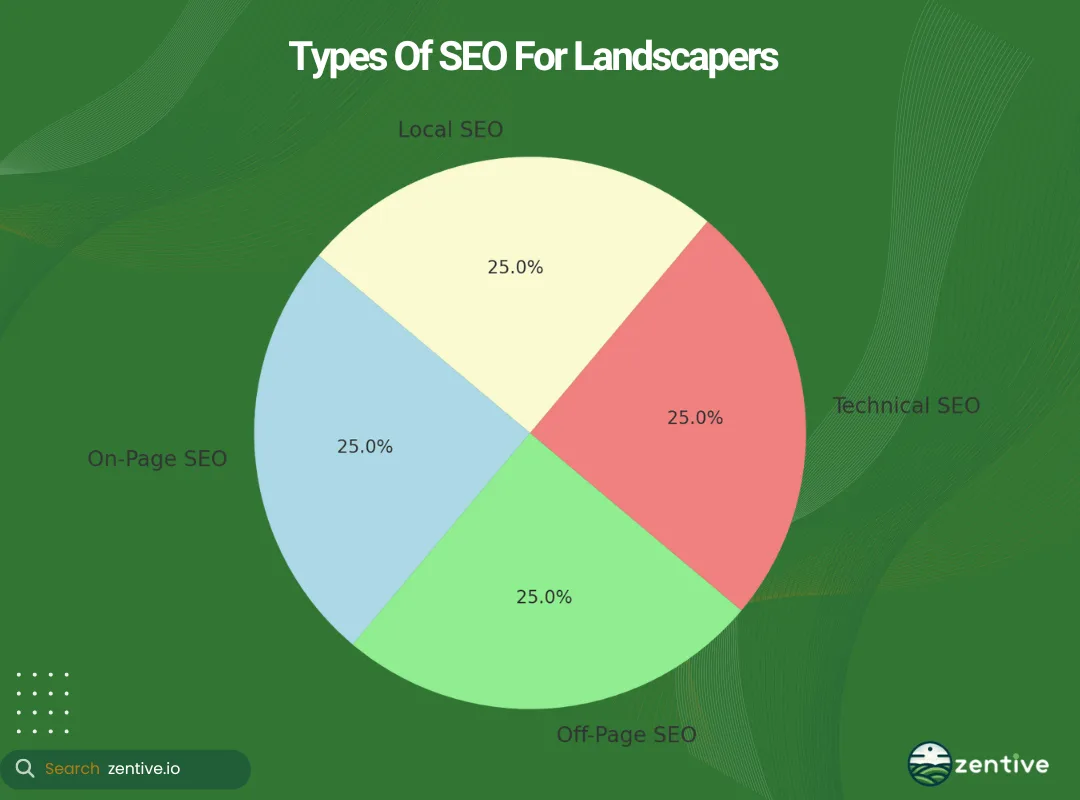
There are four types of SEO, and different landscaping businesses utilize them differently. For instance, a residential landscaping company might focus on local SEO to target homeowners in specific regions. In contrast, a commercial landscaping business operating in multiple cities needs a broader strategy to target large-scale projects and corporate clients.
Landscaping SEO Strategy Recommender
1) Business type
2) Service area
3) Primary goal
4) Monthly budget
$1,500
This article covers landscaping SEO, providing a step-by-step guide to optimization and offering tips for landscaping companies. You'll be able to implement SEO strategies effectively and attract more customers.
What Is SEO?
SEO (Search Engine Optimization) is a strategy for optimizing a website to improve its visibility and ranking on search engines like Google. Let's say you Google "lawnmowing services Houston," and then a list of local lawnmowing businesses appears on the search page. Through smart SEO, you can make your business appear higher on search results, which naturally leads to more visibility and new clients.
There are four main types of SEO landscaping companies can implement. The first type is On-Page SEO. This involves optimizing individual web pages to rank higher and earn more relevant traffic. This can be anything from publishing landscaping articles people search for to having a keyword-rich homepage.
Off-Page SEO, which focuses on external factors like backlinks that influence a website's ranking. This includes asking websites to link back to your site to increase the trustworthiness of your website.
Technical SEO ensures your website meets the technical requirements of modern search engines for improved indexing and crawling. This includes everything from website loading speed to using the correct linkings - HTTP vs. HTTPS.
Local SEO, which is arguably the easiest and most effective SEO strategy for new landscaping companies. Local SEO targets local search queries, e.g., "lawnmowing services Houston," and is essential where local clientele is the focus. SEO is one of the best methods of growing your business and increasing the revenue of your landscaping business.
Why is SEO Important For Landscaping Marketing?
SEO is an effective landscaping marketing strategy that helps attract more site visitors, potentially increasing client conversions. When a landscape company uses SEO in its landscape marketing strategy, it is able to stand out from its competitors and increase the rate of onboarding new clients.
Landscapers primarily use local SEO because it optimizes your presence for locality-specific queries. Landscaping companies operate on a regional basis, which is why local SEO is the most effective SEO campaign to use.
Landscapers should note that they need to follow a specific strategy when performing SEO, as it significantly impacts their marketing effectiveness and business growth. Not to worry; in the following sections, we'll discuss how you can optimize your landscaping SEO.
13 Steps To Optimize Landscaping SEO
There are 13 steps to implement to optimize landscaping SEO. Once implemented, your business will start gaining traffic and new clients at rates you haven't experienced before. Below table has 13 strategies to optimize SEO for a landscaping company.
| Strategy | Description |
|---|---|
| Optimize GMB (Google My Business) | Optimize GMB increases local Google Search and Maps visibility for landscaping businesses. |
| Build Local Citations | Build local citations improves NAP consistency and local rankings across trusted directories. |
| Gather Customer Reviews | Gather customer reviews strengthens social proof and boosts rankings through fresh review signals. |
| Build Backlinks | Build backlinks increases domain authority with high-quality links from relevant websites. |
| Target Relevant Keywords | Target relevant keywords aligns pages with high-intent local searches to capture qualified traffic. |
| Publish Blog Content | Publish blog content builds topical authority and earns organic visits with helpful articles. |
| Improve Title Tags & Meta Descriptions | Improve title tags and meta descriptions raises SERP click-through rates by matching query intent concisely. |
| Create Unique Imagery | Create unique imagery enhances on-page engagement and image SEO via descriptive alt text. |
| Optimize Website Design | Optimize website design increases conversions with fast, navigable, professional layouts. |
| Make Website Mobile Accessible | Make website mobile accessible delivers responsive performance that improves mobile rankings and UX. |
| Use Internal Linking | Use internal linking distributes link equity and guides crawlers to priority pages. |
| Enhance Technical SEO | Enhance technical SEO improves crawlability, indexation, speed, and security with HTTPS. |
| Monitor Your SEO Performance | Monitor SEO performance informs iteration with analytics and search data to refine strategy. |
1. Optimize GMB (Google My Business)
Google My Business (GMB) is a free service powered by Google. It allows local landscaping business businesses to create a business profile and enter information about their business, which helps improve their visibility on Google Search and Maps. It's especially important for landscapers because it directly affects how they are found by local customers. To optimize your GMB for a landscaping business, follow these four steps.
- Complete All Sections of Your Profile: Fill out every detail, including business hours, address, services offered, and contact information. How else are people going to know what you do if you don't directly mention it?
- Add High-Quality Photos: Show the world how good you are at what you do. Use professional photos to showcase your work and team and attract potential customers.
- Encourage Customer Reviews: Ask satisfied customers to leave positive reviews and respond promptly to all reviews to enhance engagement and trust. People value customer reviews, and Google knows that which is why you should prioritize customer reviews.
- Regular Updates: Keep your profile fresh with regular posts about services, special offers, or recent projects to engage potential clients and keep them informed. A customer gets discouraged when they see a one-year-old service list.
2. Build Local Citations
Local citations are mentions of your business name, address, and phone number (NAP) on other web pages, such as local business directories or local news websites. People often use local and industry-specific directories to help them find a landscaping company, so naturally, if your business is listed on these directories, new clients can find you.
When building local citations, make sure your listings are consistent across all directories. This will boost local SEO and ensure your business doesn't look shady. Another important thing to consider is always choosing quality directories. Focus on reputable directories to avoid associations with spammy links, which can harm your SEO.
3. Gather Customer Reviews
Customer reviews are evaluations of your landscaping business's services by its customers. Customer reviews are important for building a professional reputation and help with SEO.
As a business, it's important you encourage reviews. Ask clients to review your service on platforms like Google, Yelp, and Facebook. Doing so will boost your SEO.
It's vital that you engage with reviewers to show clients that you are active and care about their concerns and praise. Respond to reviews, thanking customers for positive feedback, and addressing any concerns to demonstrate your commitment to customer satisfaction.
Prominently display positive reviews on your website and social media to enhance credibility and attract new customers. Put yourself in the client's shoes and think about what would create a better impression of your business—a couple of positive reviews on your homepage detailing the excellent work you do or just a regular homepage highlighting your services.
| Aspect | Details |
|---|---|
| Definition | Customer reviews are evaluations of your landscaping business's services by its customers. They are important for building a professional reputation and enhancing SEO. |
| Encouraging Reviews | Ask clients to review your service on platforms like Google, Yelp, and Facebook. This will boost your SEO and online presence. |
| Engaging with Reviewers | Respond to reviews by thanking customers for positive feedback and addressing any concerns. This shows your commitment to customer satisfaction. |
| Showcasing Positive Reviews | Display positive reviews prominently on your website and social media to enhance credibility and attract new customers. |
| Unique Info: Automated Review Requests | Use automated tools to send review requests to clients after service completion, increasing the likelihood of receiving reviews. |
| Unique Info: Incentivize Reviews | Consider offering small incentives, like discounts on future services, to encourage customers to leave reviews. |
| Unique Info: Regular Monitoring | Regularly monitor review platforms to quickly respond to new reviews and maintain an active presence. |
4. Build Backlinks
Backlinks are links from other websites to your website. It's an essential SEO component that tells search engines that other businesses trust your website, so they can trust it. It signals to search engines that others value your content, which can improve your site's ranking.
For backlinks to be successful, you need to create valuable content. Develop content that is informative and useful enough that other sites want to link to it. This can be anything from statistics on the number of homeowners who utilize landscaping services in a certain region to quality blog posts like the one you're reading right now.
Backlink building can be very difficult at first, which is why you should collaborate locally. Partner with local businesses and organizations for link exchanges. Ask them if they can include a link to your website. In exchange, you'll add a link to their website in one of your blog posts.
Guest posting is another great strategy for new websites. Ask reputable landscaping or home improvement blogs whether you can write them an article for free and include a link back to your site.
5. Target Relevant Keywords
SEO keywords are terms added to online content to improve search engine rankings for those terms. For instance, when you're writing a blog post, you'll include keywords that help people find your article. For this article, I use keywords like "landscaping SEO service," "SEO for landscaping companies," etc. Use keywords on your homepage to help people find your webpage.
Use tools like Google Keyword Planner or Ahrefs to help you with keyword research. These tools help you find keywords relevant to your services. As a landscaping company, prioritize local keywords to attract local searches. If you're offering services in Houston, make sure your keywords revolve around "landscaping services" and "Houston."
Service-specific keywords are important. Target specific terms related to the landscaping services you offer to capture targeted traffic, whether leaf removal services, lawnmowing services, or backyard patio installation services.
6. Publish Blog Content
Blog content (like the article you're currently reading) involves writing and publishing articles on your website about topics related to your industry. As a landscaper, you can share your expertise, such as landscaping tips, project ideas, and care guides, to establish authority and engage readers.
Ensure you regularly update your blog content to encourage new and returning website visitors. Maintain a consistent publishing schedule to keep content fresh and encourage repeat visits, even if it's five articles of 1,000 words a month - it goes a long way!
We're fortunate enough to have AI at our disposal. You can use AI tools to generate ideas or draft content. However, Google values human-written content, so use AI for the ideas and draft content, but prioritize writing the article yourself - Google wants that experience and knowledge you keep inside your head.
7. Improve Title Tags & Meta Descriptions
Title tags and meta descriptions are HTML elements that can be customized to reflect the content of a webpage. I might be speaking in a foreign language to you currently, but it's really simple. Title tags provide Google and the reader with an idea of what the article is about. At the same time, meta descriptions provide a brief description of the content they can expect from the article.
Why are they important? They help search engines understand the topic of a page and are displayed in search results, affecting click-through rates (the number of people clicking on a web result)
You can use WordPress to create title tags and meta descriptions. WordPress will have an option to include title tags and meta descriptions for the respective article. For title tags, keep them concise (30-60 characters) and include important keywords. For meta descriptions, write compelling summaries (about 150-160 characters) that describe the page's content and include key phrases.
Here is an example of what a title tag and meta description would look like for a landscaping article.
Title Tag: "How to Cut Your Grass When It's Wet" or "How To Mulch Your Yard in Fall"
Meta Description: "Learn the best techniques for cutting your grass when it's wet, including selecting the right tools, adjusting your mower, and tips for minimizing damage to your lawn."
8. Create Unique Imagery
Unique imagery involves using custom, high-quality photos that represent your brand and the services you provide. People enjoy looking at photos, plus it's a great way to substantiate the message you're trying to convey through your website. So images give you a two-birds-with-one-stone effect - enhancing the visual appeal of your website and supporting your SEO efforts.
Always use professional photos. These photos should showcase your projects and highlight the quality of your work. Try and incorporate your logo and brand colors to enhance brand recognition.
You'll notice there is something called an "alt text." Think of it as your title tag but for an image. It's used primarily for SEO purposes. Therefore, use descriptive alt text for images to improve SEO and accessibility, explaining what the image shows and how it relates to the content, e.g., "mulching a lawn."
9. Optimize Website Design
Website design for landscaping businesses is the process of designing your landscaping website to make it more appealing to visitors. Focus on creating a landscaper website that has a user-friendly experience that is both visually appealing and functional.
One of the most important aspects of a quality website is a user-friendly design. Ensure the website is easy to navigate and has a clear structure. You can hire a freelancer when you have trouble designing your website. Pay attention to site speed, specifically loading times. Faster websites provide a better user experience and are favored by search engines.
Lastly, incorporate some professional aesthetics. Just like a uniform represents your company in the field, so too does a website represent you digitally. Employ a clean and professional design that reflects the quality of your landscaping services.
10. Make Website Mobile Accessible
A mobile-accessible website is one that looks and functions well on mobile devices. Most people use their mobile devices when they're searching for landscaping services, so it is imperative that your website looks just as good on mobile as it does on a notebook or computer.
To make your website mobile accessible, you should focus on three things. First, ensure a responsive design that adapts to different screen sizes and orientations. Secondly, optimize your website for quick loading times on mobile networks. Lastly, utilize internal links so that users can navigate your website more easily from mobile devices.
11. Use Internal Linking
Internal linking involves adding links from one page on your website to another page on the same site. This practice helps search engines crawl and index your site more effectively and distributes page authority across your website, boosting the SEO performance of individual pages.
For example, when you're writing a blog post on how to mulch your yard, you can include the internal link to your article on how to mow your yard when wet. Just make sure you add it naturally so it doesn't look forced.
12. Enhance Technical SEO
Technical SEO refers to the process of optimizing the infrastructure of your site so that search engines can index and crawl it effectively while users enjoy fast loading times and easy navigation on your website.
Site speed optimization is an important aspect of technical SEO, as it improves page load times and user experience. You can improve load times by using smaller images or opting for a faster web hosting service.
Improve technical SEO by making your site more secure through HTTPS. Ensure your site uses HTTPS to secure user data and improve trust. Regularly check and fix broken internal and external links which can harm your site's usability and SEO.
13. Monitor Your SEO Performance
Monitoring your SEO performance is crucial to understanding the effectiveness of your strategies and making informed decisions to enhance your site's search engine ranking. You use SEO tools to track and analyze your SEO performance so that you can determine whether your SEO strategies work.
Tools like Google Analytics, Google Search Console, Ahrefs, and SEMrush can track traffic, rankings, and user behavior. They identify poor-performing web pages or pages with errors.
Remember, SEO is not a one-size-fits-all type of strategy. Different types of landscaping businesses have different SEO goals and priorities, be it increasing web traffic or web authority rating.
What To Know About SEO For Different Types Of Landscape Businesses?
he main thing to know about SEO for different types of landscape businesses is that each category—residential, contractor, commercial, and design—requires a unique strategy.
Residential landscaping business focuses on local and hyper-local keywords, including neighborhood or community names. Their content creation strategy revolves around homeowners and what appeals to them, such as DIY landscaping tips, maintenance advice, and seasonal gardening.
In comparison, a commercial landscaping business's keyword strategy involves using broader regional keywords and industry-specific terms like "commercial landscaping services" or "corporate garden design." Their content creation strategy is centered around businesses, institutions, and property managers. Their content includes publishing case studies, commercial project portfolios, and client testimonials to attract large-scale clients.
A landscaping contractor will use service-specific keywords such as "landscape installation," "hardscaping," or specific types of installation like "sod laying" in their keyword strategies. In their content creation strategy, they normally demonstrate expertise through how-to guides, videos of the construction process, and detailed service descriptions. Landscaping contractors focus on both residential and commercial clients looking for specific landscaping services or custom projects.
Landscaping design and architecture firms utilize high-end and niche keywords related to design services, like "luxury landscape design" or "urban landscape architects." Their content creation strategy includes featuring design philosophies, detailed project showcases, and designer profiles to highlight expertise and creativity. These firms normally target upscale residential and commercial clients.
What Are Unique SEO Tips For Landscapers?
There are several SEO tips for landscapers. We curated them and identified the most effective ones. Therefore, unique SEO tips for landscapers are below.
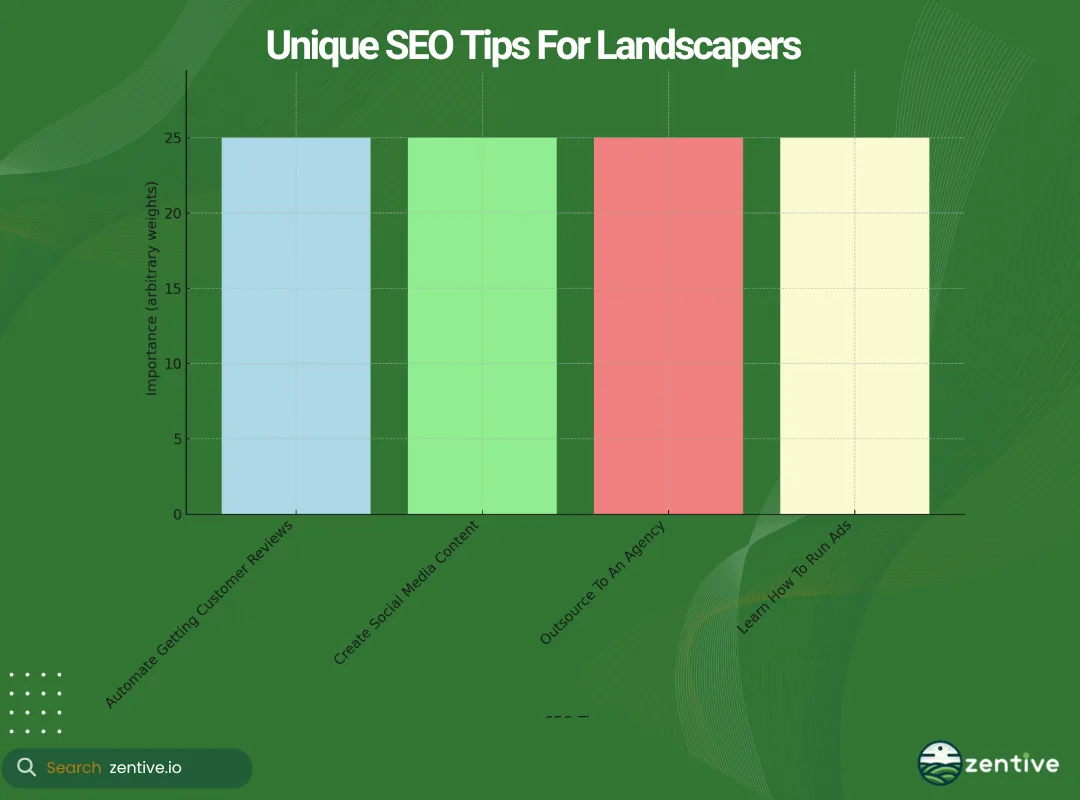
- Automate Getting Customer Reviews: Use tools to automate the review request process after service completion. This can increase the number of reviews, boosting local SEO.
- Create Social Media Content: Engage your audience with regular posts about recent projects, landscaping tips, and promotional offers.
- Outsource To An Agency: Consider hiring a specialized SEO and digital marketing agency to handle SEO and accelerate your growth.
- Learn How To Run Ads: Learn the basic principles of PPC (Pay-Per-Click) advertising and how to leverage them to gain more traffic and onboard new clients.
Feeling overwhelmed? Zentive can help you with everything SEO-related. We provide SEO marketing services for landscapers to help you put your growth in hyperdrive and gain more clients. Just as much as you know everything related to your respected landscaping niche, so too do we know SEO and how to put businesses on the map.
How Can Landscaping Software Help Gather Client Reviews?
Landscaping software allows customers to leave reviews of services after they are completed. Zentive, a software for landscaping business, for example, offers tools that help gather customer reviews and feedback, enhancing your reputation and SEO performance.
How Can Social Media Content Improve SEO?
Social media content can improve SEO by making your brand more visible, which drives traffic to your website. When landscapers create high-quality content, they can generate more shares, meaning more people see your content, which leads to increased website traffic. Directing followers to your website increases traffic, which is a positive signal to search engines.
Consider social media for landscaping companies, and if managing social media content seems like a daunting task, you can simply hire an agency to run your social media accounts.
Should Landscapers Hire SEO Agency?
Yes, landscapers should hire an SEO agency to help them with their SEO. These agencies specialize in helping companies increase online visibility and traffic, so naturally, they can do the same for your business. However, these agencies can be expensive, so consider your budget and growth goals before hiring them.
Alternatively, you can do the SEO yourself by following the step-by-step guide we discussed above.
How Much Does Landscaping SEO Services Cost?
The cost of SEO services for landscapers differs on what you want to achieve through SEO but generally costs $1,000 to $5,000 on average. Note that SEO costs vary depending on the scope of services, e.g., local SEO, content creation, website optimization, or a combination of all these.
SEO specialists usually use three types of pricing models: monthly retainers, project-based pricing (the most common), and performance-based fees. Alternatively, you can simply outsource paid ads to marketing agencies if you just want someone to create and run ads for your business.
Should Landscapers Run Ads Or Invest In SEO?
Landscapers should run ads and invest in SEO, because a combined strategy delivers both immediate visibility and long-term organic growth. A combined strategy is the most effective. Paid landscaping ads provide immediate visibility and traffic, while SEO builds a sustainable online presence that yields long-term benefits. Combining the two into a single strategy gives you access to both short-term and long-term benefits. As a landscaper, you should consider your marketing budget to allocate resources effectively between PPC and SEO.
Get This Guide as a PDF
Save this article for offline reading. We'll send a formatted PDF straight to your inbox.
No spam. Unsubscribe anytime.
Ready To Streamline Your Field Service Business?
Zentive is the all-in-one field service management software built for landscaping, lawn care, tree care, and snow removal businesses. Start your free trial today.
No credit card required · Cancel anytime