
Starting a cleaning business entails making some key decisions like choosing services to offer & customers to market to, completing the required registration, arranging insurance, buying supplies, setting prices and booking the first jobs. Using a simple written service scope, realistic job estimate and repeatable booking process turn those decisions into a workable launch.
The lean solo example below includes $508.77 in equipment, initial supplies and first-month insurance and bonding. This is a partial planning subtotal, not the total cost of starting a cleaning business. The ten steps below cover the business plan, budget, staffing, daily administration and first-client outreach for a U.S. residential or commercial cleaning company.
FREE CLEANING BUSINESS STARTUP CHECKLIST
Track launch tasks, build a complete budget and prepare the first cleaning quote.
Download the startup checklist (PDF)3 printable pages · No email required

What does an owner need to start a cleaning business?
A new cleaning business needs seven practical foundations: a service niche, a business structure, required registrations, supplies, prices, a scheduling and payment process, and first clients.
The legal checks depend on the structure, location and work offered. The SBA identifies registration, tax IDs, licenses and permits as launch decisions.
- Formation paperwork or a trade-name registration where required.
- Applicable tax registrations, local licenses and home-business permits.
- An employer identification number and employment obligations when applicable.
- Workers’ compensation coverage where state rules require it.
General liability insurance, a janitorial bond, written service terms and separate business banking support the launch. Client contracts sometimes require specific coverage. Registration and insurance processing times determine when the business is ready to accept work.
How does an owner start a cleaning business in 10 steps?
The launch follows 10 steps, from choosing the work to completing the first paid clean.
1. Choose cleaning services and a niche
A focused launch starts with one customer group and a defined service, such as recurring house cleaning or small-office janitorial work.
| Path | Customers and schedule | How work is won |
|---|---|---|
| Residential cleaning | Households and rental owners. Daytime visits, with weekly, biweekly or monthly service. | Referrals, local search and neighborhood contacts. |
| Commercial janitorial | Offices and business premises. Service around opening hours, often under a recurring agreement. | Introductions, walkthroughs and written bids. |
| Specialty cleaning | Customers needing work such as carpet care or post-construction cleaning. Equipment and training depend on the job. | Trade partners, targeted searches and referrals. |
Recurring residential cleans plus move-out cleans form one possible launch menu. Each service needs its own included tasks, exclusions and price.
The service area follows three decisions: maximum travel time, the neighborhoods with suitable customers, and enough nearby jobs to fill a route. Travel between clients belongs in the schedule and the job cost.
What should the first cleaning service include?
A written scope names the included tasks, paid extras and work the business does not offer. The following example covers routine residential maintenance. The owner adjusts it after inspecting the property.
| Included in this example | Quoted separately | Outside this example’s scope |
|---|---|---|
| Dust accessible surfaces, vacuum and mop suitable floors, clean bathroom fixtures, wipe kitchen counters and appliance exteriors. | Inside oven or refrigerator, interior windows, dishes, laundry, heavy buildup and additional rooms. | Mold remediation, biohazards, pest waste, unsafe high-access work and moving heavy furniture. |
The quote also records rooms, visit frequency, access, pets, product preferences and who supplies materials. Extra work needs an agreed price before it begins. A cleaning service agreement records payment, cancellations and how the business handles reported problems.
2. Register the business and check license, permit and sales-tax rules
Registration depends on the business structure and location. The SBA explains that operating under the owner’s legal name generally does not require registering that name. An LLC requires state formation paperwork.
A sole proprietorship leaves the owner personally responsible for business obligations. An LLC creates a separate entity under state law. The owner selects a structure with its liability and tax treatment in mind.
The registration sequence covers the following checks.
- Check the proposed name and any required DBA filing.
- Complete formation filings for the chosen entity.
- Obtain an EIN when required. The IRS issues it free.
- Set up federal and applicable state tax records.
- Open business banking and check local permits.
- Confirm whether the state taxes the cleaning services offered.
| Question | Authority to check |
|---|---|
| Which formation or name filings apply? | State business filing office and applicable local DBA office |
| Is a cleaning or home-business license required? | State licensing agency and city or county |
| Are these cleaning services subject to sales tax? | State revenue department |
| When is workers’ compensation required? | State workers’ compensation agency |
The IRS lists income, self-employment and employment-tax obligations for sole proprietors where applicable. Operating without an entity formation filing does not remove those duties. Specialty services require an additional check of the rules governing that work.
3. Write a one-page cleaning business plan
A one-page cleaning business plan records the customers, work and numbers behind the launch.
- Define the target customer and service menu.
- Choose the service area and available working hours.
- Set the pricing method and expected average job price.
- List startup purchases, monthly expenses and cash reserves.
- Calculate expected revenue as jobs per week multiplied by average price.
- Choose the first outreach channels and follow-up process.
For example, eight weekly jobs at $125 produce $1,000 in weekly revenue before costs and taxes. The schedule must also accommodate travel, quoting and administration. A lender or franchise application may require a more detailed plan.
4. Estimate startup costs and fund the launch
Budget for setup purchases, first-month bills and reserve cash. These partial examples total $508.77 for a solo residential cleaner and $2,839.76 for a small commercial operation.
| Selected cash requirement | Solo residential | Small commercial |
|---|---|---|
| Equipment and initial supplies | $448.77 | $908.47 |
| First-month insurance and bond | $60.00 | $184.00 |
| First month of software, monthly billing | $0.00 | $95.00 |
| First-month employee wages | $0.00 | $1,534.87 |
| Employer Social Security and Medicare taxes | $0.00 | $117.42 |
| Subtotal of listed costs | $508.77 | $2,839.76 |
The commercial example includes one employee at 20 hours a week and $17.71 an hour, plus monthly software. The solo owner performs the work.
Add local fees, taxes, transport, marketing and a cash reserve. Equipment is a one-time purchase. Other listed costs cover the first month. Savings avoid borrowing costs; financed purchases need room for repayments.
Use the downloadable budget worksheet to total the cash needed before customer payments arrive.
Example inputs: November 2026 retailer prices, Insureon policy figures, BLS wages and Zentive pricing.
5. Get insurance and bonding
General liability insurance covers specified third-party injury and property-damage risks. Insureon reports about $51 a month for its house-cleaning customers.
- General liability addresses covered accidents and property damage. Client contracts may specify limits.
- A janitorial bond addresses covered employee theft. Insureon reports about $9 a month for house cleaners.
- Workers’ compensation addresses covered work injuries. State rules determine when it is required. Insureon’s house-cleaner figure is about $100 a month.
- Commercial auto covers business vehicle risks under its policy terms. Insureon reports about $268 a month. The owner checks business use with the vehicle insurer.
Premiums depend on the business and coverage. Commercial clients may request a certificate of insurance before work starts.
OSHA’s Hazard Communication Standard requires employers with hazardous chemicals to provide labels, safety data sheets and employee training. Cleaning procedures must reflect the products and hazards at each property.
6. Buy cleaning supplies and equipment
The residential equipment example totals $448.77, including a vacuum, mop, hand tools, protective items and initial products.
- Equip the core kit with a vacuum, flat mop, microfiber cloths, caddy, brushes, duster, step stool and spray bottles.
- Choose products for the actual surfaces, including all-purpose, glass, bathroom, floor and toilet cleaning. Follow each label’s dilution and use instructions.
- Match gloves and eye protection to the product instructions and work hazards.
The commercial kit totals $795.26. A backpack vacuum replaces the residential upright, and the kit adds a wringer bucket, mop heads, a compatible handle and wet-floor signs.
A second cleaner sharing that equipment adds $113.21 in personal kit items in this example. The contract identifies who supplies restroom paper, soap and other commercial consumables.
7. Set cleaning prices
A cleaning price covers labor, travel, vehicle costs, supplies, overhead and profit. In the example below, a three-hour clean costs $82.41 before payment processing and is priced at $123.26.
The BLS May 2025 median wage for maids and housekeeping cleaners is $17.07 an hour. Adding an assumed 15% payroll burden gives a rounded labor cost of $19.63 an hour.
| Cost assumption | Amount |
|---|---|
| Three cleaner-hours × $19.63 | $58.89 |
| Half an hour of paid travel × $19.63 | $9.82 |
| Ten business miles × $0.76 | $7.60 |
| Supplies per clean | $2.22 |
| Monthly overhead of $155 ÷ 40 jobs | $3.88 |
| Job cost before payment processing | $82.41 |
The mileage allowance uses the IRS business rate effective July 1, 2026 as a planning proxy. Supply use, travel, payroll burden and job volume are example assumptions. Overhead includes $51 liability insurance, a $9 bond and $95 software. An owner who cleans includes compensation for that work.
For a card fee of 2.9% plus $0.30 and a target margin of 30%, the calculation is
Price = ($82.41 + $0.30) ÷ (1 − 0.30 − 0.029) = $123.26.
The rounded card fee is $3.87, leaving $36.98 profit before income tax. Margin measures profit as a share of the selling price.
Quotes state the unit clearly: per cleaner-hour, per visit, or per square foot with a defined visit frequency. Compare house cleaning rates by hour, visit and frequency with your calculated costs. The first clean and recurring visits receive prices based on their own scope and time.
Create a free cleaning estimate with separate service lines, exclusions and the proposed price.
How does an owner estimate the first clean?
Inspect the property, agree on the tasks and estimate cleaner-hours before setting a fixed price. Photos or a walkthrough help reveal buildup and access issues that square footage alone misses.
- Record the property: rooms, bathrooms, floor types, stairs, pets and parking or entry arrangements.
- Check the condition: grease, soap buildup, clutter and the time since the last thorough clean.
- Confirm the scope: included surfaces, requested extras, product preferences and any work excluded from the quote.
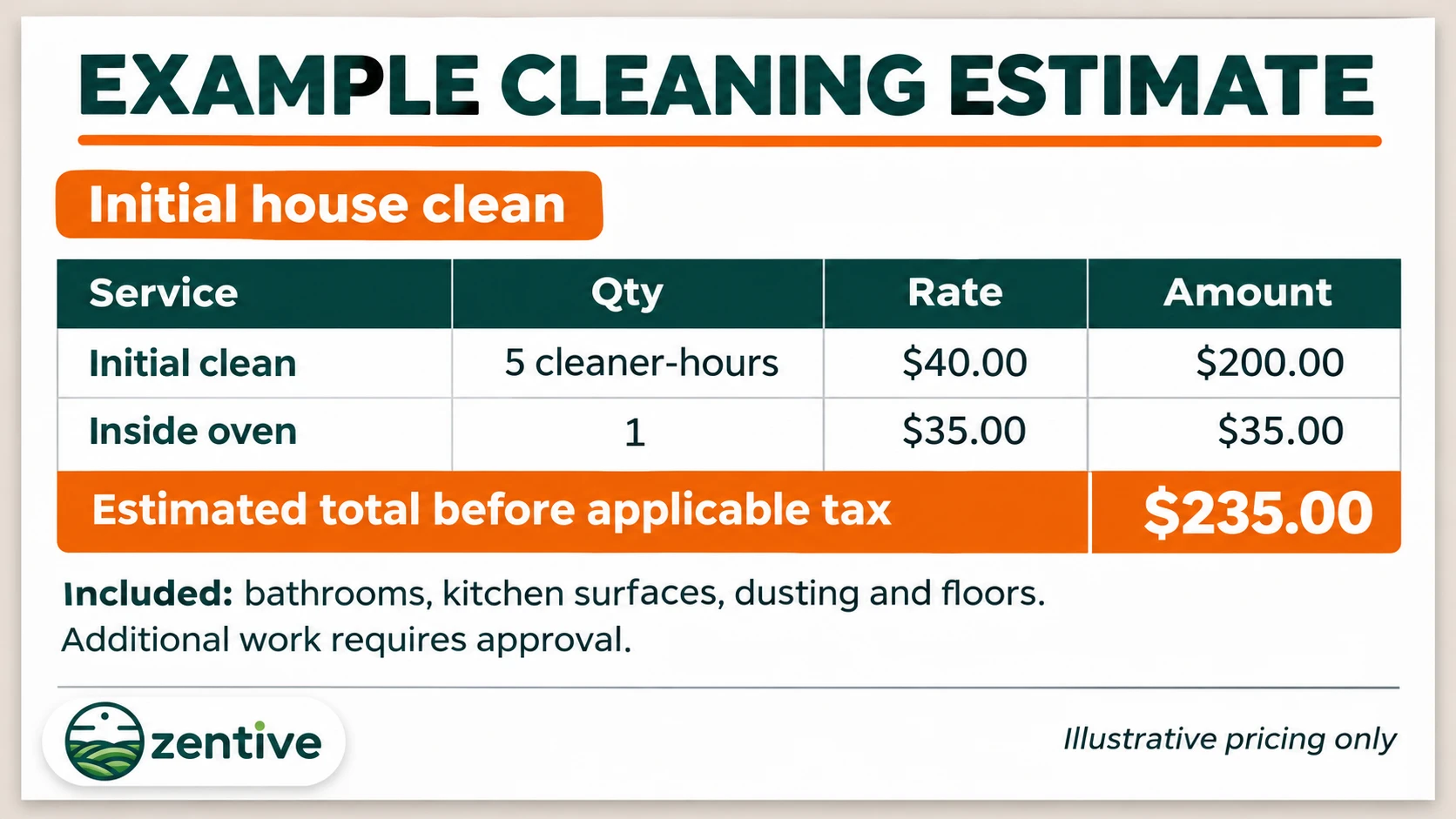
- Estimate time and cost: include setup, cleaning, final inspection, travel, supplies and overhead. Two cleaners working two hours use four cleaner-hours.
- Send the written quote: state the price, assumptions and approval process if the actual condition differs.
- Review the completed job: compare estimated and actual time before pricing repeat visits.
For example, an initial clean might require five cleaner-hours while a later maintenance visit needs three. Those are illustrative time estimates, not standard production rates. The owner quotes each visit’s scope separately and does not automatically apply the recurring price to the first clean.
For offices and other business properties, use commercial cleaning rates and the bid calculator to estimate the scope, visit price and monthly contract.
8. Decide how to staff the first jobs
A solo launch keeps the initial payroll commitment low. Hiring adds capacity when booked work exceeds the owner’s available cleaning hours.
- A solo owner performs the cleaning and administration, with capacity limited by both.
- Employees add scheduled labor and require payroll, training, supervision and applicable coverage.
- Independent contractors operate separate businesses. Their status depends on the working relationship.
The IRS considers behavioral control, financial control and the relationship between the parties. A contract label alone does not establish independent-contractor status. State labor rules also require review.
One employee working 25 hours a week costs about $2,091 a month in the example: $1,849.25 wages, $141.47 employer Social Security and Medicare taxes, and $100 workers’ compensation. Other payroll costs and paid training are additional.
Before the first assignment, document pay, cleaning methods, chemical training, property access and the process for reporting damage. Complete any lawful background checks required by the business or client.
9. Set up booking, scheduling and invoicing
Every cleaning job follows one connected sequence: inquiry, quote, approval, scheduled visit, invoice and payment.
| Stage | Record and next action |
|---|---|
| Inquiry | Contact details, property, requested service and preferred timing. Confirm the scope. |
| Property record | Access arrangements, pets, surfaces and preferences. Prepare job instructions. |
| Quote and approval | Included tasks, extras, price and terms. Record approval before scheduling. |
| Scheduled visit | Date, cleaner, expected duration and repeat frequency. Allow travel time. |
| Completed work | Checklist results, time and approved changes. Prepare the invoice. |
| Invoice and payment | Agreed charges, due date and payment status. Follow up on unpaid balances. |
| Next visit | Confirm the next booking. Send a review request after the completed service. |
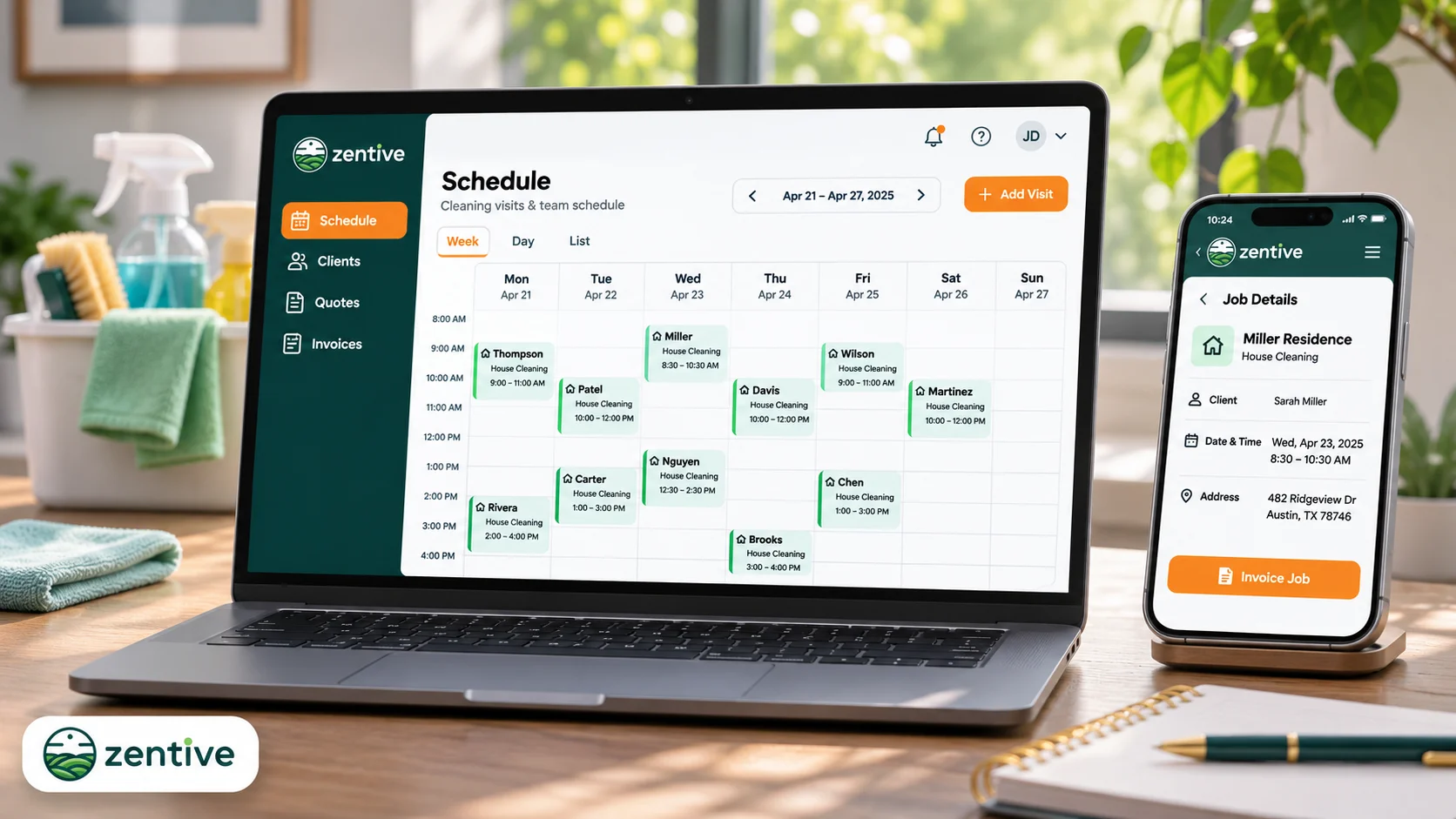
Cleaning Service Software for Small Businesses connects customer records with quotes, scheduled visits and invoices. A solo owner using Zentive records a biweekly house-cleaning client, sends a quote, schedules recurring visits and invoices the work. Zentive lists client records, quoting, scheduling and invoicing on Starter.
Cleaning business scheduling software keeps recurring appointments visible alongside one-time jobs. The owner maintains a written property checklist and sends review requests through the business’s chosen communication channel.
10. Get the first cleaning clients and launch
The first outreach targets personal contacts, nearby customers and local referral partners.
- Tell existing contacts which services and neighborhoods the business covers.
- Complete an eligible Google Business Profile with accurate services, contact details and hours.
- Participate in neighborhood groups where business posts are allowed.
- Introduce the service to real estate agents, property managers and vacation-rental hosts.
- Offer commercial prospects a walkthrough and a written bid.
- Add a simple website and a measured advertising test as budget and capacity permit.
A launch message gives the service, area and next action.
“[Business name] provides recurring house cleaning and move-out cleans in [area]. Send the property size, service needed and preferred date to [contact] for a quote.”
Before confirming the first visit, check registration, coverage, equipment, price, access and payment terms. After the job, compare actual cleaning and travel time with the estimate and confirm the next booking.
What else should new cleaning business owners know?
Startup decisions also include experience, funding, ownership models, recurring service and the point at which administration needs software.
Can an owner start a cleaning business with no money or experience?
A low-cash start still requires funds for the missing supplies and applicable obligations. An existing-equipment example totals $140.32: $80.32 in basic supplies and $60 for first-month liability insurance and bonding. It assumes an available vacuum, mop and transport. Local fees are additional. An owner new to cleaning needs practice with products, surfaces and job timing before quoting unfamiliar work.
Is a cleaning business a good business to start?
A cleaning business suits an owner prepared for physical work, customer communication and careful scheduling. Recurring visits provide repeat revenue, while a small residential operation needs relatively little equipment. Profit depends on prices covering cleaning time, travel and operating expenses. Revenue is the amount billed. Business profit remains after expenses, and owner take-home also depends on taxes and money retained in the business.
Is a cleaning franchise better than an independent start?
A franchise provides a brand and operating system in exchange for fees and contractual obligations. An independent owner chooses the brand, services and operating methods and develops the customer base. Buying an existing cleaning business adds a third route. The comparison includes total cash required, ongoing fees, customer retention, territory terms and support. Franchise buyers review the franchise disclosure document and agreement before committing.
Should a new cleaning business offer recurring contracts?
Yes, when capacity supports the agreed schedule. Weekly, biweekly or monthly visits help organize repeat work. The agreement records included tasks, frequency, price, access, payment and cancellation terms. Residential and commercial customers need terms suited to their work. A first visit receives its own scope and price when the property needs additional cleaning.
Do new cleaning businesses need a website, SEO and ads?
No. Personal referrals, an eligible Google Business Profile and local contacts provide starting channels. A website gives prospects a place to check services and request a quote. SEO develops search visibility, and paid ads require a controlled budget and tracking. The owner compares spending with booked clients and available capacity before expanding a channel.
When does a new business need cleaning business software?
Cleaning business software becomes useful when recurring bookings, quotes and unpaid invoices take too much work to track by hand. Early signals include retyping customer details, overlapping appointments and missed invoice follow-ups. Zentive connects client records, quotes, scheduled jobs and invoices, so the owner follows the work from the first inquiry through payment.