
Janitorial office cleaning costs about $20–$80 per cleaner-hour, while broader commercial work runs $20–$90. A commercial job typically costs $161–$402 in Thumbtack’s estimates. Building size, scope and frequency determine your quote.
Use the rate tables for comparison, then calculate a bid from your labor and costs. The office example below works out to $202.89 per visit or $2,637.57 per month at three visits a week.
Commercial cleaning cost calculator
Estimate a routine office’s cleaning budget per visit, month and year. Adjust the assumptions to match your site; this is a planning estimate, not a service quote.
Monthly visits = weekly visits × 52 ÷ 12. Holidays and actual invoices may differ. Routine office cleaning only: specialty floors, exterior windows, consumables, initial deep cleaning and applicable taxes are excluded. Medical, laboratory, industrial and kitchen cleaning need a tailored walkthrough.
How much does janitorial office cleaning cost in 2026?
Office cleaning is about $20–$80 per cleaner-hour. A 1,000–5,000-square-foot commercial property falls in Angi’s $150–$600 per-visit band.
| Pricing unit | Reference | Basis |
|---|---|---|
| Commercial cleaner-hour | $20–$90 | Angi customer billing rate |
| Office cleaner-hour | $20–$80 | Angi office billing rate |
| Commercial job | $161–$402; typical $253 | Thumbtack professional estimates |
| 1,000–5,000 sq. ft. | $150–$600 per visit | Angi size band |
| Worked office bid | $202.89 per visit | Calculated example below |
| Worked office contract | $2,637.57 per month | Calculated: 13 visits × $202.89 |
| Worked square-foot rates | $0.0406 / visit; $0.5275 / month | Calculated: price ÷ 5,000 sq. ft. |
The billed hourly rate is not the cleaner’s wage. A monthly price also needs a defined scope and visit schedule. Unlike house cleaning prices by bedroom and bathroom, a commercial bid should account for work areas, fixtures and access.
Commercial cleaning rates per square foot by facility type
The worked office bid equals $0.0406 per square foot per visit, or $0.5275 per square foot per month. These are calculated from its scope, not a universal commercial rate.
Monthly rate = $2,637.57 ÷ 5,000 sq. ft.
| Facility | Billed / cleaner-hour | What to measure |
|---|---|---|
| Office | $20–$80 | Workstations, shared areas, restrooms |
| Medical | $35–$80 | Treatment areas, protocol, exposure-related work |
| Retail | $20–$50 | Floor area, displays, traffic |
| Industrial | $50–$90 | Flooring, soil load, equipment access |
| Education | $30–$80 | Classrooms, restrooms, occupancy |
For restaurants, separate dining areas, restrooms and kitchen tasks; hood or grease-system work needs its own qualified scope. Warehouses, gyms and construction cleanup also need a walkthrough. A minimum visit charge can cover small sites.
Compare square-foot bids only when both use the same cleanable area, service scope and time period. Medical work must follow the facility’s protocol; OSHA’s Bloodborne Pathogens Standard applies where employees have occupational exposure.
Commercial cleaning rates per hour and per visit
Commercial customer rates run $20–$90 per cleaner-hour. With two cleaners at $40 each, two hours on site cost $160 before separately priced extras.
| Commercial property size | Price per visit |
|---|---|
| Up to 1,000 sq. ft. | $70–$250 |
| 1,000–5,000 sq. ft. | $150–$600 |
| 5,000–20,000 sq. ft. | $400–$2,000 |
| 20,000+ sq. ft. | $1,000–$2,500+ |
| Office size | Average job price |
|---|---|
| Up to 1,000 sq. ft. | $211 |
| 1,000–2,000 sq. ft. | $376 |
| 2,000–3,000 sq. ft. | $435 |
| 3,000–4,000 sq. ft. | $577 |
| 4,000–5,000 sq. ft. | $834 |
Specify whether an hourly quote covers one cleaner or the crew. Include any after-hours premium in the bid. Weekly cost equals your visit price multiplied by visits that week.
Three commercial cleaning budget examples
At an illustrative $40 billed per cleaner-hour, these scopes cost $100–$200 per visit. Restroom count and tasks can matter more than floor area alone.
| Office scenario | Scope / cleaner-hours | Schedule | Per visit | Average month |
|---|---|---|---|---|
| Small office · 1,000 sq. ft. | Floors, trash, surfaces, 1 restroom · 1.5 hours | 1× / week | $100 minimum | $433.33 |
| Restroom-heavy office · 3,000 sq. ft. | Floors, trash, surfaces, 4 restrooms · 4 hours | 3× / week | $160 | $2,080 |
| Open-plan office · 10,000 sq. ft. | Floors, trash, surfaces, 2 restrooms · 5 hours | 5× / week | $200 | $4,333.33 |
Office cleaning prices by building size and frequency
At $202.89 per visit, three weekly cleans cost $608.67 per week or $2,637.57 per average month.
| Visits per week | Average visits / month | Calculated monthly price |
|---|---|---|
| 1 | 4.33 | $879.19 |
| 2 | 8.67 | $1,758.38 |
| 3 | 13 | $2,637.57 |
| 5 | 21.67 | $4,395.95 |
For your building size, calculate the visit price first, then apply the agreed frequency. A fixed monthly contract can spread annual visits across 12 equal bills; billing actual visits produces different totals in different months.
More frequent service may shorten each clean, but travel and setup still recur. Discount only identifiable savings. Price each site in a multi-location account separately, and price an initial deep clean from its own labor requirement.
Specialty and add-on commercial cleaning prices
Published provider guidance puts carpet extraction at $0.25–$0.50 per sq. ft. and floor waxing/polishing at $0.35–$0.60 per sq. ft. Price these separately from routine visits.
| Add-on service | Published price / unit | Scope to confirm | Separate quote when |
|---|---|---|---|
| Tile / concrete scrubbing | $0.20–$0.40 / sq. ft. | Area and scrubbing method | Heavy soil, moving fixtures or unusual access |
| Floor waxing / polishing | $0.35–$0.60 / sq. ft. | Floor material and coating process | Stripping, repairs or extra coats required |
| Carpet shampoo / extraction | $0.25–$0.50 / sq. ft. | Treated area and drying plan | Stains, furniture moving or access add work |
| Window cleaning | $3–$8 / piece | Define pane versus window, sides and access | Height, exterior work or special equipment |
| Deep disinfection / high dusting | Site-specific | Tasks, products, dwell time and access | Outside agreed routine scope |
| Paper towels, soap and liners | Agreed allowance or actual usage | Who buys and restocks each item | Usage exceeds allowance |
Cleaning chemicals and equipment are different from customer consumables. State who supplies each. Give every extra its own frequency—once, quarterly or on request—and list any rental, subcontractor or applicable tax separately.
How to calculate commercial cleaning rates with workloading
Workloading means estimating the labor for each area and task, then pricing the total job cost. This example needs 6.08 paid cleaner-hours and a $202.89 visit price.
- Walk the site. Record cleanable area, floors, fixtures, access and excluded rooms.
- Use timings from your own completed jobs for each task or clearly defined area package.
- Add cleaning, setup, lock-up and paid travel hours. Count each task once.
- Calculate loaded labor: hourly wage × (1 + payroll burden). Include your own pay when you clean.
- Add vehicle cost, supplies and any equipment or subcontractor costs.
- Allocate overhead across realistic billable visits or hours.
- Set a target margin, payment fee and minimum visit charge.
- Calculate visit, monthly and square-foot prices. Compare like-for-like quotes and retime the work after launch.
Workloading formulas
Area-task hours = cleanable area ÷ square feet completed per hour.
Fixture hours = fixture count × minutes per fixture ÷ 60.
Room-task hours = room count × minutes per room ÷ 60.
Price = total job cost ÷ (1 − margin − percentage payment fee).
If a payment method has a fixed fee, add it to job cost before dividing. An area allowance must name its included tasks so fixture or room work is not counted twice.
| Worked bid line | Assumption / calculation | Result |
|---|---|---|
| Office areas | 4,600 sq. ft. ÷ 1,000 sq. ft./hour | 4.60 hours |
| Restroom fixtures | 8 × 3 minutes | 24 minutes |
| Other restroom work | 2 rooms × 10 minutes | 20 minutes |
| Setup + lock-up | Assumed | 0.25 hour |
| Paid travel | Assumed | 0.50 hour |
| Total paid labor | 4.60 + 44/60 + 0.25 + 0.50 | 6.08 hours, rounded |
| Loaded wage | $17.71 × 1.15 | $20.37/hour, rounded |
| Labor cost | 6.08 × $20.37 | $123.85 |
| Vehicle | 10 miles × $0.76 | $7.60 |
| Supplies | Chemicals and can liners | $6.00 |
| Allocated overhead | $165/month ÷ 13 visits | $12.69 |
| Job cost | Sum of cost lines | $150.14 |
| Quoted price | $150.14 ÷ (1 − 0.25 − 0.01) | $202.89 |
| ACH fee | 1% of price | $2.03 |
| Profit after listed costs | $202.89 − $150.14 − $2.03 | $50.72 |
| Monthly contract | 13 visits × $202.89 | $2,637.57 |
What this example includes—and what to replace
The office-area allowance includes trash, dusting, wiping, vacuuming and spot mopping across 4,600 square feet. Restroom fixtures are separate; the additional 20 minutes covers restroom floors, mirrors, dispensers and trash. These illustrative timings must be replaced with measured job times.
The wage is the BLS May 2025 janitor median. The 15% burden is assumed, not a universal allowance; include your actual payroll taxes, benefits and workers’ compensation without double counting. Vehicle cost uses the IRS July–December 2026 business mileage rate as a planning proxy.
The $165 overhead example consists of $60 general liability, $10 bond and $95 software per month. Insurance references: Insureon janitorial guide, September 2026; software: Zentive Standard annual billing, checked November 17, 2026. This limited example excludes other business overhead: add your actual admin, marketing, equipment and other costs before quoting.
The contractor supplies chemicals and liners; the client supplies paper and soap. The 1% ACH fee comes from Zentive’s pricing page. This is a service-price example before any applicable tax, not an insurance or tax recommendation.
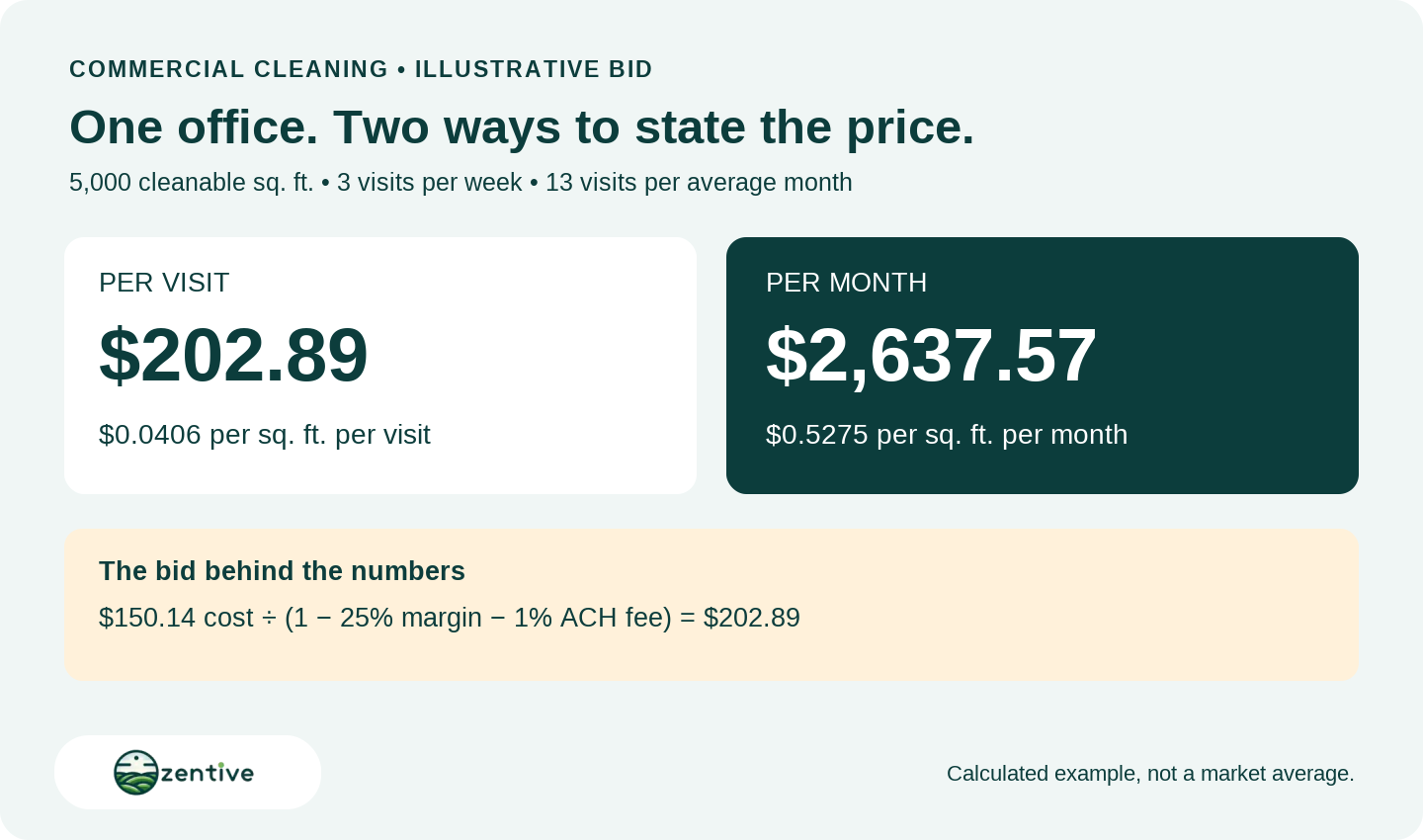
The example sits inside Angi’s $150–$600 size band. Its price divided by 6.08 paid hours is $33.37, including travel—not an employee wage. Replace every allowance with your own costs; the rate that supports a new cleaning business launch must also pay for the owner’s work.
Download a commercial cleaning bid worksheet
Use the editable worksheet to turn cleaner-hours, expenses and target margin into a visit price and monthly contract budget. The companion checklist records the walkthrough before you quote.
The CSV opens in Excel or Google Sheets. Edit the input values; keep the formula rows. Percentages use decimals: 0.25 means 25%. Margin plus payment-fee percentage must stay below 100%. The checklist can be printed or saved as a PDF from your browser.
Once the scope and price are ready, use Zentive’s cleaning estimate template to present the quote.
How to write a commercial cleaning bid and proposal
A commercial bid states the scope, frequency, price, extras and terms the customer is approving.
| Bid section | What to include |
|---|---|
| Site overview | Address, cleanable area, access and contacts |
| Routine scope | Tasks by area and visit frequency |
| Periodic work | Separate services, unit prices and schedule |
| Price summary | First clean, recurring visit and monthly amount |
| Terms | Start date, billing, changes, cancellation and insurance requirements |
| Acceptance | Approved version, price, scope and date |
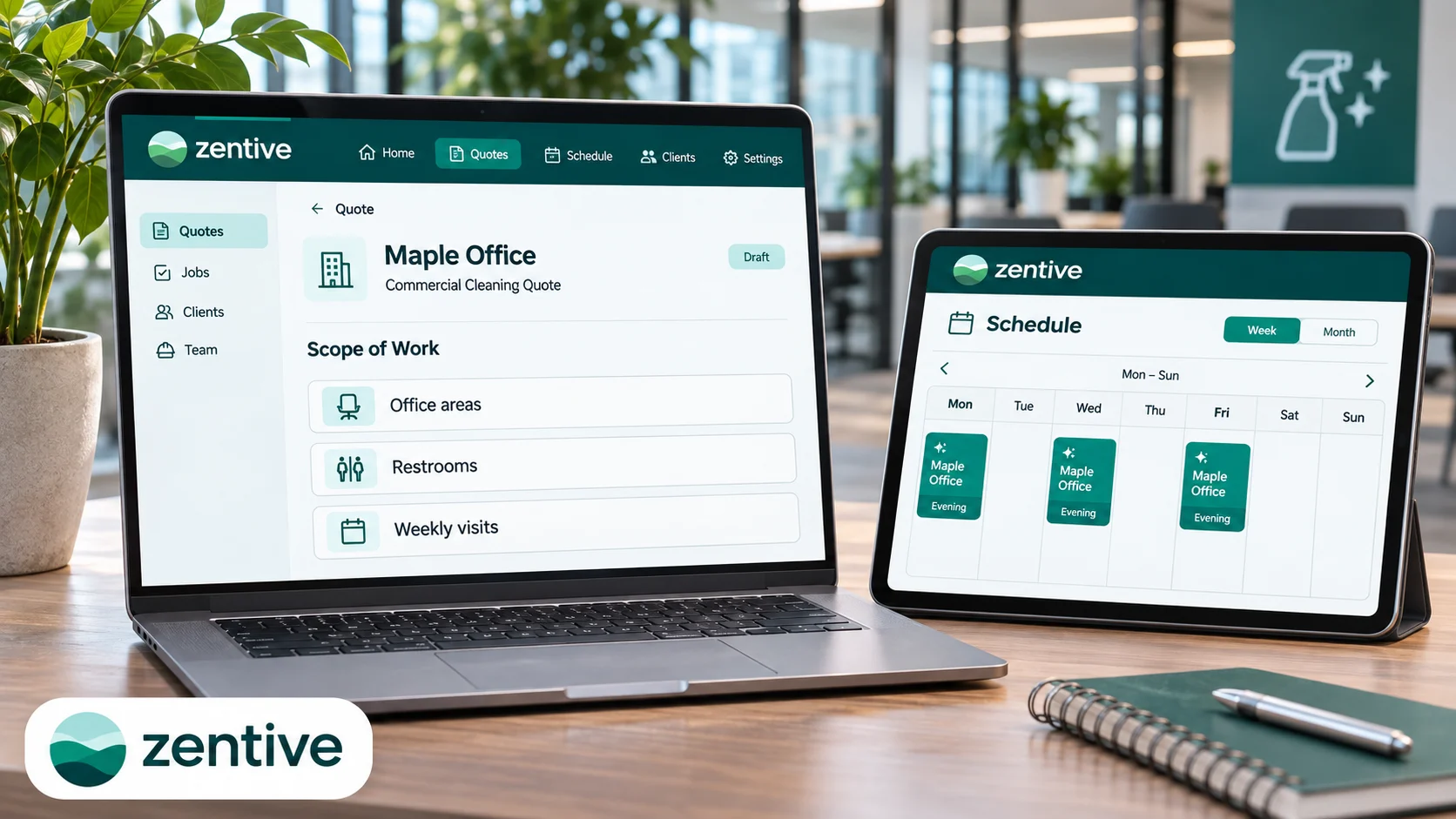
Use the free commercial cleaning estimate template to lay out the price. In Zentive cleaning company software, organize the commercial quote and customer record, then schedule the agreed work. Record changes before adding tasks.
Janitorial contract pricing: monthly billing, tiers and price increases
A fixed monthly contract pairs one price with a defined scope and frequency: $2,637.57 a month in the example above. A higher service tier should buy specified tasks or visits.
| Stage | What to keep consistent |
|---|---|
| Approved bid | Scope, exclusions and price |
| Agreement | Sites, cadence, billing and change terms |
| Recurring schedule | Visit days, access notes and crew assignments |
| Completed visits | Work notes and actual time where tracked |
| Monthly invoice | Agreed recurring fee; approved extras separate |
| Price review | Updated costs, scope and required notice |
Zentive’s cleaning business scheduling software keeps recurring visits organized; its invoicing tools help bill the agreed work. Starter includes quoting, scheduling and invoicing. Standard adds crew routing, time tracking and automatic payments.
Specify advance or arrears billing, holiday visits and periodic extras. Price multi-site accounts by location. Follow the agreement’s adjustment and notice terms when raising rates; there is no universal notice period to copy into every contract.
Is this commercial cleaning quote reasonable?
A reasonable quote covers the agreed work at a sustainable price. Compare the same tasks, visit schedule and exclusions before comparing totals.
| Check | Compare before accepting |
|---|---|
| Scope | Same rooms, fixtures, tasks and standards |
| Visit count | Weekly frequency, holiday policy and monthly billing basis |
| Cleaner-hours | Two cleaners for two hours means four cleaner-hours |
| Supplies | Chemicals versus soap, paper products and liners |
| Extras | Initial deep clean, floor treatments and windows |
| Terms | Price increases, cancellation, payment terms and tax |
A $150 visit completed in one hour is $150 in revenue, not $150 in profit. Travel, setup, supplies, insurance, administration and labor still cost money. It also does not establish a universal $150 hourly rate. A minimum visit charge can make a short job’s effective hourly revenue look high.
For example, $150 revenue minus $100 in total allocated costs leaves $50 before any costs not included in that calculation. Larger recurring accounts may support lower per-hour pricing only when their measured costs and margin justify it; do not discount automatically.
Other commercial cleaning pricing questions
Compare residential work, contract requirements and employee pay before deciding which commercial accounts fit your business.
How do commercial cleaning rates compare with house cleaning rates?
Hourly ranges overlap. Commercial bids add facility-specific scope, access arrangements and recurring contract billing. Compare residential cleaning rates and monthly budgets, but rebuild the estimate for an office’s fixtures and work areas.
How do you find and win commercial cleaning contracts?
Target buildings your crew can service, arrange a walkthrough and submit a clear proposal. Ask what the current service misses and price the actual scope. Start with accounts that fit your staffing and hours.
What should a commercial cleaning contract include?
Identify the parties and sites, tasks, frequency, price, billing, term, insurance, changes and cancellation terms. Use the same scope in the bid and agreement so the customer and crew expect the same work.
How much do janitors make compared with what cleaning companies charge?
Janitors earned a median $17.71 an hour in BLS May 2025 data. A customer rate also pays labor burden, travel, supplies, overhead and profit. Revenue is not the employee’s wage or the owner’s take-home pay.
How does commercial cleaning business software manage recurring work?
Zentive connects commercial quotes, customer details, scheduled visits and invoices. Use the agreed scope and price to organize recurring work and billing. Keep workloading assumptions in your estimating worksheet and use actual job time to refine future bids.