
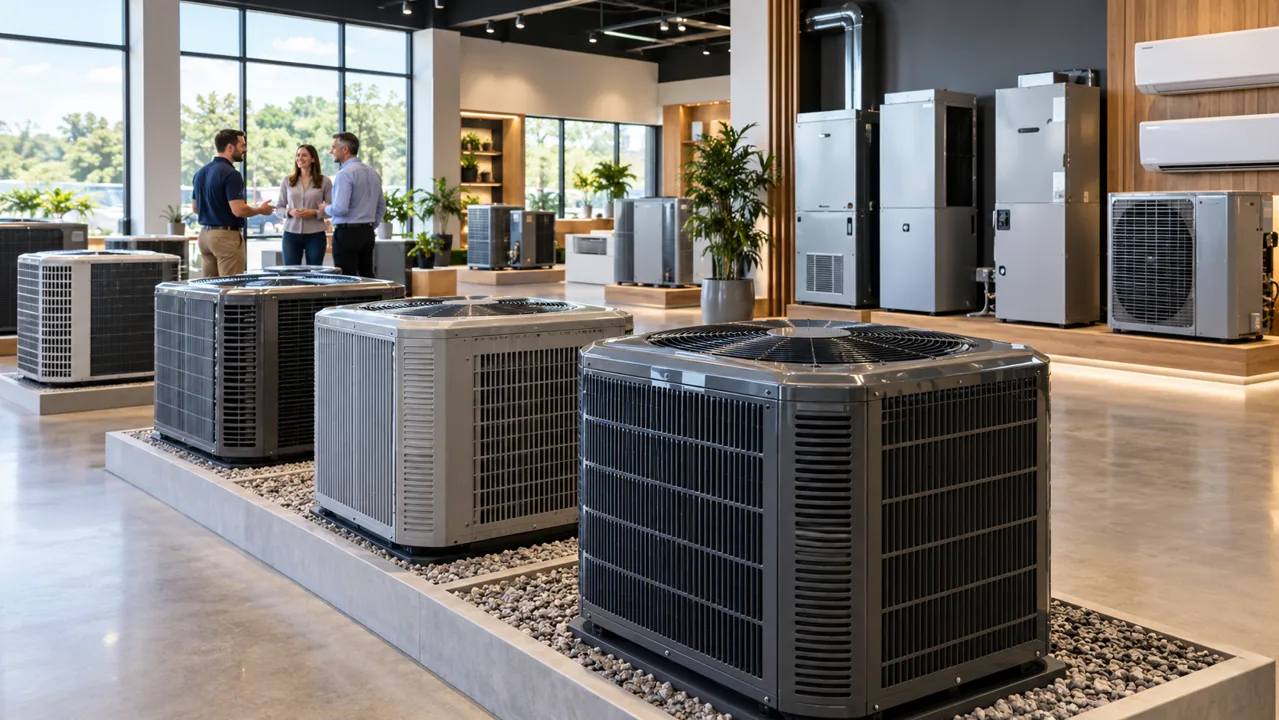
An HVAC manufacturer builds heating and cooling equipment. A brand is the name the equipment sells under. A distributor supplies equipment and parts to contractors. The 8 brand groups below are Carrier, Trane and American Standard, Lennox, Daikin with Goodman and Amana, Rheem and Ruud, YORK and Coleman, Mitsubishi Electric, and LG. Contractors compare equipment on 7 factors: application, performance, supply, installation, service, warranty and commercial terms. Supplier roles, pricing and inspection records round out the purchasing decision. Brand relationships were checked in October 2026.
What are the 8 top HVAC brands and manufacturers?
HVAC manufacturer groups are equipment-producing businesses that supply the brands and product families used by installation and service contractors. The installing contractor selects, installs and commissions the matched system. The ownership diagram identifies the corporate group or U.S. joint venture behind each profile.
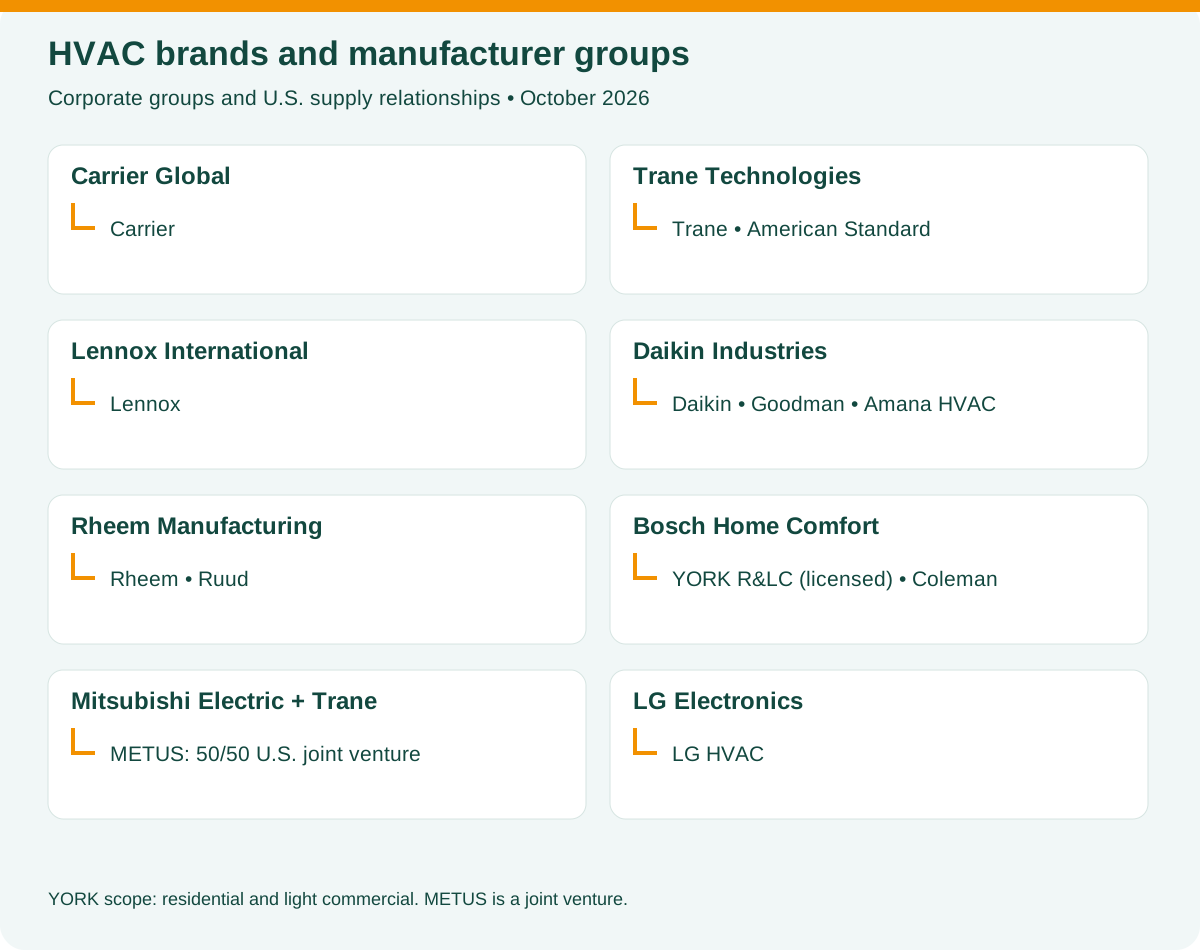
Manufacturer groups and the U.S. Mitsubishi Electric joint venture, checked in October 2026.
The comparison covers the following 8 groups in profile order.
| Group | Corporate group or U.S. supplier | Main applications |
|---|---|---|
| 1. Carrier | Carrier Global | Residential systems, rooftop units and chillers |
| 2. Trane and American Standard | Trane Technologies | Residential systems and Trane commercial equipment |
| 3. Lennox | Lennox International | Residential systems, commercial rooftop and split systems |
| 4. Daikin, Goodman and Amana HVAC | Daikin Industries | Residential systems, ductless systems, VRV and applied commercial equipment |
| 5. Rheem and Ruud | Rheem Manufacturing | Residential systems and commercial packaged equipment |
| 6. YORK and Coleman HVAC | Bosch Home Comfort residential and light-commercial business | Residential systems and light-commercial packaged equipment |
| 7. Mitsubishi Electric | Mitsubishi Electric Trane HVAC US | Ducted and ductless heat pumps, CITY MULTI VRF |
| 8. LG | LG Electronics | Single-zone and multi-zone systems, Multi V VRF |
An HVAC business launch includes licensing, equipment purchasing and an operating workflow. The HVAC company launch guide connects those decisions with the launch budget.
The brand profiles follow this numbered sequence.
- Carrier
- Trane and American Standard
- Lennox
- Daikin, Goodman and Amana
- Rheem and Ruud
- YORK and Coleman
- Mitsubishi Electric
- LG
1. Carrier
Carrier is a heating and cooling brand within Carrier Global, according to Carrier's 2025 Annual Report. Carrier's company history dates Carrier Engineering Corporation to 1915, and the annual report identifies its headquarters in Palm Beach Gardens, Florida.
| Attribute | Published fact and source |
|---|---|
| Residential lines | Carrier's residential catalog lists Infinity, Performance and Comfort central systems, furnaces, heat pumps and ductless mini-splits. |
| Commercial lines | Carrier's 2025 Annual Report lists commercial air-conditioning systems, chillers, air handlers and controls. |
| Premium efficiency | Carrier's 37MPRA specification lists the Infinity 35 ductless heat pump at up to 35.1 SEER2 and 16.2 HSPF2, with a variable-speed compressor. |
| Central-system example | Carrier's 26VNA1 specification lists the Infinity 21 central air conditioner at up to 21 SEER2, using Greenspeed variable-speed operation. |
| Parts warranty | Carrier's 26VNA1 warranty offers 10-year parts-only coverage with timely registration. Its unregistered term is 5 years, subject to state registration restrictions. |
Contractor fit: residential replacement and commercial projects requiring central systems, rooftop units or chillers. Purchasing checks cover matched-system stock, local parts access and the quoted dealer-support channel.
2. Trane and American Standard
Trane and American Standard are HVAC equipment brands in Trane Technologies, according to its official brand portfolio. Trane's official company history dates the business to 1913. Trane Technologies identifies Swords, Ireland, as global headquarters and Davidson, North Carolina, as a regional headquarters.
| Attribute | Published fact and source |
|---|---|
| Residential lines | Trane Technologies' brand portfolio and residential catalogs identify Trane and American Standard air conditioners, heat pumps, furnaces, air handlers and controls. |
| Commercial lines | The annual report lists Trane chillers, packaged rooftop units, air handlers, building controls and services. |
| Premium efficiency | Trane's 20 TruComfort Variable Speed Air Conditioner with WeatherGuard product page lists up to 24 SEER2 and variable-speed capacity control. |
| Parts warranty | Trane's warranty guidance states a typical 5-year base parts term and 10-year registered parts term. Registration is due within 60 days, subject to the product certificate and applicable state rules. |
| Technology | Trane's product specification identifies TruComfort variable-speed operation and communicating system controls. |
Contractor fit: residential central-system work and Trane commercial projects. Purchasing checks cover brand-specific distribution, compatible communicating controls and the warranty administrator.
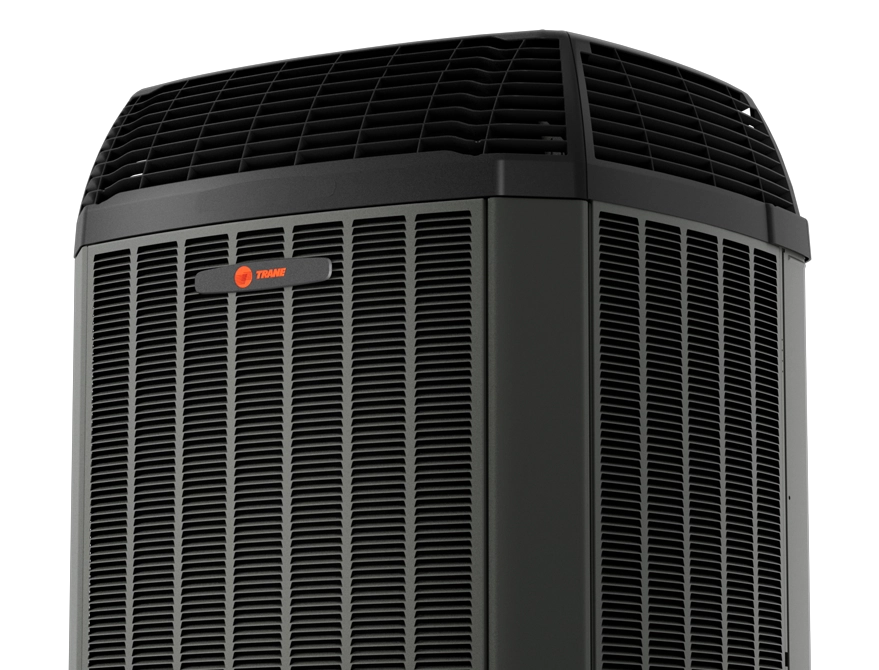
The product photo below shows the Trane XV20i outdoor heat pump.
3. Lennox
Lennox is a climate-control manufacturer operated by Lennox International, according to its 2025 Form 10-K. Lennox's company history dates its founding to 1895, and its corporate contact information identifies headquarters in Richardson, Texas.
| Attribute | Published fact and source |
|---|---|
| Residential lines | Lennox's residential catalog lists Dave Lennox Signature Collection, Elite and Merit air conditioners, heat pumps, furnaces and air handlers. |
| Commercial lines | Lennox's 2025 Form 10-K describes rooftop units, split systems, unit heaters and related commercial controls and services. |
| Premium efficiency | The current Lennox SL25KCV specification lists up to 25.10 SEER2, variable-capacity operation and R-454B refrigerant. |
| Parts warranty | Lennox's warranty program lists 10-year basic parts coverage for eligible Signature Collection equipment and 5-year basic parts coverage for Elite and Merit. Eligible Signature equipment has a 12-year parts-only registration option. |
| Technology | Lennox's SL25KCV product information identifies Precise Comfort variable-capacity control and communicating indoor equipment. |
Contractor fit: residential replacement and light-commercial rooftop or split-system work. Purchasing checks cover the exact equipment tier, control compatibility and local replacement-parts access.
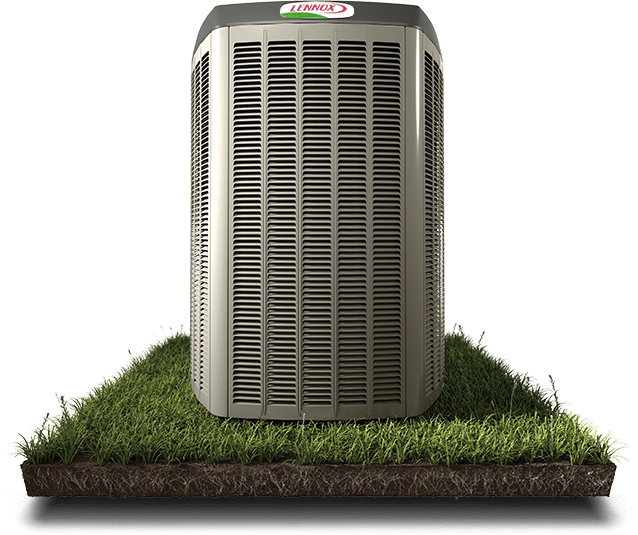
The product photo below shows the Lennox SL25XPV outdoor heat pump.
4. Daikin, Goodman and Amana
Daikin, Goodman and Amana HVAC are heating and cooling brands within Daikin Industries, according to Daikin's corporate history and its 2022 North American business announcement. Daikin's corporate profile dates its founding to 1924 and identifies its head office in Osaka, Japan.
| Attribute | Published fact and source |
|---|---|
| Residential lines | Daikin's product catalogs include FIT ducted systems, ATMOSPHERA ductless systems, Goodman central systems and Amana HVAC systems. |
| Commercial lines | Daikin's corporate product portfolio includes VRV variable refrigerant volume systems, rooftop equipment and applied chillers. |
| Premium efficiency | Daikin's ATMOSPHERA specification lists up to 27.4 SEER2 and 11.2 HSPF2, using an inverter compressor and R-32 refrigerant. |
| Parts warranty | Daikin's ATMOSPHERA warranty provides 12-year limited parts coverage with registration within 60 days, subject to state restrictions on registration requirements. |
| Brand-specific coverage | Amana's current standard warranty page lists 10-year parts coverage on qualifying registered products. The warranty belongs to the specified brand and model. |
Contractor fit: central residential systems, ductless installations and commercial VRV or applied systems. Purchasing checks compare the specific brand, model, distributor and warranty certificate.
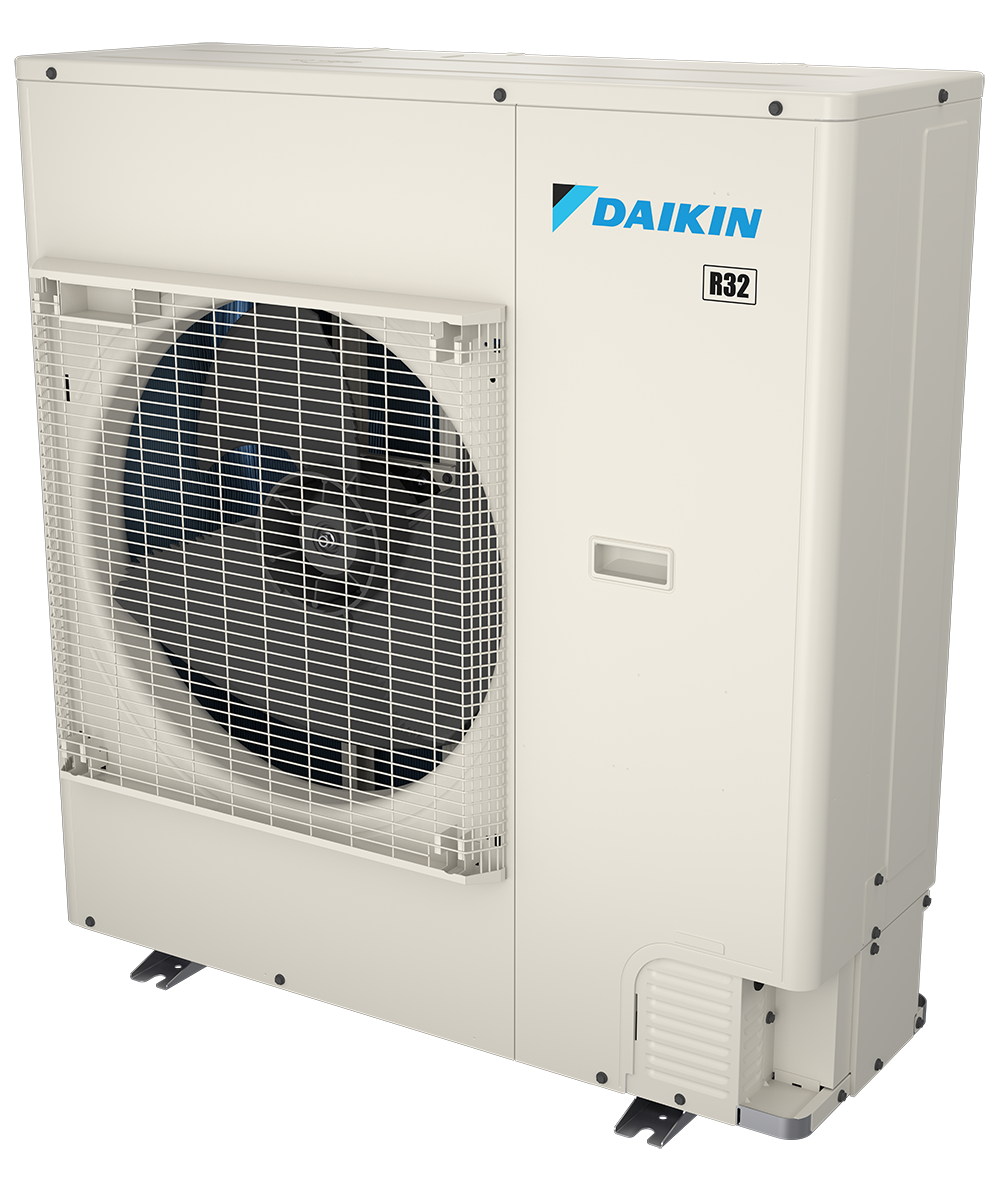
The product photo below shows the Daikin FIT side-discharge heat pump.
5. Rheem and Ruud
Rheem and Ruud are heating and cooling brands supplied by Rheem Manufacturing, according to Rheem's company information. Rheem dates its founding to 1925 and identifies its headquarters in Atlanta, Georgia.
| Attribute | Published fact and source |
|---|---|
| Residential lines | Rheem's catalog includes Endeavor Prestige, Classic Plus and Classic air conditioners, heat pumps, furnaces and air handlers. Ruud supplies its own branded heating and cooling lines. |
| Commercial lines | Rheem's commercial catalog includes Renaissance packaged rooftop equipment and commercial split systems. |
| Premium efficiency | Rheem's RA19AY Endeavor Prestige specification lists up to 20 SEER2 and 13 EER2. |
| Parts warranty | The RA19AY product page lists 10-year parts coverage and 10-year conditional unit replacement, with registration required for unit replacement. |
| Technology | Rheem's RA19AY specification identifies an inverter-driven variable-speed compressor, EcoNet controls and Bluetooth diagnostics. |
Contractor fit: residential central-system work and light-commercial packaged installations. Purchasing checks cover complete matched-system availability, EcoNet requirements and registration responsibilities.
6. YORK and Coleman
YORK residential and light-commercial equipment and Coleman HVAC are Bosch Home Comfort brands and licensed product lines, according to Bosch's brand portfolio. Bosch's August 1, 2025 announcement states that the acquisition from Johnson Controls and Hitachi closed on July 31, 2025. Bosch Home Comfort identifies Wetzlar, Germany, as headquarters. YORK's official history dates its founding to 1874.
| Attribute | Published fact and source |
|---|---|
| Corporate relationship | Bosch's announcement identifies the acquired residential and light-commercial business. Bosch uses the YORK mark under a long-term license. |
| Residential lines | YORK's residential catalog includes Affinity and LX split air conditioners, heat pumps, furnaces and air handlers. Bosch's brand portfolio includes Coleman HVAC. |
| Commercial lines | Bosch's acquired portfolio includes light-commercial packaged and split HVAC equipment. Johnson Controls retains the YORK applied commercial chiller business. |
| Premium efficiency | YORK's YXV Affinity product page lists up to 20 SEER2 and a variable-capacity scroll compressor. |
| Parts warranty | YORK's YXV page lists 10-year limited parts and lifetime limited compressor coverage for qualifying registered equipment. Registration is due within 90 days. The standard unregistered parts term is 5 years. |
| Technology | YORK's YXV specification identifies Climate Set controls and Charge Assurance refrigerant monitoring. |
Contractor fit: residential and light-commercial installations within the Bosch Home Comfort portfolio. Purchasing checks identify the supplying business and warranty channel for each quoted product.
7. Mitsubishi Electric
Mitsubishi Electric Trane HVAC US is a U.S. HVAC joint venture between Mitsubishi Electric and Trane Technologies, according to its official company profile. That profile identifies a 50/50 venture, formed in 2018, with headquarters in Suwanee, Georgia.
| Attribute | Published fact and source |
|---|---|
| Residential lines | Mitsubishi Electric's catalog includes M-Series ducted and ductless heat pumps, FX and GX wall-mounted systems, and SMART MULTI systems. |
| Commercial lines | Its commercial catalog includes P-Series systems and CITY MULTI variable refrigerant flow equipment. |
| Premium efficiency | Mitsubishi Electric's FX product information lists up to 35 SEER2 for the FX Deluxe wall-mounted heat-pump system. |
| Parts warranty | Mitsubishi Electric's registration page specifies 12-year parts and compressor coverage for qualifying single-family installations by a Diamond Contractor or Ductless Pro, registered within 90 days, for the original owner residing in the home. |
| Technology | Mitsubishi Electric's product information identifies Hyper-Heating INVERTER technology, variable-speed compressors and zoned controls. |
Contractor fit: ductless retrofits, zoned heat pumps and commercial VRF installations. Purchasing checks cover piping combinations, design assistance, commissioning training and local parts support.
8. LG
LG is a heating and cooling manufacturer within LG Electronics, according to LG's corporate and HVAC product information. LG's corporate profile dates the company to 1958 and identifies headquarters in Seoul, South Korea.
| Attribute | Published fact and source |
|---|---|
| Residential lines | LG's residential and light-commercial catalog includes ARTCOOL, single-zone and multi-zone ducted and ductless systems. |
| Commercial lines | LG's commercial catalog includes Multi V VRF systems, dedicated outdoor air systems and MultiSITE controls. |
| Premium efficiency | LG's February 2026 KSSAL091A submittal lists the ARTCOOL Deluxe KUSAL091A outdoor and KNSAL091A indoor combination at 27 SEER2 and 13.5 HSPF2. |
| Parts warranty | LG's contractor-program terms list 5-year standard parts and 7-year compressor coverage, 10-year extended coverage for qualifying registered equipment, and a 12-year tier through qualifying LG Pro installation. |
| Technology | LG's product catalog identifies inverter compressors, zoned control and Multi V variable refrigerant flow. |
Contractor fit: residential ductless systems and commercial VRF projects. Purchasing checks cover indoor-unit combinations, controls integration, trained installation support and local parts availability.
Which HVAC manufacturers fit residential and commercial projects?
Residential and commercial manufacturer selection matches the product family to the building, load and service requirements. The manufacturers’ catalogs identify the applications below. Final selection uses the quoted model and matched-system documentation.
| Project type | Product families to compare | Purchasing priority |
|---|---|---|
| Residential central replacement | Carrier, Trane, American Standard, Lennox, Daikin, Goodman, Amana, Rheem, Ruud, YORK and Coleman central systems | Load, duct compatibility, controls and local parts |
| Residential ductless or zoned retrofit | Mitsubishi Electric, Daikin, LG and Carrier ductless systems | Indoor-unit combinations, piping limits and heating performance |
| Light-commercial rooftop or split system | Carrier, Trane, Lennox, Daikin, Rheem and YORK commercial lines | Curb, electrical service, delivery and commissioning |
| Commercial VRF | Mitsubishi Electric CITY MULTI, Daikin VRV and LG Multi V | Design review, controls integration and technical support |
| Large applied commercial systems | Carrier, Trane, Daikin Applied and Johnson Controls YORK chillers | Engineer’s specification, service coverage and lifecycle requirements |
How do contractors choose an HVAC manufacturer using 7 factors?
HVAC manufacturer selection is a seven-factor equipment evaluation covering application, performance, supply, installation, service, warranty and commercial terms. A written comparison records the model numbers, evidence and total job cost for each factor.
| Factor | Evidence in the purchasing record |
|---|---|
| 1. Application | Building load, heating and cooling design conditions, system configuration |
| 2. Performance | AHRI matched-system certificate, SEER2, EER2, HSPF2 or furnace AFUE |
| 3. Supply | Stock confirmation, complete accessory list, delivery date |
| 4. Installation | Electrical requirements, refrigerant, controls, labor and commissioning scope |
| 5. Service | Parts location, training requirements and technical-support contact |
| 6. Warranty | Parts, compressor and labor terms, registration deadline, transfer rules |
| 7. Commercial terms | Freight, payment terms, quote expiry and return conditions |
AHRI's 2023 Energy Efficiency Standards guidance defines SEER2 as the seasonal cooling metric and HSPF2 as the seasonal heating metric under the revised test procedure. DOE's standards in 10 CFR 430.32 set a 13.4 SEER2 national minimum for conventional split air conditioners. Southeast and Southwest installations require 14.3 SEER2 below 45,000 Btu/h, or 13.8 SEER2 at or above that capacity. Southwest installations have additional EER2 requirements. The AHRI certificate identifies the tested indoor and outdoor combination.
An HVAC tool inventory records the instruments and installation equipment required for the selected refrigerant and system. The HVAC technician equipment guide connects those requirements with the contractor's field kit.
HVAC business software stores customer records, equipment line items, estimates and scheduled work. Zentive connects those records with approved jobs and invoices. The device image shows the dashboard, service schedule and technician route used to organize that work.
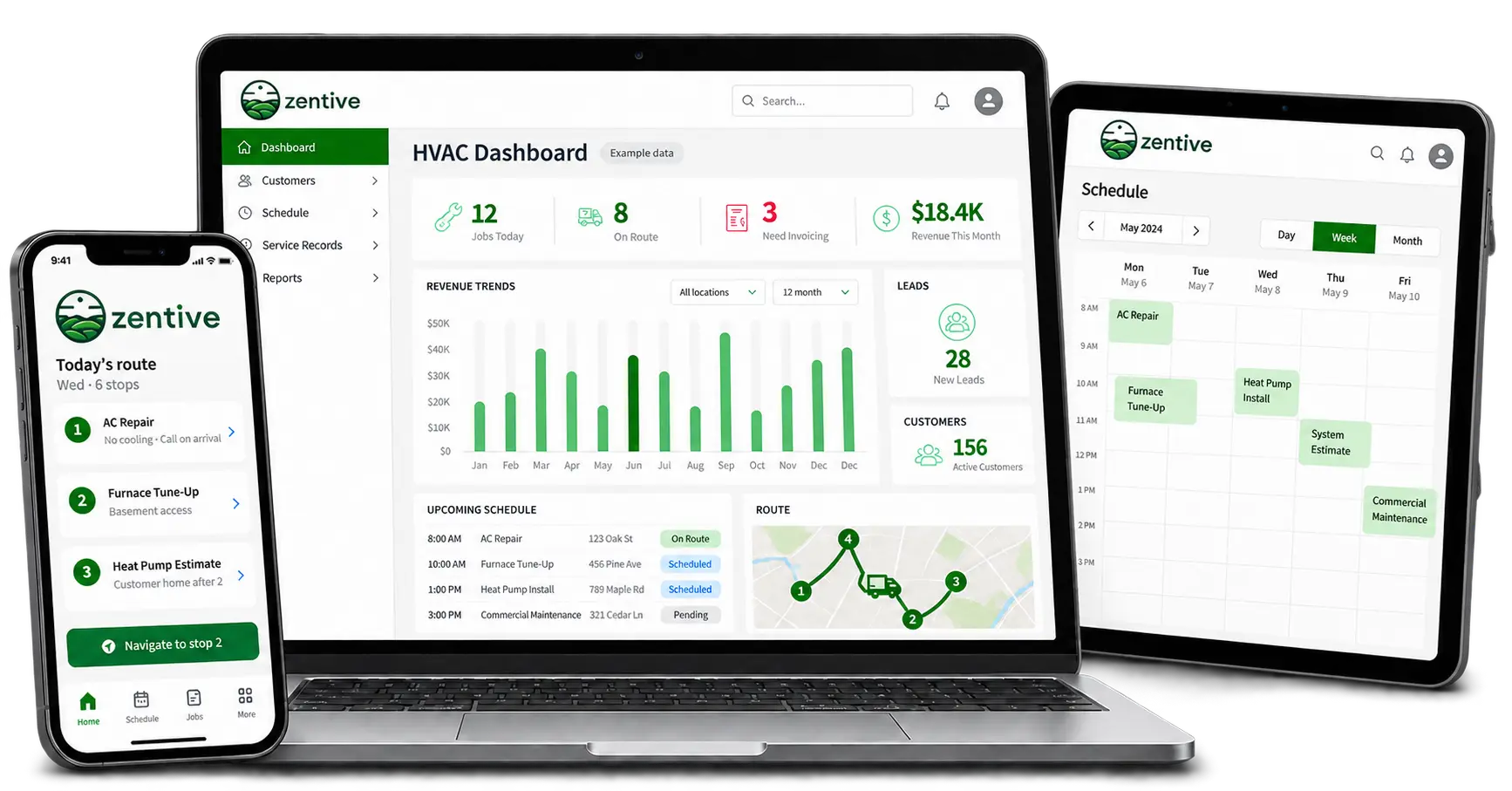
Zentive dashboard showing job and revenue totals, tablet service schedule and phone route with sample data.
How do contractors compare HVAC dealer support?
HVAC dealer support covers training, technical assistance, replacement parts and warranty administration. The comparison records local commitments for each supplier alongside the equipment quote.
| Support area | Evidence requested from each dealer or distributor |
|---|---|
| Training | Model-specific installation courses, A2L training, fees and attendance requirements |
| Technical assistance | Named contact, service hours, escalation process and commissioning support |
| Parts access | Local stock, emergency collection, shipping time and replacement-part pricing |
| Warranty administration | Claim contact, registration owner, labor coverage, freight and processing requirements |
| Commercial support | Dealer-program eligibility, written incentives, credit terms and return conditions |
The supplier comparison checklist records three quotes, their support arrangements and the purchasing decision.
How does the refrigerant transition affect equipment selection?
The EPA’s Technology Transitions guidance restricts high-global-warming-potential refrigerants in specified new equipment and systems. Its rules distinguish equipment categories, manufacture dates and installation conditions. The EPA’s HFC frequently asked questions explain that existing equipment remains serviceable.
Bryant’s Puron Advance guidance identifies R-454B in its new designated systems, while Daikin identifies R-32 in designated products. Manufacturer instructions define the approved refrigerant, matched components, installation procedures and required safety provisions for each model. The purchasing record includes the refrigerant designation, compatible tools, technician training and applicable installation requirements.
How does Zentive present good–better–best HVAC equipment proposals?
A good–better–best HVAC proposal presents three equipment-and-scope options for the same customer need. Zentive supports quotes with multiple options so the contractor presents each package with its equipment, installation scope and price. The example below varies capacity control and customer features while retaining the required installation and commissioning work in every option.
Heating and cooling replacement
Equipment and scope comparisonEach quoted option identifies exact models, certified performance, included work, exclusions and a calculated installed price. Available combinations follow the selected manufacturer’s specifications.

What else affects HVAC equipment sourcing?
HVAC equipment sourcing includes distribution, installation and warranty responsibilities. The selected system determines the required support.
Is an HVAC distributor the same as a manufacturer?
No. A manufacturer produces equipment. A distributor supplies equipment, parts and local purchasing support.
Should equipment choice change an HVAC estimate?
Yes. HVAC pricing changes when equipment selection changes purchase cost, accessories, labor or commissioning requirements. The HVAC Pricing Guide: 5 Steps to Calculate Job Costs, Markup and Profit explains the cost and margin calculations.
Does a good brand replace installation and inspection quality?
No. Installation, commissioning and inspection quality remain the contractor’s responsibility. An HVAC inspection checklist documents equipment conditions and follow-up. The HVAC service-visit checklist provides the visit record.
What is the most popular HVAC brand in the United States?
Global Market Insights assigns Carrier Global 22% of the 2025 North American residential unitary HVAC market. That comparison includes Canada and multiple Carrier brands. It does not establish a United States individual-brand ranking.
What is the longest HVAC warranty?
YORK’s YXV warranty lists lifetime limited compressor coverage for qualifying registered equipment. Daikin ATMOSPHERA and qualifying Mitsubishi Electric installations offer 12-year parts coverage. Each warranty’s registration and installation conditions apply.
How does HVAC software support equipment installation work?
HVAC software connects installation estimates, customer records, schedules and invoices. Zentive supports the job workflow around the selected equipment. The HVAC service management software page explains Zentive’s connected workflow.