
Customer Relationship Management (CRM) software aggregates customer interactions into a central hub, helping your team manage new and existing customers.
Benefits for landscapers and other field service businesses using CRM software include streamlined operational efficiency, improved customer satisfaction, and results like recurring clients, referrals, and business growth. Understand key differences between types of CRM platforms and how to pick the right one for your business before you choose a CRM.
| CRM Type | Definition |
|---|---|
| Operational CRM System | Manages daily customer interactions to streamline sales, marketing, and service tasks. |
| Collaborative CRM System | Connects teams and channels so everyone shares the same customer information. |
| Analytical CRM System | Examines customer data to reveal patterns that guide business decisions. |
What Is A CRM?
A CRM (Customer Relationship Management) a software system designed to help businesses manage all interactions with current and potential customers. The main business purpose of a CRM system, like Zentive, is to improve business relationships with clients, improve operational efficiency, and boost profitability. CRM is very important, especially for landscapers, because using CRM software is one of the easiest ways to improve a business's profitability.
Why Is CRM Important To Landscapers?
CRM systems are important for landscapers because they improve sales and profitability. The top CRM for landscapers provides all the necessary tools to manage customer relationships effectively, leading to happier clients who stay with the business and refer friends and family. A CRM system helps landscapers track customer preferences, schedule appointments, and ensure timely follow-ups, all of which contribute to improved customer satisfaction and loyalty.
Research shows that businesses using CRM systems can increase sales by up to 29%, improve sales forecasting accuracy by 42%, and boost productivity by 34%. For field service businesses like landscaping, these benefits are particularly valuable, given the high volume of customer interactions and project management requirements. The benefits of CRM depend on selecting the correct platform type.
What Are Types Of CRM Platforms?
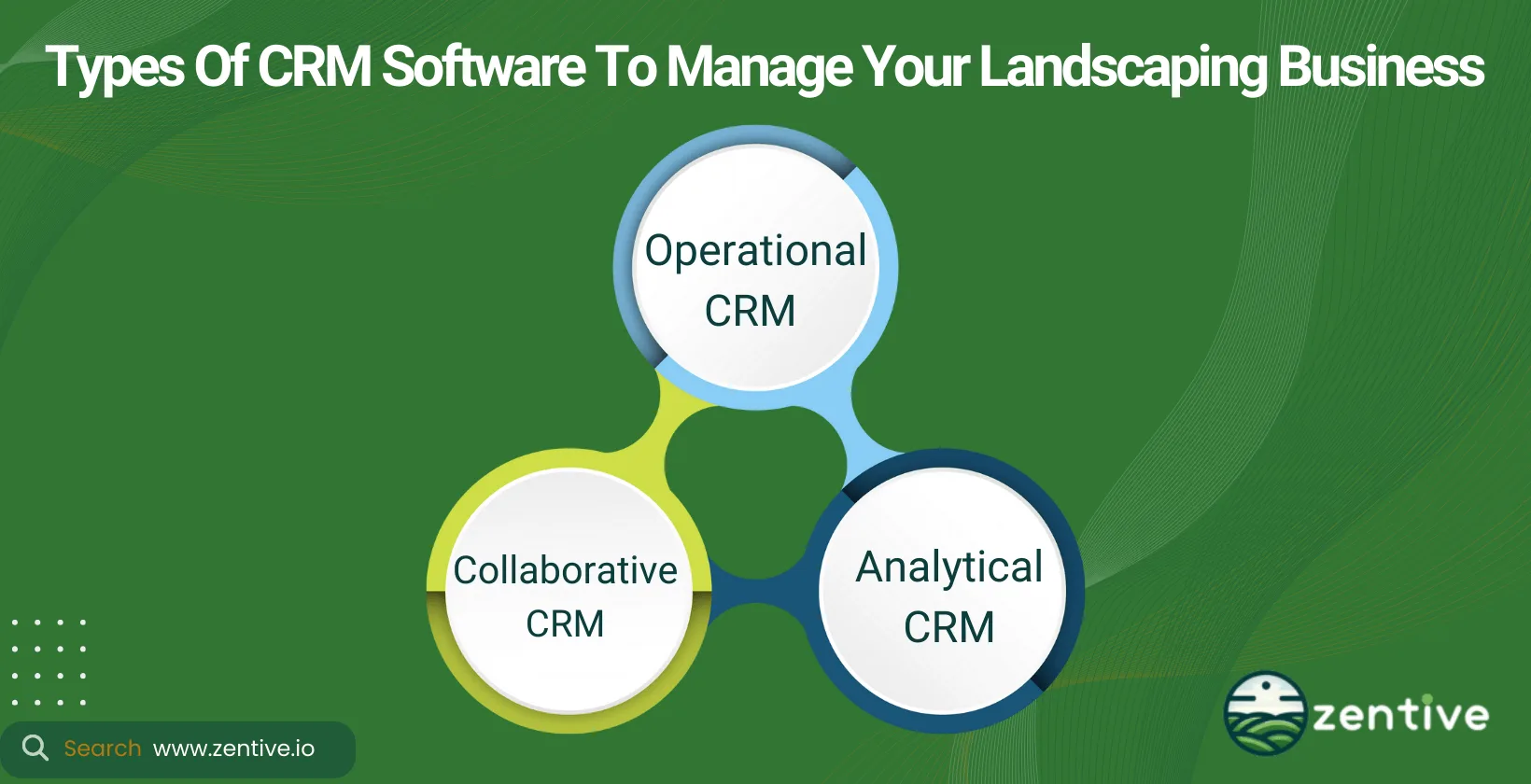
There are three main types of CRM systems.
- Operational CRM System: Automates and improves customer-facing processes to elevate the efficiency of sales, marketing, and service operations.
- Collaborative CRM System: Facilitates communication and information sharing among business departments to improve customer service and teamwork.
- Analytical CRM System: Analyzes customer data to provide insights for strategic decision-making and understanding customer behaviors and trends.
1. Operational CRM System
Operational CRM systems focus on automating and improving customer-facing business processes. They improve the efficiency of sales, marketing, and service departments. Operational CRMs focus on improving routine customer-related tasks. This includes automating scheduling, customer communication, and service tracking tasks. They often include tools for sales automation, marketing automation, and service automation.
Among the different CRM types, operational CRMs standout as the best CRM for landscapers and other field service businesses. Operational CRMs are ideal for businesses managing a high volume of customer interactions and want an improvement in their efficiency of handling sales, marketing, and customer service.
2. Collaborative CRM System
Collaborative CRM systems focus on communication and collaboration among different business departments. This type of CRM software is especially useful when multiple departments need to work cohesively.
Through collaborative CRMs, information is more easily shared between sales, marketing, and customer service departments. They include features such as shared databases, customer interaction tracking, and communication tools.
Collaborative CRMs are the best choice for businesses requiring strong inter-departmental communication. Tech and marketing companies often use collaborative CRM systems.
3. Analytical CRM System
Analytical CRM systems focus on analyzing customer data to drive business decisions. They help businesses understand customer behaviors and trends to improve strategic decision-making. Analytical CRMs use advanced algorithms and data-scraping tools to collect and analyze customer data from various sources to provide insights into customer behavior, preferences, and trends. They include tools for data mining, pattern recognition, and predictive analytics.
Any type of business can use an analytical CRM system, especially those that rely on data to make their decisions. Pick a CRM type based on the primary business need. For instance, if the business wants to improve operational efficiency, an operational CRM system would be better compared to an analytical CRM.
How To Pick A CRM Type?
When you pick a CRM type, there are four main factors to consider. Your business type is the most important factor influencing your CRM type. Landscaping businesses, for example, benefit most from CRM systems that can handle a high volume of customer interactions and improve operational efficiency (scheduling and project management features).
Cost is an important factor in choosing a CRM system. Your choice of CRM must match your budget. Calculate the return on investment that a CRM system can provide for your landscaping business.
Software integration is another important criterion for CRM systems. Using a new tool that doesn't integrate with your existing systems can sometimes decrease efficiency instead of improving it. Therefore, research and double-check that the CRM tool can integrate with other software tools you use, such as scheduling, quoting, and invoicing software.
Identify your sales goals and ensure the CRM system can support them. Sales goals include customer retention as well as new acquisition. Landscaping businesses focus on increasing customer retention. Therefore, they should choose a CRM type that best aligns with these goals.
| CRM Type | Main Use Case | Pros | Cons |
|---|---|---|---|
| Operational CRM | Automating and improving customer-facing business processes |
|
|
| Collaborative CRM | Facilitating communication and collaboration between departments |
|
|
| Analytical CRM | Analyzing customer data for strategic decision-making |
|
|
Which Type Of CRM Is Best For Landscape Business?
An operational CRM system is the best for a landscaping business. These systems improve day-to-day operations by automating scheduling, customer communication, and service tracking. Landscapers use operational CRM systems to manage their customer interactions more efficiently. This, in turn, leads to more timely follow-ups and maintains higher customer satisfaction levels.
CRM system investments often appear costly initially. The ROI on these systems often far outpaces the costs. Ensure the CRM type aligns with business needs and budget to cover the costs.
What Are Costs Of Types Of CRM Tools?
The cost of CRM tools varies between $10 for basic operational CRM tools and $500+ for large enterprise collaborative and analytical CRMs.
Operational CRM systems typically range from $12 to $50 per user per month for small to medium-sized businesses, and for large enterprises, the costs are around $250 per month. Prices can increase based on the number of users and additional features like advanced automation and mobile access.
Collaborative CRM systems usually cost between $20 and $75 per user per month, depending on the level of integration and communication tools your team requires. Large businesses with multiple departments often pay $250-$1000 for their CRM system.
Analytical CRM systems tend to be more expensive because of their complexity. Their cost usually ranges from $30 to $150 per monthly user. Some tools can cost $1000+, depending on the level of advanced data analysis, reporting features, and software integrations they offer.
What Integrations Does A CRM Have?
A comprehensive CRM system for landscaping businesses should offer integrations with scheduling, quoting, invoicing, and routing software. You use all of these software types when interacting with clients, from sending the initial quote to the client to routing employees to their address and requesting payment by sending an invoice to their email. Therefore, a CRM system that integrates with all these software types will increase your operational efficiency and customer satisfaction level manyfold.
Does Landscape CRM Integrate With Scheduling Software?
Yes, landscape CRM systems integrate with scheduling software. Scheduling software schedules landscape bookings for your business. Landscape software for scheduling is important because it helps manage appointments, assign jobs to crew members, and track project timelines.
By integrating CRM with scheduling software, landscapers can ensure they meet deadlines, reduce downtime, and improve overall efficiency.
Does Landscape CRM Integrate With Quoting Software?
Yes, landscape CRM systems integrate with quoting software. Quoting software is a type of software that generates accurate and professional estimates quickly. Landscape software for quoting enables you to send professional and well-crafted quotes.
When you integrate it with CRM it ensures all customer information is centralized, making it easier to follow up on quotes, convert leads into customers, and maintain a consistent and professional image.
Does Landscape CRM Integrate With Invoicing Software?
Yes, landscape CRM software integrate with invoicing software. Invoicing software makes the billing process more convenient. Landscape software for invoicing generates invoices, tracks payments, and manages overdue accounts.
Integrating invoicing software with CRM has the added benefit of ensuring timely and accurate billing, reducing administrative workload, and improving cash flow management.
How Does CRM Improve Marketing Efforts?
Yes, CRM systems improve marketing efforts. CRM tools provide insights into customer behavior and preferences, allowing you to optimize your landscaping business marketing strategy, which can yield a greater return on marketing campaigns.
Through a CRM, you can segment customers based on specific criteria, which allows you to create more targeted marketing campaigns. Automate email marketing campaigns thanks to your CRM's database of your clients. You can even use CRMs to analyze customer data to identify trends and opportunities for upselling or cross-selling services. The fact of the matter is that CRM greatly improves marketing efforts. Correct implementation of CRM systems results in higher client conversion and retention.
Get This Guide as a PDF
Save this article for offline reading. We'll send a formatted PDF straight to your inbox.
No spam. Unsubscribe anytime.
Ready To Streamline Your Field Service Business?
Zentive is the all-in-one field service management software built for home service and field service businesses. Start your free trial today.
No credit card required · Cancel anytime